Saturday, 9 August 2014

Micro ID help

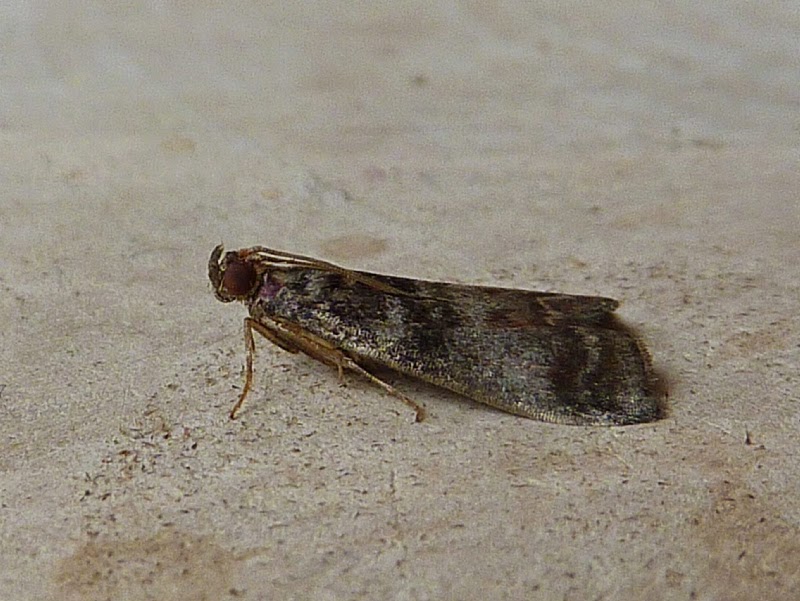
This 8mm f/w micro has confused me somewhat. Help appreciated.


Dave Ferguson, Beaconsfield

For ID / Confirmation

Last night was probably one of the worst for a long while - the weather forecast said it would be dry warm and cloudy after midnight but I get the feeling it just went on raining.

I think I have a Satin Wave and Celypha lacunana.

Mark Griffiths, Garsington, Oxford


Figure of Eighty - one brood or two?

I didn't run the trap here at Westcott, Bucks last night, but on the previous night (Thursday 7th August) I got Six-striped Rustic and Rosy Rustic as new garden species for the year amongst what was a reasonable collection of 380 moths of 80 species.

Rather more interesting than the new arrivals was a fresh Figure of Eighty Tethea ocularis.  This year I saw the species on 13 occasions between 17th May and 24th June (its normal flight period) and this fits with the reference books which reckon it flies between May and July in a single brood.  However, I think it must be attempting a small second brood nowadays of which my example may be one of the first locally this year.  In Bucks we've had quite a few August records now (including one I caught at Weston Turville reservoir on 21st August last year) and I see the latest county database record is for 3rd September (1996).  Looking at the French "bible" (Guide des papillons nocturnes de France, Robineau et al) the species is given as flying between May and September with one or two broods dependent upon latitude, while the phenology chart for this species on the Hants Moths web-site http://www.hantsmoths.org.uk/species/1654.php even shows an October record.

Figure of Eighty, Westcott 7th August
   Dave Wilton

Ear Moth question

In my garden trap I had the moth photographed below which will go in my personal records as an Ear Moth. However, to be an "official" record, does it require further examination to separate it from the other scarcer members of the ear moth group?


Steve Trigg, Cookham

Friday, 8 August 2014

A few bits and pieces

I came across this rather nice looking Lime Hawkmoth larva crawling across the path in front of me at Little Marlow GP, S. Bucks late afternoon today.  Shortly afterwards a Hummingbird Hawkmoth was nectaring on willow herb and bramble flowers nearby.  I also had one of the latter in the garden in Marlow Bottom a couple of days ago - is this a sign of an influx? Has anyone else noticed any recently?


Adam Bassett

For ID please (catch 7/8/2014)

A poor catch and an even pooer ID session - although I did get a Tawny Speckled Pug.

The first one - I thought maybe a Straw Underwing - I didn't even get the egg box out of the trap before this one was off -  usually only something the Yellow Underwings and some of the geometers do.

next again no idea - I thought it would be easy - that one also didn't hang about.

Final one - maybe a Flounced Rustic?

Mark Griffiths, Garsington, Oxford.


A few also-rans

In keeping with the lower numbers of moths overall, we haven't been too preoccupied with difficult individuals in the last few days, but here are a few which we've not been sure on: any confirmations or suggestions would be welcome. In no particular order, we have what we think may be a Cydia fagiglandana from 29th July; a presumed Currant Pug and an unknown pug (possibly Double-striped) also from the 29th; a possible Acleris rhombana from 4th August and an unknown micro from the same date; and a presumed Phyllonorycter leucographella and what is presumably a poorly-marked female Orange Swift from the 5th. Steve and Xander Goddard.

Possible Cydia fagiglandana, 29/7/14

Possible Currant Pug, 29/7/14

Unknown pug, 29/7/14

Possible Acleris rhombana, 4/8/14


Thursday, 7 August 2014

A couple of lifers (and others for confirmation)

Numbers are down in our garden in Wolvercote, Oxon (though 223 individuals of 53 species on the 5th wasn't bad), but a couple of lifers over the last couple of days have kept the interest up: Tawny-barred Angle showed up on the 5th, and Oblique Carpet on the 6th - the latter perhaps fitting with Marc's observations about wetland species, although as we're on the northern edge of Port Meadow, near a few smallish lakes, we're maybe not that far from wetland habitats.

Oblique Carpet, 6/8/14

Tawny-barred Angle, 5/8/14
We also had on the 4th what I think must be a male Bulrush Wainscot (to go with the female we had on 25th July) and on the 5th a presumed Tawny Speckled Pug.

Presumed male Bulrush Wainscot, 4/8/14

Presumed Tawny Speckled Pug, 5/8/14
And the micro below, from 6th August, looks, from the Micro Bible, like a Cochylis molliculana, which would also be a lifer (one of those species spreading into the country from the south, apparently). As ever, confirmation of these would be much appreciated - I'm about to post a few others we're not very sure of. Steve and Xander Goddard.

Possible Cochylis molliculana, 6/8/14

ID Confirmations (catch 6/8/2014)

Another quiet night  - I think the first is Rusty Dot Pearl the other is evading me. The illustrations in Townsend make me lean towards Square Spot Rustic bu photos I've seen don't.

Mark Griffiths, Garsington, Oxford.


Wetland species in bone dry habitats

Rather than moan like normal about poor catches and local farmland destruction I thought I'd pass comment on the number of wetland macros that seem to be turning up well away from wetland habitats this year. This was spurred on by my fifth Crescent in the last few weeks in the garden trap this morning. I have also had Twin-spotted Wainscot and Brown-veined Wainscot and Double Lobed has graced the garden trap on numerous occasions - the latter species seems to have been absolutely everywhere this year and in good numbers and other people have commented similarly. Micro wise I have also had Orthotelia sparganella in the Wallingford Rothamsted trap, and good numbers of Limnaecia phragmitella, which as mentioned by Dave W in a past post does wander, but numbers have been greater than normal and it has turned up at most sites I have trapped including several records this year for the garden. I think like Dave W said a while back that this may be caused by warm, dry summers forcing increased dispersal to search for other suitable wetland habitats, but might also represent these species having had a bumper year following the extremely wet winter?

Other moths of interest are few and far between, but  a new site record of Kent Black Arches at Warburg on 1st August was nice, first of year garden records of Crocidosema plebejana over last couple of days and after a peak of Diamond-back Moths a little while back I am now starting to get increased numbers of the probable offspring of other common migrants such as Silver Y, Rush Veneer and Rusty Dot Pearl. White-point second generation also out, but these are almost certainly resident round these parts as I get good numbers of both generation annually. Marc Botham, Benson

Wednesday, 6 August 2014

Red Underwing

Almost Knocked over by a Red Underwing outside my back door at 2:30pm. It settled on the wall but not for long enough for me to collect camera. Clouded Yellow at the watercress beds was more co-operative.
Tom Stevenson

Death's Head

I have had a convincing report of a Death's Head Hawkmoth in a garden in Hazlemere, Bucks on 22nd July. The householder walked into her garden at 10pm and heard a buzzing sound coming from near her feet. A very large flying something flew up and landed on a fence. She ran into the house screaming. She and her husband returned to the garden and investigated the fence. On it was a very large dark moth. It had its wings slightly open so they could see the dark and pale bars on the abdomen. They also noted the pale marking on the thorax. Curiously, they identified it from a painting hanging on a wall in the house which included a Death's Head Hawkmoth. They have a small potato patch in the garden. Unfortunately, no photo.

Dave Ferguson


A Hint of Immigration

For the first time this month and despite the rain, my garden trap here at Westcott, Bucks just scraped past 100 species again.  Numbers of Brimstone Moth, Lesser Broad-bordered Yellow Underwing and Straw Dot have increased significantly over the past couple of nights but in the lead currently so far as quantity is concerned are the grass moths Agriphila straminella and Agriphila tristella along with Mother of Pearl Pleuroptya ruralis.  New for the year last night were Dichrorampha acuminatana, Rusty Dot Pearl Udea ferrugalis, White-point and Webb's Wainscot (the only other additions to the year list so far this month have been Epinotia nisella & Pammene populana both on the 3rd).  The two Udea ferrugalis and single White-point which graced the trap are migrants, or at least wanderers, so far as my garden is concerned.  Nothing else remotely migratory appeared, though - no Diamond-backs or Silver Ys, for example.

Pammene populana, Westcott 3rd August

Udea ferrugalis, Westcott 5th August
White-point, Westcott 5th August

This afternoon I paid a short visit to what is arguably the best chalk downland site in the Chilterns, at Grangelands near Cadsden, Bucks.  This was mainly to obtain a Bucks 'year tick' for Chalkhill Blue and Silver-spotted Skipper butterflies (duly achieved, along with the unexpected addition of Clouded Yellow), but while there I also checked out the few dark mullein plants on site and found two rather late Striped Lychnis caterpillars still munching away.  It was also good to see at least five examples of the uncommon long-horn micro-moth Nemophora metallica resting on flowers of field scabious.


Nemophora metallica, Grangelands 6th August

Dave Wilton


COAM

Traps left overnight at the Chiltern Open Air Museum with Andy King produced a list of 103 species (41 micro, 62 macro) and there are a few more in Andy's fridge.

A few new species for the year list included Opostega salaciella, Bucculatrix ulmella, Agonopterix purpurea, Batrachedra praeangusta, Zeiraphera isertana, Six-striped Rustic, Square-spot Rustic, Small Square-spot, Straw Underwing and an out-of-place Brown-veined Wainscot.

We also managed to catch 3 Tree-lichen Beauty so I get the feeling these are going to be commonplace before too long!

DAVE MORRIS

Couple of IDs

Despite the warm start didn't get much last night.

I think I have my first Orange swift, the pug - not sure - maybe Double Striped?

Mark Griffiths, Garsington, Oxford


Tuesday, 5 August 2014

Night-time Butterflies

Linda Murphy kindly sent me the picture below of a Brown Hairstreak which came to her overnight garden trap in Merton, Oxon on 25th July.  I'm not aware of this species ever having been caught previously in a moth-trap, but I did once have a Black Hairstreak to a Skinner MV in Finemere Wood, Bucks and Purple Hairstreak is quite well known for its night-time appearances.  Linda's record prompted me to look at some of my own notes and I've gone back through the past seven or eight years to see which species I've had to light in Bucks over that period.  It is actually quite a surprising number:

Dingy Skipper (Westcott disused railway, May 2007)
Grizzled Skipper (Westcott disused railway, May 2007)
Small Skipper (disused railway near Mursley, July 2009)
Green-veined White (Finemere Wood, July 2013)
Purple Hairstreak (Bernwood Forest, July 2011 & Finemere Wood, July 2013)
Black Hairstreak (Finemere Wood, June 2010)
Red Admiral (Westcott garden, September 2008)
Marbled White (Ivinghoe, July 2013)
Speckled Wood (Westcott garden, September 2009)
Meadow Brown (Finemere Wood, July 2013 & Bradenham, July 2013)
Ringlet (five occasions, the most recent being Homefield Wood, August 2013)
Small Heath (Ivinghoe, July 2013)

It is interesting how different species react to light in different ways.  The above all entered the trap, while in 2013 and 2014 I can recall finding roosting Wood Whites, Chalk-hill Blues & Common Blues right next to light traps yet they just sat out the experience on their grass stems and didn't seem to be too disturbed at all. 

We don't normally consider butterflies as being creatures of the night but migratory species such as Red Admiral and Painted Lady certainly do fly nocturnally.  My Red Admiral in September 2008 could quite easily have been on its way south.

Dave Wilton

Brown Hairstreak, Merton 25th July
photo taken by Linda Murphy


Something different - leaf mines

Leaf mines are something I know almost nothing about.  Like most people I suppose, I have noticed leaf mines on various plants all over the garden, but have never bothered to try and identify them, but I thought that I would make a start.  My first photo is from a Beech leaf and using the website that Dave Wilton suggested a while back, www.leafmines.co.uk I have tentatively identified the species that made it as Stigmella hemargyrella.  I would welcome any comments on this and suggestions on methods to further my identification of leaf mines.


Adam Bassett, Marlow Bottom

Monday, 4 August 2014

Wrong again, but a pleasant surprise.

In the middle of June the following Footman arrived in my back garden in Chorleywood, Bucks:


I kept it back in case it was a Hoary Footman but, once the wings were spread I could definitely see a faint ochre-ish tinge to the hindwings. I went on record that it was definitely a faded Scarce Footman;  it does, after all, look pretty worn out. The other day I thought I may as well dissect it anyway and, surprise, definitely Hoary. Now I'm trying to think back and remember how many other faded-looking Scarce Footmans I've recorded this year - and it has been a few. More and more people are reporting this species, it seems.
Andy King.

Beautiful Plume?

Not run the trap for a couple of nights - hoping that Tuesday night won't be too wet. In the meantime I spotted this in the garden, I'm assuming it's a Beautiful Plume?

Mark Griffiths, Garsington, Oxford.


Sunday, 3 August 2014

Empty Egg-boxes

July ended on a high here at Westcott, Bucks with another 100+ species count in the garden trap on the 31st, although Tawny Speckled Pug and Oak Nycteoline were the only species new for the year list.  However, the last two nights have been dire, especially last night when I caught a grand total of 29 moths of 22 species.  That's not to be wondered at, though, after a day of torrential thundery showers and then a clearance to bring on a very chilly night.  Tonight might be better if (and it is always a big "if" where anything to do with the Met Office is concerned) the promised cloud cover appears.  Later this coming week might see more of an improvement, with southerly winds and warmer overnight temperatures even though there may be a bit of rain about.  Perhaps it will be my turn for a Bedstraw Hawk-moth?!  Apart from Diamond-backs (Plutella xylostella), migrants have been avoiding my garden so far this year and even Silver Ys have been few and far between.

Dave Wilton 

Saturday, 2 August 2014

Wormwood Pug?

After months of not being able to find any pugs in a good condition - here's one we found in the house. I'm thinking Wormwood Pug possibly?

Mark Griffiths, Garsington, Oxford


3 micros that I might have identified

I have had a go at identifying these 3 small micros that appeared in my garden trap earlier this week. As ever, a second opinion is much appreciated.
The first had a fw of 6mm and I am fairly certain is Acleris aspersana.


The second has a fw of 5mm and a white head, and looks to me like Cochylis dubitana.


The final one is the smallest, with a fw of about 3 and a half mm. My thought is Phyllonorycter leucographella.


Steve Trigg, Cookham

Which Pyralidae

Can anyone help me with this one.  Although not quite in your territory it was beaten from the bushes in South Herts. at the end of last month.


Thanks,
Greg Keith  Barnet

Dark spinach

I had a Dark spinach in my garden trap Friday morning which is only my second ever here in my Aylesbury garden, despite my books saying it is `common`! Just the usual common selection here otherwise, with Dark arches and Heart and dart dropping rapidly in numbers, and the occasional Square-spot rustic appearing. Dave Maunder
Dark spinach, 31-7-2014

For confirmation please

Hopefully fairly straight forward, I think I have

Garden Rose Tortrix
September Thorn
Swallow Prominent

Mark Griffiths, Garsington, Oxford


Friday, 1 August 2014

Mystery moth (to me)


I'm feeling very dim because I can't crack the ID of this very distinctive moth (about the size of a Shuttle-shaped Dart) which shared the Robinson trap this morning with lots and lots of Flame Shoulders - which have toppled Ruby Tigers from the number one spot - a Treble or Lesser Treble-bar and much else. Can anyone help? I've kept the moth in a takeaway box on the advice of Steve Trigg who was over here collecting Emperor cocoons to start a branch of their academy in Cookham. Very nice to meet a fellow moth-er.  My best guess is a Mouse Moth but there seem to be an awful lot of differences, so that's just having a stab at it rather than giving up. Martin Wainwright, Thrupp, Oxon


Small Ranunculus

I have only seen one adult Small Ranunculus at light trap in my current garden and this was back in 2011. Last year I found larvae on the prickly lettuces I had in one area of my garden. This year I have found even more larvae, I would estimate easily over 100 on prickly lettuce plants around my garden. I then decided to check some prickly lettuce plants we have at work growing where some sand has been deposited several years ago and a few plants that are growing underneath a poly-tunnel - all of which are within 2m of the Rothamsted moth trap, some right next to it. Every plant is covered in larvae and there has never been an adult caught in the Rothamsted trap. Then whilst cycling home I checked some plants growing by the side of the road - guess what, covered in Small Ranunculus larvae. So despite once again not seeing a single adult yet this year, the moth is clearly pretty common all around me.

Otherwise things have been pretty bleak here at Lonesome Farm. The farmer has just ripped out the other side of the 1-km mature hedgerow he started on last year and I am now truly surrounded by a dusty moon-scape. We can safely kiss good bye to the Yellow Wagtails that bred between that hedgerow and the crop, as well as several Grey Partridge, Corn Buntings, Yellowhammers and Linnets as well as Hares and Barn Owls that also use the hedgerow as cover and hunting grounds. But even worse, I think of the number of moth larvae on those mature Hawthorns etc and want to give up. That said, it has pushed a family of Hares and lots of birds into our garden as it is now one of the only refuges for them, and I did have a very nice surprise in the trap this morning with my first garden record of Square-spotted Clay. Marc Botham, Benson

ID confirmations please

Rather a poor night last night - I noticed Dave talking about the late summer lull - when does it pick up again?

I think I have

Bryotopha domestica
Cydia splendana


Mark Griffiths, Garsington


Brown House Look-alikes

It's definitely quietened down here in central Oxford with only modest numbers over the last few nights and Lesser Broad-bordered Yellow Underwing the only year tick. I seem to be getting plagued by small micros that look similar to but yet slightly different from the Brown House Moth (Hofmannophila pseudospretella). In the past I've probably been guilty of just calling them all Brown House so this year I'm trying to be more careful but I can't seem to make my mind up. I've posted two examples below together with my best guesses. NB the second is a repeat from the other day but I didn't have any luck with suggestions then and since then I've changed my mind as to what it is.

Adam Hartley

Bryotropha domestica?
Borkhausenia fuscescens?