Friday, 31 January 2014

Moths by 10km square

Inspired by Dave's presentation of the Bucks species per 10km square, here is another view of the data for both Berkshire and Buckinghamshire - you should be able to click on the squares and see the number of species recorded in that square, and you can zoom in and see what locations the squares cover. To see a larger version of the map click here.

Red, pink or yellow means the square could do with some more attention (often these are squares on the county boundaries, and some would be filled in if the Oxfordshire data was added to the map).
Martin Harvey 

Key: 
Red square = up to 100 species
Pink square = up to 200
Yellow square = up to 300
Blue square = up to 400
Green square = up to 500
White square = the square in which Steve Nash used to trap! (506 species)


View Macro-moth species per 10km square in a larger map

Another Burial Park Moth

Not as exciting as Peter's discovery below, but a new year moth on the windows at Chiltern Woodland Burial Park this morning, with this Dotted Border. Nothing in the trap, though.


Dave Morris

Thursday, 30 January 2014

Your Records!

This is just a gentle reminder that, if you haven't already done so, now is the time to send your moth records for 2013 to your County Moth Recorder:

VC22 Berks  Martin Harvey  (kitenetter@googlemail.com)
VC23 Oxon  Martin Townsend  (martin.townsend4@ntlworld.com)
VC24 Bucks  Martin Albertini  (malbertini@onetel.com)

With the National Moth Recording Scheme now fully up and running, Butterfly Conservation (in conjunction with MothsIreland) intends to produce a printed atlas covering all of the macro-moths of Great Britain and Ireland.  The plan is for this to appear towards the end of 2018 using data collected up to and including 2016.  The timescale therefore gives us another three years in which to try and improve our knowledge of moth species in under-recorded areas of the three counties.

The map below is for VC24 Bucks and shows the number of macro-moth species known from each 10km square at the beginning of 2013.  The totals will no doubt have changed slightly when all of last year's records have been processed but the map is still a useful indicator of under-recorded squares and gives an idea of those which we should be targetting over the next three years.  Those with 400 or more species are well covered already but there is plenty of scope for improvement in those which have fewer than that number.  Highlighted in yellow is SP82 (including Whitchurch, Wing, Stoke Hammond and Mursley) which is desperately in need of some trapping!  Dave Wilton


Tuesday, 28 January 2014

"Second" County Record

There was a BIG meeting at the start of June last year at Jordans "Chiltern Woodland Burial Park". The moth trapping was a distinctly quiet affair as the weather turned quite chilly early. Whilst the old diehards of myself and Martin Albertini sat in our chairs and tried to keep warm, the younger enthusiasts ran around the trap site every time there was a small moth flying by (thanks Rob P and Dave M) and netted most. There seemed to be an endless potting of tiny Parornix moths from this. Well, thanks to their efforts, one turned out to be a fourth county record of Parornix carpinella. The other 3 records are from Burnham Beeches Rothamsted trap, back in 2002-3 (I have yet to do 2004-2009). So this is the second location. It looks just like all the other Parornix species we get, but this one feeds on Hornbeam. Attached is an image of its bits. The bits also all look much the same too!  The long straight line going at 45 degrees at the base is the end of the aedeagus, one of the diagnostics. Peter Hall

Monday, 27 January 2014

First moth

I have been putting my moth trap out each week in my garden (Cookham, Berkshire) as part of the winter garden moth scheme. So far this year, not a single moth has been seen, and I generally spend the next day drying out the trap.
However, last Wednesday I did finally see my first moth of 2014 on my kitchen ceiling. It was a male light brown apple moth. I was having work done on the roof above at the time, so this moth may have been disturbed from it's slumbers.

Steve Trigg

Sunday, 26 January 2014

Another new species for me

Another new moth for me this year was Pale Brindled Beauty, also an Early moth - both found at the Fairford leys sports centre after a wet and windy spell. The hind wing of moth pictured seems to have blown out of position by the strong winds as it sat on the door of the changing rooms! Dave Maunder

Saturday, 25 January 2014

Mompha lacteella

Every time I've thought about going out and running a light in the new year laziness or the weather have persuaded me not to. However, I'm still building a moth-list, by dissecting left-overs from the last couple of years. The other day I managed a kind of cricketing-type hat-trick: Three in a row; in this case three species that were 'new-for-me'. Two weren't Upper Thames moths, but the third, from my back garden in Chorleywood, Bucks, turned out to be a Mompha lacteella. Peter Hall kindly confirmed this. I've checked with Martin Albertini and he could find only one previous record of this species in Bucks, in 1928.
Andy King.

Thursday, 23 January 2014

First trap of the year

As it wasn't too wet and windy last night I put the trap out in the garden (Loosley Row, Bucks) for a few hours. It managed to attract 2 Early Moths and singletons of Chestnut, Dark Chestnut, Mottled Umber and Agonopterix heracliana.


Nigel Partridge

Tuesday, 21 January 2014

And how was it for you...?

Peter Hall (thankyou!) has completed the last few dissections of moths from me for 2013 so I've now been able to sit down with all the data and work out exactly how good a year it was here at Westcott, Bucks.

"Fantastic" is the only word for it.  Even though the weather for the first six months was often dismal, overall it proved to be the best year ever.  This bog-standard village garden on the clay produced exactly 600 species of lepidoptera, comprising 575 moths (306 macros, 269 micros) and 25 butterflies.  I don't know why the place gets as many species as it does, although I'm certainly not complaining.  However, I suspect it may be a while before those figures are equalled here again.  Dave Wilton  

A couple of moths...

At security lights in Chiltern Woodland Burial Park this morning, in spite of the cold and fog, an Early Moth and a Chestnut.

Dave Morris

Sunday, 19 January 2014

A quiet start

No photo available, but we had an Acleris schalleriana on an indoor wall on 10th January, bringing our 2014 list to a grand total of one. Ironically we didn't have a record of the species at all last year. Otherwise like most, we've been finding it rather quiet; we haven't yet bothered putting out the trap this month; we may at some point if there's a night which manages to combine being fairly warm with not featuring torrential rain.

Steve and Xander Goddard

Saturday, 18 January 2014

Early moth

Early moth on front door light tonight.  Ched George

Woodland is the place to see moths now

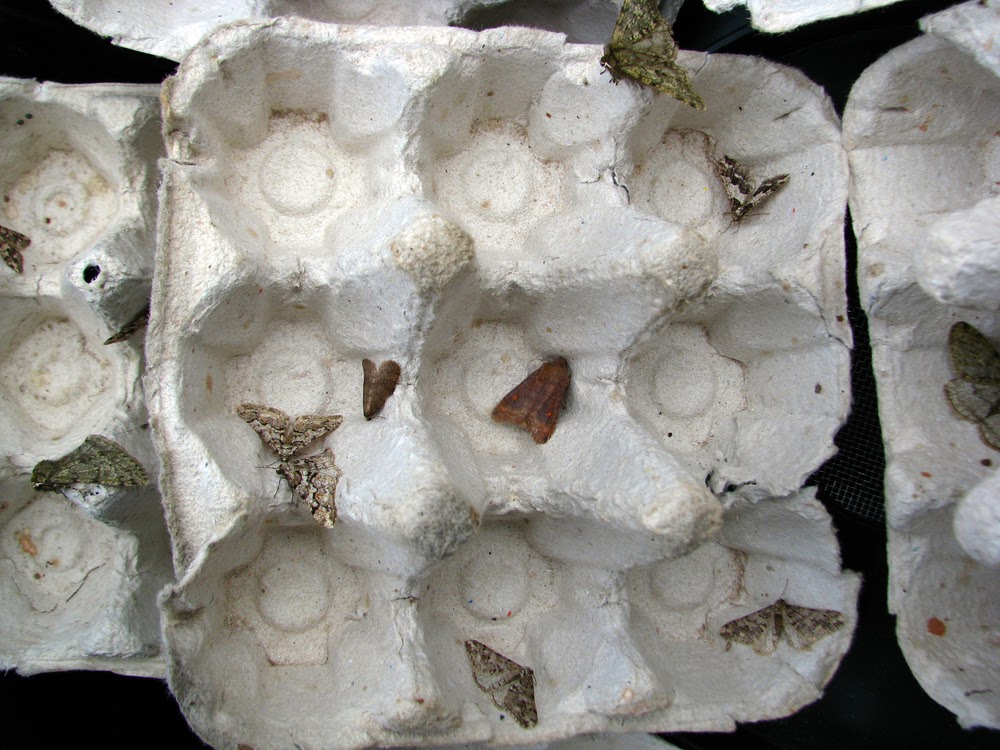
Last night's weather seemed quite suitable for moths up until midnight so I ran the actinic trap in the garden here at Westcott, Bucks and got a Pale Brindled Beauty for my trouble.  That takes the garden list to three for the year (Agonopterix heracliana and Acleris hastiana having made appearances at lit windows over the previous week).  I also took the Robinson trap into some local woodland for a few hours from dusk and Spring Usher was out and about in some numbers (about 30 were caught), while Winter Moth, Pale Brindled Beauty, Satellite and Chestnut also put in appearances.  The picture below illustrates part of the catch, just in case anyone had forgotten what egg-boxes containing moths look like!   Dave Wilton

Wednesday, 15 January 2014

Meadow Farm at Blackthorn, Oxon

Today Gavin Bennett of BBOWT led an egg search of the blackthorn-rich hedgerows at Meadow Farm, the Wildlife Trust's recent acquisition near Blackthorn, Oxon.  A handful of UTB stalwarts went along to help but most of the work was carried out by a bunch of young and enthusiastic conservation trainees.  We were primarily looking for Brown Hairstreak eggs (found there, as expected) but in addition we came across a hibernating Drinker Moth caterpillar, numerous Blue-bordered Carpet eggs and a ring of hatched Lackey Moth eggs from last year as well as two batches of Vapourer Moth eggs.  Wendy Wilson took a picture of one of the Vapourer egg-batches (see below) which had been laid, as usual, on the flightless female's cocoon.  What a sedentary existence!  She probably moved many times further as a caterpillar than she did as an adult moth!  Dave Wilton 

Vapourer egg-batch, Meadow Farm

Sunday, 12 January 2014

Overwintering pupae

As there's a dearth of moths to be found at the moment, i just thought people might be interested in some of the pupae i'm overwintering at the moment! I've 7 Large Elephant hawks, 4 Small Elephant hawks, a Lime hawk and a Privet hawk pupa; i've also got a batch of Orange Sallow eggs overwintering, and i've got a batch of Deep-brown dart eggs which are now hatching - the new larvae are going out into a pot of grass and other low plants to begin feeding - strange that they don't wait until warmer weather before hatching! I find it interesting to document the growing life-cycle on film, which i put on my Flickr photostream!
http://www.flickr.com/photos/51715371@N04/Dave Maunder

Saturday, 11 January 2014

Where do Chestnuts go in winter?

This is actually a moth from the last day of 2013, although I didn't realise I had it until a few days later.

One of my winter entomological past-times is to collect handfuls of leaf-litter and take them home to sort though. This usually produces a good mix of beetles, snails, leaf-hoppers and spiders, but on this occasion a moth crawled out of the leaves - the Chestnut.

The Chestnut is known to over-winter as an adult, and will fly on mild nights, but where does it hide itself away the rest of the time? None of my books say much about this, but for this one specimen at least it buries itself in the leaf-litter.

The patch where I collected the leaf-litter (Ragpit Hill, near Great Kimble) was underneath a fallen Beech tree (click on the moth to see photos of the habitat as well), and although it was raining at the time the tree trunk had kept the litter relatively dry. Whether the moth had chosen it as a dry place to be, or whether that's just coincidence, I don't know. Martin Harvey

Chestnut Conistra vaccinii

Second species for 2014!

I found this nice form of Mottled umber below a porch lamp on Fairford leys estate, Aylesbury on my morning cycle ride. Dave Maunder

An ex moth...

There is a deceased Brown House Moth on my coffee machine this morning; given that it wasn't there yesterday, I have to assume it has only recently shuffled off this mortal coil and arrived overnight under its own steam.
Nothing in the GMS garden trap though :(

Dave Morris

Friday, 10 January 2014

2 species!!

After running a 6w trap in Chiltern Woodland Burial Park last night for the weekly winter GMS, we had one Winter Moth at the trap and 2 Early Moths on one of the park buildings.


Dave Morris

Tuesday, 7 January 2014

First moth of 2014!

First moth for me this year was a specimen of the lowly Winter moth, found here in Aylesbury at our local sports centre at Fairford leys. Due to rubbish weather i've not seen anything else or been able to get my garden trap out!  Dave Maunder.