Sunday, 23 February 2014

A welcome return

Last night's actinic trap here at Westcott, Bucks produced just two moths, although both were new for the garden year list.  One was Hebrew Character, the other was Lead-coloured Drab (note the feathered antennae in the photo below).  The latter failed to make an appearance at all here last year, despite there being several black poplars within sight of the house, so it was good to see it return and on such an early date - in fact one day earlier than my earliest ever sighting.

Hebrew Character & Lead-coloured Drab, Westcott 22 Feb 

With reasonably warm conditions out of the wind, I also took the Robinson MV trap to nearby Finemere Wood at dusk and in the allotted three hours it caught 83 moths of 9 species:  Tortricodes alternella (31), Yellow Horned (1), March Moth (1), Small Brindled Beauty (10), Pale Brindled Beauty (21), Spring Usher (10), Dotted Border (6), Satellite (1) & Chestnut (2).  The Yellow Horned (illustrated below) was again a day earlier than I've ever seen it before.  Dave Wilton


Yellow Horned, Finemere Wood 22 Feb


Common Quaker?

First moth for this year actually inside the trap. Hopefully someone can do a positive ID.

Mark Griffiths, Garsington, Oxford.


Squeezed in a Feb survey for Bagley Woods last night and had a nice mix of moths (though quite a few of the species I expected were missing). Additions to the year included Grey Shoulder-knot (2) and Yellow-horned (1). Otherwise a small selection of what has already been seen (Chestnut (16), Satellite (7), Common Quaker (1), Dotted Border (1), Small Brindled Beauty (9), Pale Brindled Beauty (6), Spring Usher (5), Torticodes alternella (31) , Acleris notana/ferrugana (1), Acleris cristana (1).

Nice fresh Yellow Horned:


Thought I'd play a bit of spot the moth as well:


Marc Botham

Friday, 21 February 2014

CWBP Moths

This morning at CWBP (which is marginally less W after the recent winds!), 4 Dotted Border and 2 Spring Usher.

Dave Morris

Thursday, 20 February 2014

Some wet beauties

Great stuff, finally ran a trap away from garden as part of my monthly survey at Harcourt Arboretum and got plenty of personal firsts for 2014 last night despite wet conditions. 12 species included: Chestnut, Dotted Chestnut, Hebrew Character, Small Quaker, Common Quaker, Pale Brindled Beauty, Oak Beauty, Spring Usher, Red-green Carpet, March Moth, Torticodes alternella and Agonopterix spp (probably heracliana but TBC). Numbers not great with just 33 moths but a welcome start. Marc Botham

Wednesday, 19 February 2014

Is this an Early Moth?

I had a single moth on the outside of my trap this morning. It is rather faded, but based on size and shape I think it is an Early Moth. The forewing was 16mm. I would be grateful for a second opinion.
Steve Trigg, Cookham.

Chestnut or Dark Chestnut?

My wife found this on the kitchen window last night. It's a bit tatty which may make the wing shape based distinction between a Chestnut or Dark Chestnut tricky. I was thinking perhaps the Dark Chestnut?

Still nothing in the trap last night.

Mark Griffiths, Garsington, Oxford.


Hebrew Character


Just one moth last night in my Robinson trap in Thrupp, Oxon: this Hebrew Character which I'd judge by its fine condition to be newly emerged. The Cherwell remains out in its flood plain for a fourth week and I'm wondering about the effects on this year's butterflies and moths. How waterproof are eggs?

Martin Wainwright


Tuesday, 18 February 2014

Scarlet Tiger caterpillars

hi, found two of these chaps marching up and down a pear sucker - one was at the top of at about three feet up, then turned around and marched back. There was another about half way up. I found one a few years back in February similarly up on a rose sucker. Are they trying to sun themselves because I thought their food was mainly at ground level - certainly I found alot while weeding later in the season, always on the ground.

Mark Griffiths, Garsington, Oxford


Early days, or rather nights

I am not used to winter trapping and this year has so far hardly been one to encourage the practice. But there have been a few dry nights in Thrupp since the start of February and moths seem to have adapted to the monsoons.

On the night of Sunday 2nd, I lit the lamp for the first time since the night before 9th December last year when my first grandchild, Emily, arrived at University College Hospital in London and a very handsome December Moth overnighted in the trap.


This year's debut saw the slightly worn male Pale Brindled Beauty (above) and a Chestnut Moth (below), in good condition with just a nick or two out of the edge of its wings.


Rain then poured down until the night of 15th February when a Dark Chestnut (below) braved the cold. Here it is, as comatose as an Oxford student after a Valentine's Night bender. Update: sorry, it is a plain Chestnut - see Comment (3) below from Peter Hall to whom many thanks.


The following night was much milder and with only a skimpy shower and there was a new species for my list (after a year of trapping in Thrupp and nine on the edge of Leeds): this male Dotted Border.


I hope my identifications are correct - and I always appreciate more expert colleagues putting me right. I'd also be grateful for any information on why the females of species such as the Dotted Border and Pale Brindled Beauty are flightless, which seems a raw deal for a moth. I have also got another pair of pyjamas which I will feature in due course.

Warm thanks for arranging this blog and I much appreciate and am learning from the other entries. Martin Wainwright

Monday, 17 February 2014

Spring moths in Finemere woods

I had my first outing with my new portable trap to Finemere woods on Sunday 16th February, with quite reasonable results considering the temperature dropped to 3-4 centigrade and clear skies! Using a 15 watt actinic bulb with a Skinner trap i got :- Small brindled beauty (5); Pale brindled beauty (7); Spring usher (12); Dotted border (12); Chestnut moth (1), and Tortricodes alternella (4). I took a bit of advice from Dave Wilton and checked nearby Oak trunks where i found a pair of mating Pale brindled beauties, a Chestnut moth and a Spring usher (male). Anyway, i was pleased i made the effort!   Dave Maunder

Sunday, 16 February 2014

Not a moth, but moth related...

There was another nil return in the actinic trap last night so far as moths are concerned here at Westcott, Bucks.  However, I did get two examples of the common nocturnal parasitoid wasp Ophion obscuratus which usually starts appearing in moth traps at this time of the year.  As the larvae of these wasps feed on the larvae of noctuid moths, we should at least take a passing interest in them! 

Ophion obscuratus, Westcott 15th February

There are hundreds of different species but almost none of them are identifiable in the field.  Ophion obscuratus is an exception thanks to the creamy yellow markings on its thorax and the creamy yellow wedge either side of the orangey-brown stigma on each forewing.  There is only one other species like it in the UK, Ophion forticornis which is rare, associated with sand dunes and has the ocelli and eyes merged together in a single area of black rather than being separate as can be seen in the picture of obscuratus below.  Dave Wilton


Ophion obscuratus, showing ocelli and thorax

Wednesday, 12 February 2014

Another Pale Brindled Beauty...

Only macro moth so far this wet&windy year (6th Feb) along with huge numbers of Trichocera......

Chris Pickford

Sunday, 9 February 2014

Some from August 2013

hi, a couple more.


Old pictures for ID

hi, just been going through some old pictures and I have a few unidentified ones from several years ago, taken at the porch light. I'd welcome IDs. thanks

The first one was June 2007 and the other two are from August 2009. Sorry about the really blurred 3rd shot, I just found it in a picture I'd taken of a burnished brass and noticed it hiding in the corner!


Saturday, 8 February 2014

Moths will fly in any weather!

Today i found a freshly emerged Pale brindled beauty at a porch lamp in Fairford leys, Aylesbury, after a night of heavy rain and high winds, showing some moths will fly even in very inclement weather. When i picked it up it released the red waste after emergence, which shows it had only hatched last night.  Dave Maunder

Spring Usher

While there might seem to have been fewer garden moths around than usual to get 2014 started, looking back over the last couple of years shows that it really is no different to normal here at Westcott, Bucks where I'm lucky to get more than the very occasional specimen of anything before late-February. Last night (Friday) seemed suitable enough to run the actinic trap for a few hours from dusk without danger of it floating or being blown away and I was rewarded with a single Spring Usher.  Dave Wilton

Spring Usher, Westcott 7th February

Friday, 7 February 2014

My first macro of the year - a Chestnut?

Wednesday night was dry this week (a rare event at the moment!) and so I put my trap out. I was rewarded with a single moth hiding on the outside of the trap. Like Steve Goddard's individual, I think it is a Chestnut.
Steve Trigg

Thursday, 6 February 2014

Kitchen Pug

My wife found this in the kitchen today. Sorry for the poor image, it seems almost irridescent. Several pugs had similar colouration but they all seem to be Spring/ Summer fliers. I'd love an ID.


edit, hopefully a better pic taken in natural light.  Mark Griffiths


Wednesday, 5 February 2014

Pale Brindled Beauty?

Hi all, first post and first moth of the year despite putting the trap out several times. I'm a beginner to trapping so I'd appreciate a confirmation of the ID, I think it's a Pale Brindled Beauty. I found it sitting on the trap electrics on Monday morning. I'm in Garsington just outside of Oxford.  Mark Griffiths


Tuesday, 4 February 2014

A new hobby - egg carton watching

The sight of moths is something of a rarity in my garden so far this year. Apart from the odd overwintering adult popping out to see what season it is (occasional singles of Dark Chestnut, Chestnut, Satellite, Agonopterix heracliana), and a lowly Early Moth at the back end of January, the trap has been empty....well except for rainwater that is. On a relatively dry day I deliberately left out the rotting egg-trays hoping they'd dry out and I could squeeze a bit more use out of them as per usual. I forgot about them and they have pretty much become part of the grass surrounding the trap now. However, having decided to have a quick look at them in the vain hope that all the moths I'm not catching were actually being intercepted before the trap by these mushy egg boxes, I have found something quite interesting. Pretty much every egg box had at least one caterpillar in it and this is the same most times I have checked - they appear to be using it as shelter. I have had several Angle Shades and Large Yellow Underwing and a couple I haven't been able to identify yet. The Angle Shades also chew up the egg box and then fill in the cell in which they sit with silk covered in the chewed up egg carton. I assumed this meant they were pupating, but they keep vacating the cells and starting new ones and some of them don't seem large enough yet. Anyway, this is literally the most interesting thing that has happened moth wise so far this year for me, which I think says it all :). Marc Botham

A Brace of Acleris

This morning at Chiltern Woodland Burial Park (I'm going to call this CWBP going forward since most of my moths are coming from there and it takes a long time to type...) was an Acleris ferrugana/notana and this Acleris cristana:


Also a Dotted Border and an Early Moth.  Dave Morris

First trapping of the year

On a whim, I decided to put out the trap last night (it wasn't raining, and didn't look as though it was going to freeze, so I thought 'what the hell'), and was rewarded with this lone individual - sorry for the poor quality of photo - which is presumably a Chestnut. I suspect we'll have to make the most of it while we can: can't see the trap being used much more this month.  Steve Goddard

Presumed Chestnut, 3.2.14

Sunday, 2 February 2014

Berkshire highlights from 2013

Over on the Berkshire Moth Group website I've just added a brief report on the highlights from the latest batch of records to be imported to the Berkshire database. Les Finch's Beautiful Brocade is the pick of the bunch for me, but there's a good range of new 10km-square records. - Martin Harvey

P.S. Did you know that of all the different types of wildlife, moths have the greatest number of species with the word "beautiful" in their name?

Friday, 31 January 2014

Moths by 10km square

Inspired by Dave's presentation of the Bucks species per 10km square, here is another view of the data for both Berkshire and Buckinghamshire - you should be able to click on the squares and see the number of species recorded in that square, and you can zoom in and see what locations the squares cover. To see a larger version of the map click here.

Red, pink or yellow means the square could do with some more attention (often these are squares on the county boundaries, and some would be filled in if the Oxfordshire data was added to the map).
Martin Harvey 

Key: 
Red square = up to 100 species
Pink square = up to 200
Yellow square = up to 300
Blue square = up to 400
Green square = up to 500
White square = the square in which Steve Nash used to trap! (506 species)


View Macro-moth species per 10km square in a larger map

Another Burial Park Moth

Not as exciting as Peter's discovery below, but a new year moth on the windows at Chiltern Woodland Burial Park this morning, with this Dotted Border. Nothing in the trap, though.


Dave Morris

Thursday, 30 January 2014

Your Records!

This is just a gentle reminder that, if you haven't already done so, now is the time to send your moth records for 2013 to your County Moth Recorder:

VC22 Berks  Martin Harvey  (kitenetter@googlemail.com)
VC23 Oxon  Martin Townsend  (martin.townsend4@ntlworld.com)
VC24 Bucks  Martin Albertini  (malbertini@onetel.com)

With the National Moth Recording Scheme now fully up and running, Butterfly Conservation (in conjunction with MothsIreland) intends to produce a printed atlas covering all of the macro-moths of Great Britain and Ireland.  The plan is for this to appear towards the end of 2018 using data collected up to and including 2016.  The timescale therefore gives us another three years in which to try and improve our knowledge of moth species in under-recorded areas of the three counties.

The map below is for VC24 Bucks and shows the number of macro-moth species known from each 10km square at the beginning of 2013.  The totals will no doubt have changed slightly when all of last year's records have been processed but the map is still a useful indicator of under-recorded squares and gives an idea of those which we should be targetting over the next three years.  Those with 400 or more species are well covered already but there is plenty of scope for improvement in those which have fewer than that number.  Highlighted in yellow is SP82 (including Whitchurch, Wing, Stoke Hammond and Mursley) which is desperately in need of some trapping!  Dave Wilton


Tuesday, 28 January 2014

"Second" County Record

There was a BIG meeting at the start of June last year at Jordans "Chiltern Woodland Burial Park". The moth trapping was a distinctly quiet affair as the weather turned quite chilly early. Whilst the old diehards of myself and Martin Albertini sat in our chairs and tried to keep warm, the younger enthusiasts ran around the trap site every time there was a small moth flying by (thanks Rob P and Dave M) and netted most. There seemed to be an endless potting of tiny Parornix moths from this. Well, thanks to their efforts, one turned out to be a fourth county record of Parornix carpinella. The other 3 records are from Burnham Beeches Rothamsted trap, back in 2002-3 (I have yet to do 2004-2009). So this is the second location. It looks just like all the other Parornix species we get, but this one feeds on Hornbeam. Attached is an image of its bits. The bits also all look much the same too!  The long straight line going at 45 degrees at the base is the end of the aedeagus, one of the diagnostics. Peter Hall

Monday, 27 January 2014

First moth

I have been putting my moth trap out each week in my garden (Cookham, Berkshire) as part of the winter garden moth scheme. So far this year, not a single moth has been seen, and I generally spend the next day drying out the trap.
However, last Wednesday I did finally see my first moth of 2014 on my kitchen ceiling. It was a male light brown apple moth. I was having work done on the roof above at the time, so this moth may have been disturbed from it's slumbers.

Steve Trigg

Sunday, 26 January 2014

Another new species for me

Another new moth for me this year was Pale Brindled Beauty, also an Early moth - both found at the Fairford leys sports centre after a wet and windy spell. The hind wing of moth pictured seems to have blown out of position by the strong winds as it sat on the door of the changing rooms! Dave Maunder

Saturday, 25 January 2014

Mompha lacteella

Every time I've thought about going out and running a light in the new year laziness or the weather have persuaded me not to. However, I'm still building a moth-list, by dissecting left-overs from the last couple of years. The other day I managed a kind of cricketing-type hat-trick: Three in a row; in this case three species that were 'new-for-me'. Two weren't Upper Thames moths, but the third, from my back garden in Chorleywood, Bucks, turned out to be a Mompha lacteella. Peter Hall kindly confirmed this. I've checked with Martin Albertini and he could find only one previous record of this species in Bucks, in 1928.
Andy King.

Thursday, 23 January 2014

First trap of the year

As it wasn't too wet and windy last night I put the trap out in the garden (Loosley Row, Bucks) for a few hours. It managed to attract 2 Early Moths and singletons of Chestnut, Dark Chestnut, Mottled Umber and Agonopterix heracliana.


Nigel Partridge

Tuesday, 21 January 2014

And how was it for you...?

Peter Hall (thankyou!) has completed the last few dissections of moths from me for 2013 so I've now been able to sit down with all the data and work out exactly how good a year it was here at Westcott, Bucks.

"Fantastic" is the only word for it.  Even though the weather for the first six months was often dismal, overall it proved to be the best year ever.  This bog-standard village garden on the clay produced exactly 600 species of lepidoptera, comprising 575 moths (306 macros, 269 micros) and 25 butterflies.  I don't know why the place gets as many species as it does, although I'm certainly not complaining.  However, I suspect it may be a while before those figures are equalled here again.  Dave Wilton  

A couple of moths...

At security lights in Chiltern Woodland Burial Park this morning, in spite of the cold and fog, an Early Moth and a Chestnut.

Dave Morris

Sunday, 19 January 2014

A quiet start

No photo available, but we had an Acleris schalleriana on an indoor wall on 10th January, bringing our 2014 list to a grand total of one. Ironically we didn't have a record of the species at all last year. Otherwise like most, we've been finding it rather quiet; we haven't yet bothered putting out the trap this month; we may at some point if there's a night which manages to combine being fairly warm with not featuring torrential rain.

Steve and Xander Goddard

Saturday, 18 January 2014

Early moth

Early moth on front door light tonight.  Ched George

Woodland is the place to see moths now

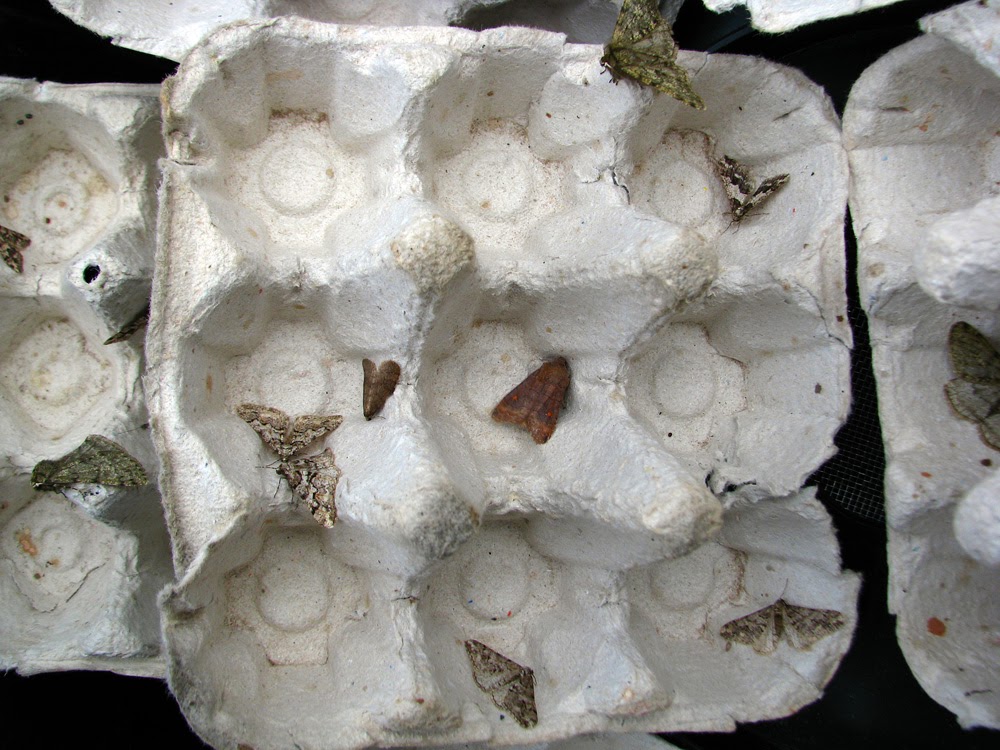
Last night's weather seemed quite suitable for moths up until midnight so I ran the actinic trap in the garden here at Westcott, Bucks and got a Pale Brindled Beauty for my trouble.  That takes the garden list to three for the year (Agonopterix heracliana and Acleris hastiana having made appearances at lit windows over the previous week).  I also took the Robinson trap into some local woodland for a few hours from dusk and Spring Usher was out and about in some numbers (about 30 were caught), while Winter Moth, Pale Brindled Beauty, Satellite and Chestnut also put in appearances.  The picture below illustrates part of the catch, just in case anyone had forgotten what egg-boxes containing moths look like!   Dave Wilton

Wednesday, 15 January 2014

Meadow Farm at Blackthorn, Oxon

Today Gavin Bennett of BBOWT led an egg search of the blackthorn-rich hedgerows at Meadow Farm, the Wildlife Trust's recent acquisition near Blackthorn, Oxon.  A handful of UTB stalwarts went along to help but most of the work was carried out by a bunch of young and enthusiastic conservation trainees.  We were primarily looking for Brown Hairstreak eggs (found there, as expected) but in addition we came across a hibernating Drinker Moth caterpillar, numerous Blue-bordered Carpet eggs and a ring of hatched Lackey Moth eggs from last year as well as two batches of Vapourer Moth eggs.  Wendy Wilson took a picture of one of the Vapourer egg-batches (see below) which had been laid, as usual, on the flightless female's cocoon.  What a sedentary existence!  She probably moved many times further as a caterpillar than she did as an adult moth!  Dave Wilton 

Vapourer egg-batch, Meadow Farm

Sunday, 12 January 2014

Overwintering pupae

As there's a dearth of moths to be found at the moment, i just thought people might be interested in some of the pupae i'm overwintering at the moment! I've 7 Large Elephant hawks, 4 Small Elephant hawks, a Lime hawk and a Privet hawk pupa; i've also got a batch of Orange Sallow eggs overwintering, and i've got a batch of Deep-brown dart eggs which are now hatching - the new larvae are going out into a pot of grass and other low plants to begin feeding - strange that they don't wait until warmer weather before hatching! I find it interesting to document the growing life-cycle on film, which i put on my Flickr photostream!
http://www.flickr.com/photos/51715371@N04/Dave Maunder

Saturday, 11 January 2014

Where do Chestnuts go in winter?

This is actually a moth from the last day of 2013, although I didn't realise I had it until a few days later.

One of my winter entomological past-times is to collect handfuls of leaf-litter and take them home to sort though. This usually produces a good mix of beetles, snails, leaf-hoppers and spiders, but on this occasion a moth crawled out of the leaves - the Chestnut.

The Chestnut is known to over-winter as an adult, and will fly on mild nights, but where does it hide itself away the rest of the time? None of my books say much about this, but for this one specimen at least it buries itself in the leaf-litter.

The patch where I collected the leaf-litter (Ragpit Hill, near Great Kimble) was underneath a fallen Beech tree (click on the moth to see photos of the habitat as well), and although it was raining at the time the tree trunk had kept the litter relatively dry. Whether the moth had chosen it as a dry place to be, or whether that's just coincidence, I don't know. Martin Harvey

Chestnut Conistra vaccinii

Second species for 2014!

I found this nice form of Mottled umber below a porch lamp on Fairford leys estate, Aylesbury on my morning cycle ride. Dave Maunder

An ex moth...

There is a deceased Brown House Moth on my coffee machine this morning; given that it wasn't there yesterday, I have to assume it has only recently shuffled off this mortal coil and arrived overnight under its own steam.
Nothing in the GMS garden trap though :(

Dave Morris

Friday, 10 January 2014

2 species!!

After running a 6w trap in Chiltern Woodland Burial Park last night for the weekly winter GMS, we had one Winter Moth at the trap and 2 Early Moths on one of the park buildings.


Dave Morris

Tuesday, 7 January 2014

First moth of 2014!

First moth for me this year was a specimen of the lowly Winter moth, found here in Aylesbury at our local sports centre at Fairford leys. Due to rubbish weather i've not seen anything else or been able to get my garden trap out!  Dave Maunder.

Apodia bifractella

I've just id'd this little moth from a batch caught at Steps Hill, near to Ivinghoe on July 22nd 2013. It is supposedly common, but for Bucks at least, it is a county first. You are supposed to be able to find the pupae by looking at the old seedheads of Common Fleabane and Spikenard. The pupal case is tough and mixed with frass and chewed seed fragments. Here's a link to the moth: http://ukmoths.org.uk/show.php?id=3456

They give you more collecting tips there as well. Meanwhile here is a photo of its bits.
Apodia bifractella male
Peter Hall

More indoor mothing

I wonder how big a moth list we could come up with if we stayed indoors all year?! Today's addition was on the inside of my front door, and is another micro that over-winters as an adult and often turns up in houses: the Garden Cosmet, Mompha subbistrigella. It's tiny, about 6mm long, but worth looking out for. Martin Harvey


Monday, 6 January 2014

Another Indoor Moth

...and frankly I don't blame it given the wind and rain without, a Twenty-plume Moth (Alucita hexadactyla) on the window blind on my landing.  Dave Morris

Sunday, 5 January 2014

Body in the bathroom

Micro-moths in the genera Agonopterix and Depressaria are sometimes called "flatbodies'. They hibernate as adults, and their flattened shape allows them to creep in to all sorts of nooks and crannies, including under the bark or in splits in pieces of wood, in thatched roofs, or in the hollow stems of plants. This one chose to hide away in our bathroom, where I found it on 4 January. It is the Parsnip Moth (Depressaria radiella, = heraclei), which has caterpillars that feed on Wild Parsnip, Hogweed and other umbellifers. Martin Harvey


Another couple from indoors

Jan 5th - a Double-striped Pug is currently on the ceiling of my lounge, whilst a White-shouldered House-moth Endrosis sarcitrella was in the kitchen on Jan 2nd. Marlow Bottom, Bucks. Adam Bassett

Friday, 3 January 2014

Christmas Tree Stowaway

We have a Christmas tree that lives outside during the year and comes inside during the festive period. Shortly after bringing the tree inside a few weeks ago, a single Agonopterix arenella flew out and has been turning up in different rooms ever since. I see that Martin has beaten me to reporting the first for the year, but I might actually get a photo to post at some stage! Marlow Bottom, Bucks. Adam Bassett

How it managed I'll never know....

Despite the incredible weather trying it's hardest to destroy our garden the moth trap has still been running over Christmas period and into new year. Generally there has been nothing but a few flies and lots of water, but this morning there was my first moth of 2014 - a Dark Chestnut. How it got into the trap, or in fact anywhere near it, with the winds that have been battering our extremely exposed garden is an achievement in itself! Marc Botham

Thursday, 2 January 2014

Off the mark for 2014

No adult moths for the New Year as yet (last night's trap here at Westcott, Bucks produced a not-unexpected nil return), but I managed to find larvae of three micro species today.  In the garden were active leaf-mines of Stigmella aurella on bramble and Phyllonorycter leucographella on pyracantha, both of which have multiple broods throughout the year.  Then a short trip out locally to inspect holm oaks at Quainton and Middle Claydon produced the expected mines of Ectoedemia heringella on trees at both locations, now being the best time of year to look for evidence of this recent invader.  Dave Wilton 

Stigmella aurella, Westcott 2nd January

Ectoedemia heringella, Quainton 2nd January

Two for 2014

This morning my son and I were out in the glorious sunshine helping with conservation work at Brush Hill local nature reserve, and in the process of shifting piles of dead wood around we disturbed the Brindled Flat-body micro-moth (Agonopterix arenella), my first moth for 2014! I wasn't quick enough to get a photo, it soon flew off to find a quieter spot to hide away in. There were also plenty of leaf-mines of the Golden Pygmy (Stigmella aurella) in the bramble we were clearing away.  Martin Harvey