Saturday, 18 February 2023

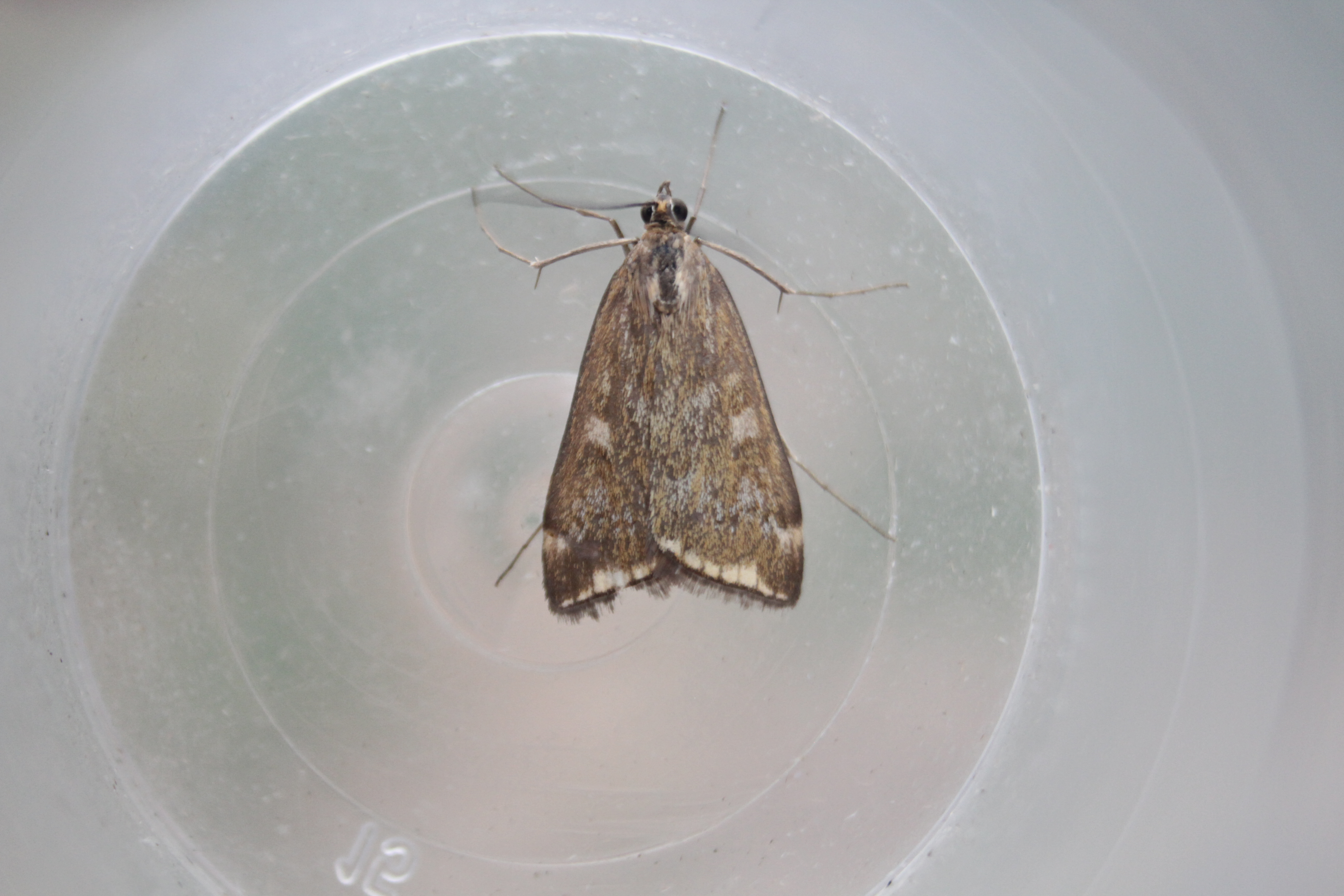
Which Yponomeuta?

 Hi there,

Another photo from last August near Chesham. I think I've narrowed this down to malinellus or cagnagella, but not sure I can rule out rorrella or padella, although I think the apparent 'grey' areas are more shadow than pigment. We have willow, spindle and apple in the garden!

Can anyone help with a more specific ID?


Friday, 17 February 2023

Even Clothes Moths count...

Seen hover-taxying (you couldn't really call it flying) across the carpet in my study this morning was a freshly-emerged tineid.  I don't think there's much doubt that this is Tineola bisselliella although it'll be checked in the usual way.  It is only the third I've ever seen in Bucks after one to MV light on Rammamere Heath in 2017 and an example which turned up in the garden actinic trap here during July last year.  The question now is to find where it might have come from because our carpets are all of man-made fibre...


Likely Tineola bisselliella, Westcott 17th February

Dave Wilton Westcott, Bucks  

Thursday, 16 February 2023

Early Drab

 I was surprised to find my first Clouded Drab of the season this morning (Stoke Goldington) along with the more usual Dark Chestnut. It beats my previous earliest by about a month!


Sunday, 12 February 2023

Westcott, Bucks

Species added to the garden year-list over the last couple of nights have comprised Agonopterix alstromeriana (10th), Grey Shoulder-knot (10th) & Dark Chestnut (11th), while a likely Mompha jurassicella was found indoors on the 10th.  Last night's catch by the garden actinic light was actually a record-breaker here for February, comprising 32 moths:  Agonopterix heracliana (2), March Moth (1), Pale Brindled Beauty (21), Spring Usher (4), Early Moth (3) & Dark Chestnut (1), while a likely Satellite put in a very brief appearance at 6.30am this morning as I was shutting off the light but escaped before it could be confirmed. 

Mompha species, Westcott 10th February

Grey Shoulder-knot, Westcott 10th February

The Mompha will be checked but is likely to be jurassicella, although I do get bradleyi here too on occasions and those two species can be very hard to tell apart visually.

Dave Wilton Westcott, Bucks

Saturday, 11 February 2023

Wednesday, 8 February 2023

ID teaser

 Hi there,

I can't work out what this is - it's from August 19th last year.

Any help gratefully received!

Thanks, David


A Winter's Tale

 Many moth species overwinter in the larval stage of their life cycle. They often enter a phase known as diapause (suspended development), and many have evolved additional mechanisms for survival in cold winters. Typically they produce cryoprotective substances such as glycerol in their bodies but some may also synthesise anti-freeze proteins (AFPs); remarkably these can bind to ice crystals, inhibiting their growth. The Spruce Budworm Choristoneura fumiferana, a destructive pest of conifers in Canada and NW USA that overwinters as a tiny caterpillar (second instar) on host tree branches, is known to produce AFPs as well as wrapping itself up in a silken 'hibernaculum' for diapause. In a recent publication* the location and sequence of the genes specifying these AFPs was found. Similar genes were then found in other north American Choristoneura species but not in a few other tortrix species for which genome data are available (including the codling moth Cydia pomonella, common in the UK, which overwinters as a 5th instar larva but in a loose cocoon spun under tree bark or in leaf litter). However, similar genes were found in the genome of the Bramble Shoot Moth Notocelia uddmanniana. This strikingly-marked species is also common in the UK, and in a nice correlation to the Canadian story it overwinters similarly as a tiny caterpillar in a hibernaculum on the stems of blackberries, raspberries and loganberries (therefore perhaps more exposed than C. pomonella). This study raises some interesting questions about the evolutionary relationships of these species and the origins of AFPs.

Notocelia uddmanniana

*The Spruce Budworm Genome: Reconstructing the Evolutionary History of Antifreeze Proteins. Catherine BĂ©liveau et al. 2022 Genome Biol. Evol. https://doi.org/10.1093/gbe/evac087.

John Thacker,  Harwell  VC22


Saturday, 4 February 2023

Danger of humiliation!

 Hi there,

I got the trap out this week - usual suspects - but I'm also going through some photos from last year. This one, from August 19th last year, I'm not even sure is a moth! Is it? And if it is can someone help with the ID? Thanks! David


Nine species

I took advantage of a milder evening by taking a couple of MV traps to nearby Finemere Wood, Bucks at dusk yesterday for my first away trapping session of the year but the results weren't all that exciting.  A grand total of 45 moths turned up in just over three hours, drawn from the following species:  Acleris cristana (1), Acleris ferrugana/notana (1), Tortricodes alternella (1), Small Brindled Beauty (3), Pale Brindled Beauty (16), Spring Usher (11), Dotted Border (1), Satellite (3) & Chestnut (8).  I was expecting Tortricodes alternella, Pale Brindled Beauty and Spring Usher to be around in rather larger numbers than that by now, but I suppose there's plenty of time yet for them to get going.

Small Brindled Beauty, Finemere Wood 3rd February

Dotted Border, Finemere Wood 3rd February

Co-incidentally, back home in the garden at Westcott the actinic light also brought in nine species, comprising Agonopterix heracliana (6), Acleris cristana (1), Acleris schalleriana (1), Acleris ferrugana/notana (1), Emmelina monodactyla (1), March Moth (1), Pale Brindled Beauty (3), Spring Usher (1) & Early Moth (1), along with the first ichneumon wasp here of the year (Ophion obscuratus agg.).  

March Moth, Westcott 3rd February

It looks as though tonight might bring in a few more moths, during the hours before midnight at any rate, but then we should be heading back to colder conditions again for at least a week. 

Dave Wilton Westcott, Bucks

Monday, 30 January 2023

Acleris hastiana?

 I am assuming this is one of the many forms of Acleris hastiana attracted to the light in the window last night. 


Andy Newbold, Sibford Ferris, Oxon.


Sunday, 29 January 2023

Newton Longville moths in 2022

Rather belatedly, I have finished entering moth records for 2022 into my database and analysing them.  They'll go on to Martin tomorrow.

The mothing year at home can be summed up in the table below.  I have continued running two traps simultaneously in the garden: one using a self-built 15W LED light with a range of wavelengths (heavy in ultraviolet) and the other with a 15W actinic light.  From mid-March 2022 onwards, the actinic striplight was replaced by its Synergetic equivalent which emits in the green wavelengths as well as in the blue and UV colours typical of actinic lights.  I'm not sure it has made much of a difference.


The "Site Total" column also includes moths found in the house and garden by means other than light-trapping.

By comparison with 2021, the number of moths caught was up by about 5% and the number of species caught was also slightly higher.  This is despite the lower level of trapping effort (57 nights vs 70 in 2021).  In 2022 I missed a lot of the peak season largely by being overseas: although I managed to trap on nine nights in May, I missed three weeks in June and I only managed to run the traps at home once each in July and August.

There were ups and downs amongst the species: some grass moths did markedly better than the year before, for example Agriphila tristella went from 13 to 168 individuals.  Shuttle-shaped Dart and Large Nutmeg did well and the abundant Large Yellow Underwing and Lunar Underwing both more than doubled their numbers.  On the other hand, Common Wainscot did particularly poorly (74 individuals in 2022, down from 300 in 2021), as did Setaceous Hebrew Character.  Compared to the cold, wet spring of 2021, many spring and early summer species emerged two to four weeks earlier in my garden in 2022.

2022 was my fourth full year of trapping and I added 42 species (evenly divided between micros and macros) to the garden list which now stands at 442: 260 macros and 182 micros not counting aggregates or records at genus level.  A few of the new micros were thanks to Peter and would otherwise have remained as aggregates as in previous years.  Most new species were unexceptional but (subject to verification in some cases) I was pleased to get Tachystola acroxantha, Elachista luticomella, Cydia fagiglandana, Small Marbled, Dewick's Plusia, Toadflax Brocade, Scarce Bordered Straw and Mere Wainscot.  I also caught a dozen Scrobipalpa ocellatella which would have been very noteworthy in previous years but they seemed to be everywhere last year.

I also increased my recording of by-catch of other taxa.  I've made progress with Caddisflies, I managed some Dor Beetles, a couple of easier Diptera and even two ichneumons.

Tim Arnold
Newton Longville, Bucks

Friday, 27 January 2023

Moths Return

With blank nights here since the 15th due to that cold snap, it was nice to see some moths in the garden again last night.  The four below had arrived by 10pm but there were no subsequent additions.

Winter Moth, Mottled Umber x 2, Pale Brindled Beauty
Westcott 26th January

Winter Moth can sometimes go on into early February but I haven't seen one that late since 2017.  The trend actually seems to be in the other direction with fewer being seen in the New Year, especially in the garden here.  Pale Brindled Beauty and Mottled Umber should be around for a while yet.

Dave Wilton Westcott, Bucks


Tuesday, 17 January 2023

Request for photographs

Dear All

Martin Corley has written the chapter on moths for a proposed book on the biodiversity of High Park Wood in Blenheim Park.  For this he needs high resolution photographs.  Five of the photos he had used were too low-resolution and the provider of those photos had not retained the high resolution versions.

Martin is looking for replacements for these five photos, on natural backgrounds, and they need to be on the right background.  They are as follows:

Leopard Moth

September Thorn

Satellite (with white reniform stigma, not orange)

Sallow, on more or less yellow autumn leaves.  The photo he had previously included both forms, but one will do.

Merveille du Jour.  Must be on a lichen background.

Any help with these would be much appreciated.  Please send them to Martin as low resolution versions (to avoid clogging emails) at martin.corley@btinternet.com

He will need the high resolution version when the photos have been chosen.

Martin Townsend

Monday, 16 January 2023

Westcott, Bucks

Since the trio of species on 1st January (see here) I've had several more Mottled Umbers to the garden actinic light, while more of the usual suspects which fly during the first few weeks of the year have also begun to appear with Winter Moth (3rd), Spring Usher (13th) and Early Moth (15th) seen to date, although the only micro recorded so far has been an Acleris species (8th).  There has been no sign of any noctuids as yet but I imagine species such as Chestnut, Dark Chestnut and Satellite will join the party when and if we get some slightly warmer nights with rather less wind than we've had so far.

Acleris sp., Westcott 8th January

Spring Usher, Westcott 13th January

Early Moths, Westcott 15th January

The average number of adult macro-moth species seen here during January over the past 20 years is five and the maximum ever is ten (in 2019), drawn from 13 different species altogether, so I'm already very slightly ahead of the game. Dotted Border is likely to be the only one still left to emerge before the end of the month, with any other visitors being hibernators tempted out on suitable nights.
  
Dave Wilton Westcott, Bucks

Friday, 13 January 2023

One more query

 Hi there,

I'm really not sure at all about this one from August 31st. Can anyone help? Slightly strangely angled photos, I'm afraid.

Thanks, David


Which Agriphila?

 Going through the 'too difficult for me' folders of photos from earlier this year (31st August)!

I think I've narrowed this one down to geniculea or inquinatella. Am I right, and, if so, is it possible from these photos to decide which?

Thanks, David


Tuesday, 10 January 2023

Submitting your records

Here is the annual plea for your records!  If you haven't already submitted your records for 2022 to your County Moth Recorder, please do so as soon as possible now.

Grateful thanks go to the many of you who already use iRecord and either input your data there as the year progresses or are doing so now during the quieter winter period.  This is the ideal way of getting your records to your CMR and it involves you in no further effort as well as providing you with a safe and secure method of storing your own sightings.  When the moth records for the year have been verified and any queries answered, your CMR downloads the dataset from iRecord and either adds it to the relevant county moth database or simply creates an upload for the National Moth Recording Scheme.  Once the data has been accepted by the NMRS we will be able to update our own local area Moth Atlas so, if you want to see your dot on the map, time is of the essence.

For those of you who currently use other methods of data storage, why not try iRecord in 2023 and see how you get on with it?  The input of nightly trap lists is very straightforward and it is simple enough to download your own data from the site and add it to your own database system if that's what you still prefer to use.      

For those of you who do still use other methods of data storage, be it via MapMate, Excel, a bespoke database or simply paper records, please do ensure that your records for 2022 are submitted as quickly as possible now so that they can be put to good use.  All attempts at trying to conserve our native moth species, many of which are in serious decline, rely on us knowing where they are in the first place.

Contact details for our three County Moth Recorders are given under the "Your Records" tab at the top of the page.

Sunday, 8 January 2023

The Hill, Garsington 2022

 Overall number of records up (6900 moths vs 5719 2021), 381 species in total which is also my best year. Part of that would have been increased usage of pheromone lures.

Personal highlights were Metalampra italica,Triaxomasia caprimulgella, Palpita vitrealis, Lobster Moth, Lunar Hornet Clearwing, Barred Hook-tip, Hedge Rustic and Hoary Footman.

Not such a great year for unusual migrants apart from the Palpita vitrealis and Beet Moth. Only 6 Silver Y compared to over 50 last year.

Although the numbers remain low it seems that Clifden Nonpareil, Box-tree Moth and Tree-lichen Beauty have established. Jersey Tiger which showed up once last year failed to put in an appearance this year.

Most moths I get in fairly low numbers so the ups and downs aren’t particularly statistically significant. For those that were in larger numbers the winners were

Shuttle-shaped Dart  up about 300% of the average since 2014 at 213

Scarce Footman & Common Footman seem to have increased over the last few years.

Small Square Spot disappeared completely in 2018, it was back in 2021 and it was also around in 2022 (phew).

Flounced Rustic was double last year’s tally.

Large Yellow Underwing took an approximate 50% dive in numbers 2018 to 2021, this year it recovered a bit to 921.


Those that seem to have declined

Heart & Dart, average from 2014 was 130, 2021 it was only 31, 2022 39.

Buff Arches and Dot Moth seem to have largely disappeared since 2018.

Thursday, 5 January 2023

Sibford 2022

 206 nights trapping (58 with 20w Wemlite (mostly in the winter months) and 148 with 125w MV)

538 species recorded (19381 individuals) 305 macros (14 new for the garden) and 233 micros (25 new)

Dewick's Plusia and 9 Clearwing species were to pheromone lures along with a number of the micros.

Notable new macros included Autumnal Rustic, Cypress Pug, Delicate, Dewick's Plusia, Hornet Moth, Oak Rustic and Sallow Clearwing. It was also pleasing to record 3 Silver Cloud and another Raspberry Clearwing. 

The pick of the micros were Caloptilia honoratella and Cochylis flaviciliana.

In terms of numbers of the "common" macros Heart and Dart and Large Yellow Underwing were lower than previous years. On the other hand Lesser Broad-bordered Yellow Underwing with 689 individuals was the third most common species. Small Square-spot with 170 continued to improve from its low of 4 in 2019. 

Nothing special in terms of migrants but 152 Rush Veneer Nomophilia noctuella was remarkable. I also recorded 8 Ostrinia nubialis mostly in September and I wonder if they are breeding in the fields of Maize which is being grown in increasing amounts locally for the nearby biodigester.


Wednesday, 4 January 2023

Early stages

In case anyone needs reminding, there are still quite a few moths active as larvae at this time of year and a quick look around the garden here at lunchtime today produced evidence of four of the easiest ones to find.  

Stigmella aurella appears to be continuously-brooded on bramble and I found more than 30 mines on the softer recent growth but unfortunately they were all freshly vacated (there were also quite a few mines on the older more brittle leaves but they'll be leftovers from last summer/autumn).  I usually manage to find an active mine or two in early January but the warmer weather must have spurred them on more quickly towards pupation.  Finding one with a larva inside at this time of year is useful and I shall continue looking because it means there's no chance of confusion with the rather similar Stigmella splendidissimella which only feeds in the summer and autumn.  Coptotriche marginea, another bramble feeder, is also active at the larval stage at the moment and two of its mines were found in the garden.

Active mine of Coptotriche marginea on bramble
Westcott 4th January

Phyllonorycter leucographella feeds on the evergreen leaves of pyracantha throughout the year and at least five active mines were found on our bush today in a very cursory search.  The moth does use other plants too (I've found it on apple, hawthorn & rowan in the garden) but, fairly obviously, only when they are in leaf.

Active mine of Phyllonorycter leucographella on pyracantha
Westcott 4th January

I opened up five teasel heads and the largest one contained a larva of Endothenia gentianaeana, which is separated from Endothenia marginana (another user of teasel) by the lack of an anal comb - this can be confirmed quite easily using a x10 hand lens.  After the photo session the teasel head was resealed using an elastic band and placed back out in the garden where the caterpillar will hopefully be able to continue its development.

Larva of Endothenia gentianaeana in teasel head
Westcott 4th January

Another easy-to-find leaf-miner at the moment is Ectoedemia heringella on holm oak Quercus ilex.  I've had the adult moth in the garden on a few occasions but we don't have the tree which isn't really a native of our local area although it is often planted on country estates and in churchyards.  Holm oak is fairly easy to spot at the moment because it is an evergreen.  My nearest known trees are a couple of miles away in Waddesdon and I went there this afternoon to have a quick look at them.  They are a small group of about five relatively young holm oaks on the Rothschild Estate and, as expected, they were absolutely covered in mines.  The fairly typical leaf shown below has more than 60 on it so you can easily imagine that each of those trees is currently home to thousands of the caterpillars although they don't seem to have much of an adverse effect on their host.  I doubt if there is a holm oak left in our three counties which isn't infested with heringella now.  It has spread rapidly across the region much like the Horse Chestnut Leaf-miner Cameraria ohridella.  


Mines of Ectoedemia heringella on holm oak
Waddesdon 4th January

Finally, those of you still running garden traps at the moment might well come across larvae of Angle Shades or Large Yellow Underwing which occasionally wander towards the light on warmer winter nights.  

Dave Wilton Westcott, Bucks    

Tuesday, 3 January 2023

2022 - First season trapping after a long break

I was very active in moth trapping in the late 90' and early 00's but then, with work, marriage and a child I gradually gave up. This spring my 11 year old expressed an interest so I dug out a Robinson and ran it in the garden for him. This rekindled my interest and I've been actively trapping in the garden since late March. The result? 5329 records of 448 moths identified to species level. 

Highlights for me were the new macros. Clifden Nonpareil and Gypsy Moth were both rare migrants when I was last trapping so I was delighted to add them both from the garden. They took my UK macro list to 707.

I've also been trying to do micros this year with the highlight being a single Cydia Illutana but really there have been too many highlights amongst the micros to list them all here. At the end of the season my UK micro list stands at 310 for a combined macro/micro list of 1017. Hopefully I'll add many more micros over the coming season as there is lots more room for new discoveries.

Monday, 2 January 2023

Off the mark

Happy New Year everyone!  Eight individuals of three species came to the actinic light last night and if my memory is correct that is the highest number of moths I've ever had in the garden on the first night of the year - I'm usually pleased to get just a single Winter Moth to open the new account:

Westcott 1st January 2023

The Red-green Carpet and Pale Brindled Beauty arrived as singletons while it was still raining quite heavily during the first few hours after dark, but the balance of Mottled Umber (6) turned up much later after the rain had stopped.

Looking back at the final couple of weeks of December, there was little of interest in the garden over that period and the species count for the entire month came to just nine:  Mompha subbistrigella, Agonopterix heracliana, Acleris ferrugana/notana, Acleris hastiana, December Moth, Winter Moth, Scarce Umber, Mottled Umber & Satellite.  We were away for a few days on the Wirral between Christmas and New Year where I did manage to find a Herald hibernating indoors.  The final moth of the year was, needless to say, a Mottled Umber back at Westcott on the night of the 31st.  

Acleris hastiana, Westcott 20th December 2022

Dave Wilton Westcott, Bucks 

Sunday, 1 January 2023

Devon Moth Group recording spreadsheet updated.

Happy New Year all. 

For those of you that use the Devon Moth Group's excellent recording / look up table spreadsheet, if you were not aware it was updated in April 2022. I'll be using the new version for my 2023 records. 

Devon Moth Group Spreadsheet 

I'm about to start preparing my 2022 records, hopefully will publish an analysis for those that are interested shortly. 

Saturday, 31 December 2022

New Year's Eve trio


My long torpor in posting has been ended by my irrepressibly entomological granddaughter who demanded that I light the lamp last night. She was rewarded with these three moths, three more than her aged grandpa was expecting.


They conformed nicely to the three types of Mottled Umber shown in the Moth Bible, although she was outraged by the flightless, unimpressive role allocated to the female. I tried to console her with suggestions that the latter led a safer and more comfortable life than her menfolk but in vain. At nine, you want to fly.

Happy New Year all!  Martin Wainwright, Thrupp, Oxon


Wednesday, 21 December 2022

Stowe moths 2022

At the end of 2022, my third year of moth recording, the garden total now stands at 517. The total for the year was 436, of which 102 were new, (38 macro, 64 micro). Light trapping was done on 174 nights with a 20W actinic and a 120W MV—some nights with both, but on a number of nights just the MV, whilst the actinic was deployed off-site in local woodland. Best night was 17 July with 350 moths of 100 species across the two traps.
Lunar Underwing returned to being the most numerous species, having dropped to #6 in the ranking last year. Square-spot Rustic has rapidly climbed the ranks from 12th place in 2020, to 7th last year, to second most numerous in 2022. Most numerous micro was Chrysoteuchia culmella as it has been every year.
Highlights included: Evergestis limbata, a first for Bucks, and based on iRecord data this seems to be the furthest NW UK sighting, apart from a couple of sites in Leicestershire, one of which seems to have recorded the species almost annually for the past five years. 


Clifden Nonpareil, (finally!); Dusky-lemon Sallow, with only one prior (1963) record in the whole of northwest Bucks up to the end of 2020; and three new clearwing species—Sallow Clearwing, Currant Clearwing and Hornet Moth, (with exit holes of the latter found in the base of a mature poplar), bringing the garden clearwing total to eight species.


As to migrants, several Rusty-dot Pearls and Vestals put in an appearance, both new to the garden, with the latter apparently being the first records for the hectad according to the Atlas. It was also good to add some more identified cnephasia and coleophora species to the list, thanks to Peter, as well as a few expected species that had not so far put in an appearance, such as Twenty-plume Moth, Blossom Underwing, Peach Blossom, Bright-line Brown-eye, and Ear Moth. Still plenty to go at though!

Monday, 19 December 2022

A moth!

Even though it became very windy, the significant increase in temperature last night meant that it was worth trying the actinic light again for the first time in nearly a fortnight and, as luck would have it, a single moth appeared:

Acleris ferrugana/notana, Westcott 18th December

This will undoubtedly be ferrugana which is a regular at Westcott and is far more widespread than notana (I've never had the latter in the garden and in Bucks at least it is restricted to sites with a lot of birch, so Bernwood is probably my closest known colony).  However, rather than recording it as the aggregate this one will be checked because I've not seen it here this year.  When its identity is known for sure it will become species number 743 for the 2022 garden list.

Dave Wilton Westcott, Bucks

Saturday, 17 December 2022

E-moth Newsletter

The latest issue of Butterfly Conservation's E-moth newsletter can be read here.  Amongst other things, it contains information about the annual Moth Recorders' Meeting which will be held at the end of January (via Zoom).

Tuesday, 13 December 2022

2022 in numbers: Worminghall, Bucks

The garden year list stands at 491 at the moment (partly verified on Irecord) but I'm still hoping for Winter Moth by the end of the year. That was over approx 121 nights mainly with one MV Robinson's trap but also running an extra twin-actinic during favourable conditions. The all time garden list is now 594 (since 2016 occasionally and more regularly since 2021). 

Highlight was a Vagrant China-mark, Diasemiopsis ramburialis on 11th November, a first for Bucks, which I was delighted about. Supporting cast included Diamond-spot Pearl, Loxostege sticticalis on 3rd September,  Bordered Straw, Convolvulus Hawkmoth, L-album Wainscot, Raspberry Clearwing, Cream-bordered Green Pea and Small Black Arches.

Vagrant China-mark
Diamond-spot Pearl
Bordered Straw
Raspberry Clearwing

Wednesday, 7 December 2022

Westcott, Bucks

There has been very little activity out in the garden over the past ten or so nights but, until last night, I have members of the trio below to thank for the continued absence of any blanks:    

Scarce Umber, Mottled Umber & Winter Moth
Westcott 3rd December

Scarce Umber must be all but over by now and I've not had a December Moth yet this month so, as Tim Arnold commented to an early post, that species may also be well past its peak this year.

With forecast temperatures barely above freezing during the daytime for the next week or so and frosts each night, the first hour or two after dark might perhaps bring in the odd Winter Moth (just as likely to a lit window as to the moth light) but I'm not really expecting anything else.  Roll on 2023 when it starts all over again!  

Dave Wilton Westcott, Bucks

Tuesday, 6 December 2022

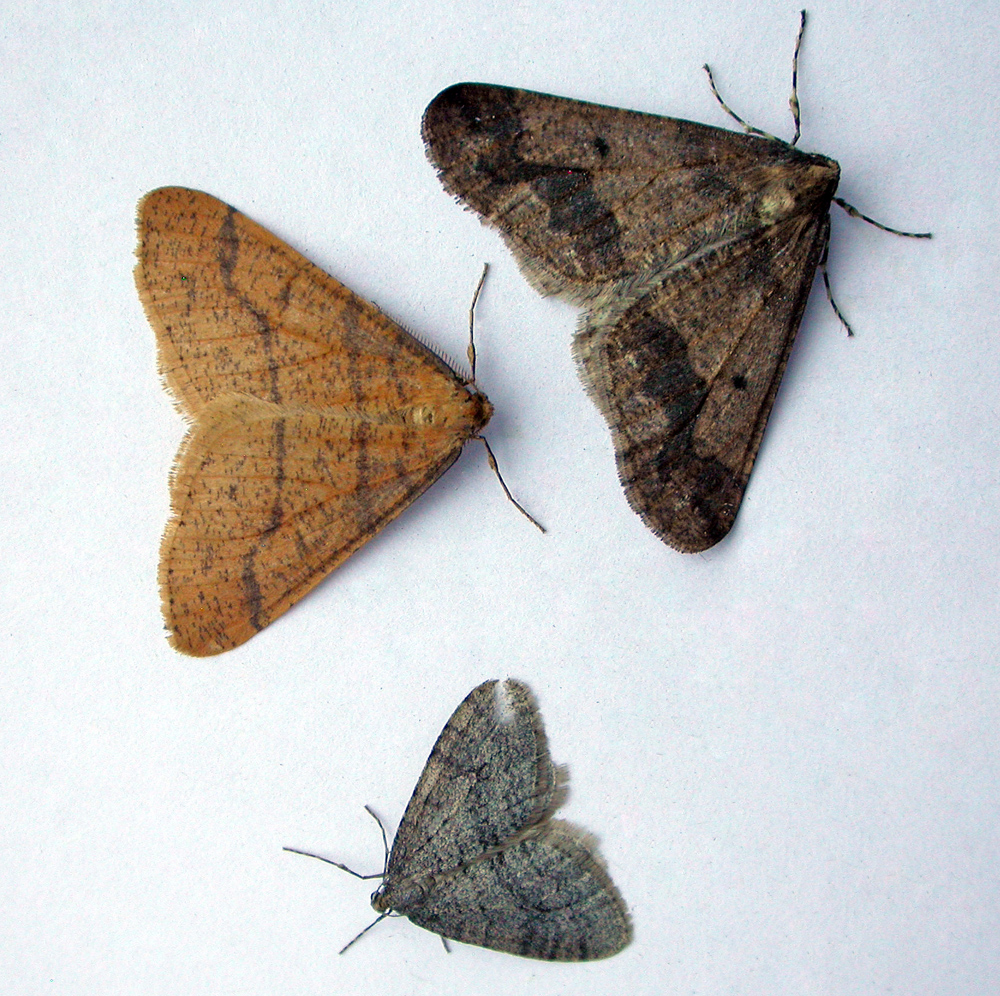
Winter or Northern Winter?

 These specimens (amongst others) turned up on Monday night. Does No 4 have pale enough hind wings to make in Northern? I imagine the others are Winter moth. Thanks, David


Monday, 5 December 2022

Acleris sparsana

Back on 29th October, I posted this picture of what I thought was Acleris schalleriana.
It has now been checked by Peter, and it is infact Acleris sparsana. They are definitely tricky to tell apart sometimes. Steve Trigg, Cookham

Friday, 2 December 2022

Moth Dissection website

This is a request for those that use the Moth Dissection website either directly or indirectly, to consider sponsoring the site . I make this plea every year so that we can cover the running costs and keep it going. There's been an astonishing number of new dissection images as well as adult, larval and other stages posted. Every day new images appear. So please consider helping to keep it going. Thank you. Peter Hall

Thursday, 1 December 2022

2022 in Numbers: Westcott

As I've mentioned on here before, finding out what people think about their own mothing year is a fascinating exercise (to me, anyway!).  Each December I usually try to present some information about how things have been in the garden here in the hope that others might be tempted to do something similar.  That's not seeking comparisons between Westcott and other sites (all will be different, due not least to effort and local habitat), but looking at how each one's results compare to previous years at that same site.  With dissections for 2022 completed earlier than usual (many thanks, Peter), I have an excellent idea already as to what kind of year it has been for moths at Westcott so here are a few statistics to compare with previous years:

Number of nights the lights were run (1st Jan to 30th Nov):  310, of which 121 were with a single twin-30w actinic and the remainder with two traps (37 nights using two twin-30w traps and the remainder with one 125w MV & one twin-30w actinic).  That amount of effort is broadly similar to the previous four years, although running two actinics in the garden is not something I've tried before. 

Number of species caught:  742, comprising 382 micros and 360 macros.  That is the highest annual species count ever for the garden, exceeding last year's record total of 712 by a significant margin. 

Nights with 100+ species:  18, spread between 16th June and 1st August and all using both traps (125w MV and twin-30w actinic).  A further 13 nights came quite close with more than 90 species recorded and the results from one of those (19th July, 96 species) came from the actinic alone because the MV failed not long after it was switched on and contained zero moths when inspected at dawn.  The night with the highest species total was 11th July with 167, while 17th & 18th July shared second place with 154 each.  The year's results are certainly an improvement over both 2020 and 2021, being broadly similar to 2019 but still not as good as 2018 when there were 26 nights with 100+ species.

Best night for moth numbers:  2nd August when the total came to 782 individual moths (of 91 species).  The best night for species (11th July) had produced only 660 moths.  The second highest moth count occurred on 21st July (706 moths of 138 species) and that was the only other date on which the total surpassed 700.  Those figures are not at all exceptional here and, for example, have a way to go to catch up with the regular 1,000+ nightly totals achieved during 2019 using the same two traps.  

Highest overall counts for a single species:  Common Footman (1,575), Large Yellow Underwing (1,439) & Lunar Underwing (1,248) for macros and Acentria ephemerella (2,195), Agriphila tristella (547) & Patania ruralis (491) for micros.  In all, seven specific species passed the 1,000 barrier, the other three being Flame Shoulder, Setaceous Hebrew Character & Common Wainscot.  Heart & Dart (674) showed an improvement over its dismal performance in 2021 but still has a way to go to get back to its normal position amongst the highest counts.  Small Square-spot (512) was also working its way back up towards another peak after a trough of just 17 individuals in 2019.  It seems to undergo regular cycles like this lasting seven or eight years.

New for the site in 2022:  Seven macro and 16 micro species which, incredibly, is almost identical to the results for 2020 & 2021 and takes the garden lepidoptera count to 1,096 (606 micro, 458 macro & 32 butterfly species).  The new macros comprised Raspberry Clearwing & Sallow Clearwing both to pheromone lures during the daytime, while the overnight traps brought in Yellow Horned (common locally, long awaited), Jersey Mocha (migrant), Rest Harrow (migrant), Wormwood (widespread but seldom comes to light) & L-album Wainscot (spreading).  Of the micros, two were added as leaf-mines (Eriocrania sangii on birch, Phyllonorycter tenerella on hornbeam) and two as by-catch to pheromone lures (Triaxomasia caprimulgella to LUN, Pammene giganteana to MOL) while the remainder came to light:  Tineola bisselliella, Caloptilia populetorum, Caloptilia alchimiella, Povolnya leucapennella, Acrocercops brongniardella, Scrobipalpa ocellatella, Coleophora discordella, Elachista rufocinerea, Merrifieldia baliodactylus, Cnephasia pasiuana, Epinotia trigonella & Pempelia palumbella.   

Total number of moths caught in the garden (1st Jan to 30th Nov):  38,069 which is a marked improvement over 2021 (29,330 for the year) but nowhere near the total achieved in 2019 (54,400).

So to summarize, moth diversity at Westcott was above normal levels while moth abundance showed a recovery from the low of 2021 but was still significantly down on what was achieved in 2019.

2022 will be remembered as a particularly good year for migrants although Ancylosis oblitella was probably the only interesting one here not already mentioned.  Most of those seen at Westcott were the more common species - there were just more of them than usual.  They included Vestal, Four-spotted Footman, Small Marbled, Bordered Straw, Scarce Bordered Straw, Small Mottled Willow, Delicate & Pearly Underwing as well as Hummingbird Hawk-moth, Silver Y & Dark Sword-grass which are annual visitors.     

Dave Wilton Westcott, Bucks