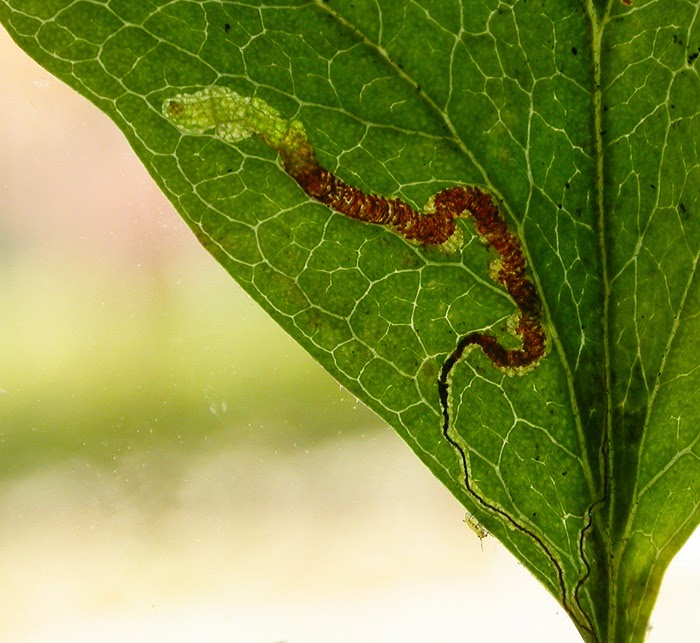
I have been finding leaf-mines of a moth which has very few (if any) records around this area and has generally been considered scarce in, I think, the whole of Britain. But I have encountered reports of its increase and that might well be the case. Part of the problem might be that they are not very visible being, as they are, in hairy leaves of White and Grey Poplar. I've found them in Herts, Middlesex (Regent's Park, no less) and eventually in Bucks - just outside Denham Garden Village.
Unlike most Phyllonorycter, P. comparella emerges now and hibernates. The remains of the chrysalis is visible, poking out of the membrane of the mine:
Andy King.
Sunday, 5 October 2014
How to boost your garden list
Last night's near-frost here at Westcott, Bucks caused the expected severe reduction in the number of moths caught by the garden actinic trap, which amounted to just 18 individuals of two species (a single Dusky-lemon Sallow accompanying the Lunar Underwings). However, despite the continued low temperatures today it was sufficiently sunny to tempt a few things out and I had activity in the garden from Anthophila fabriciana and a Vapourer, while a pug caterpillar (possibly V-Pug) was found munching away on an Osteospermum flower.
Now is a very good time to search for leaf mines and today I concentrated on our garden hawthorn, finding evidence of nine species: Bucculatrix bechsteinella, Stigmella hybnerella, Phyllonorycter leucographella, Lyonetia clerkella & Parornix anglicella (all vacated mines) as well as Stigmella oxyacanthella, Stigmella regiella, Phyllonorycter corylifoliella & Phyllonorycter oxyacanthae (all containing active larvae). In addition, an active coleophorid case was found but it proved to be one of Coleophora coracipennella/prunifoliae/ spinosella which are difficult if not impossible to separate at this stage (all three species have been recorded in the garden as adults).
For those of you who haven't indulged in looking for leaf-mines, there is an excellent resource here (http://www.leafmines.co.uk/index.htm) to help identify these early stages. A good starting point would be to download and print off the mine-keys. Most leaf-miners are specific to a particular host plant or tree. The position of the egg, the type and shape of the mine, the colour and patterns made by the caterpillar's frass and, if present, the colour and markings of the larva itself all help to identify some of our smallest moth species, many of which are exceedingly difficult to separate as adults.
Dave Wilton
Now is a very good time to search for leaf mines and today I concentrated on our garden hawthorn, finding evidence of nine species: Bucculatrix bechsteinella, Stigmella hybnerella, Phyllonorycter leucographella, Lyonetia clerkella & Parornix anglicella (all vacated mines) as well as Stigmella oxyacanthella, Stigmella regiella, Phyllonorycter corylifoliella & Phyllonorycter oxyacanthae (all containing active larvae). In addition, an active coleophorid case was found but it proved to be one of Coleophora coracipennella/prunifoliae/ spinosella which are difficult if not impossible to separate at this stage (all three species have been recorded in the garden as adults).
For those of you who haven't indulged in looking for leaf-mines, there is an excellent resource here (http://www.leafmines.co.uk/index.htm) to help identify these early stages. A good starting point would be to download and print off the mine-keys. Most leaf-miners are specific to a particular host plant or tree. The position of the egg, the type and shape of the mine, the colour and patterns made by the caterpillar's frass and, if present, the colour and markings of the larva itself all help to identify some of our smallest moth species, many of which are exceedingly difficult to separate as adults.
Dave Wilton
![]() |
| Pug caterpillar, Westcott 5th October |
![]() |
| Vacated mine of Stigmella hybnerella, Westcott 5th October |
![]() |
| Active mine of Stigmella oxyacanthella, Westcott 5th October |
Saturday, 4 October 2014
Convolvulus hawkmoth
My first post - I live in Southend, Garsington. This hawkmoth came to the trap two nights ago. Andrew Callender
Another leaf-mine
I found this mine in hazel at Little Marlow GP, S. Bucks. The best fit I can see for it is Stigmella floslactella. Can someone please confirm or advise otherwise. Thanks, Adam Bassett
Short-cloaked Moth
Hardly a stunning photograph of a "small grey job", but it serves to illustrate another species added to the ever increasing list of those which have attempted an extra brood this year. This one came to the garden actinic trap at Westcott, Bucks last night.
Trap catches will presumably decline very quickly now that the weather has turned. Lunar Underwing is past its peak and there aren't all that many new species left to look forward to. Three hours spent in the company of Martin Albertini and Andy King at Stoke Common, Bucks last night produced few moths and the only 'highlights' were another second-brood Marbled White Spot and the first November Moth of the season (exact species awaiting determination).
Dave Wilton
![]() |
| Short-cloaked Moth, Westcott 3rd October |
Trap catches will presumably decline very quickly now that the weather has turned. Lunar Underwing is past its peak and there aren't all that many new species left to look forward to. Three hours spent in the company of Martin Albertini and Andy King at Stoke Common, Bucks last night produced few moths and the only 'highlights' were another second-brood Marbled White Spot and the first November Moth of the season (exact species awaiting determination).
Dave Wilton
Friday, 3 October 2014
Finemere Wood, Bucks
Just twenty species came to a single MV run at Finemere for three hours last night. Figure of Eight (19) was the only moth to appear in any numbers but I did get a well-marked Pine Carpet (a new species for the site, which perversely had most of its conifers removed a couple of winters ago!) as well as second-brood Small Fan-footed Wave and Yellow-tail. Dave Wilton
![]() |
| Pine Carpet, Finemere Wood 2nd October |
![]() |
| Yellow-tail, Finemere Wood 2nd October |
Good catches continue
After my Small Wainscot last week which I thought was the small version of the Large Wainscot, here is a genuine Large Wainscot which flew in on Wednesday night/Thursday morning. I think so, anyway. It was certainly large.
Also in a very busy trap was the Grey or Dark Dagger below, another to add to the late broods I guess, and my first Satellite of the year which nestled up to one of the many Black Rustics which continue to flock in. Martin Wainwright, Thrupp, Oxon
Thursday, 2 October 2014
Cosmopterix zieglerella
Walking along the towpath of the Grand Union Canal (somewhere SW of Heath and Reach) today I spied the accompanying hedgerow had wild Hop in it and, in one area, there were leaf-mines that looked like this:
This is caused by the caterpillar of Cosmopterix zieglerella which is a relatively scarce and local moth. Indeed, although there was Hop off and on in quite a long stretch of the hedge, leaf-mines were only evident in a short portion.
It would be nice to post a picture of the adult - a very colourful moth.
It might also be worth pointing out it was very close to the border with Bedfordshire.
Andy King.
This is caused by the caterpillar of Cosmopterix zieglerella which is a relatively scarce and local moth. Indeed, although there was Hop off and on in quite a long stretch of the hedge, leaf-mines were only evident in a short portion.
It would be nice to post a picture of the adult - a very colourful moth.
It might also be worth pointing out it was very close to the border with Bedfordshire.
Andy King.
Beaded Chestnut and a micro query
50 individuals in the garden trap last night comprising 22 species. Lunar Underwing was down to just 11, most of them on the lawn. New for the year were Blair's Shoulder-knot and Pink-barred Sallow. There was also a Common Footman which I guess is a later than usual record.
There were a couple of Beaded Chestnuts, plus this one photographed below. It has quite strong cross lines, but am I correct in thinking that this is a Beaded Chestnut as well?
I also discovered this small micro in the trap, measuring 6mm. Is it Gypsonoma dealbana?
Steve Trigg, Cookham
There were a couple of Beaded Chestnuts, plus this one photographed below. It has quite strong cross lines, but am I correct in thinking that this is a Beaded Chestnut as well?
I also discovered this small micro in the trap, measuring 6mm. Is it Gypsonoma dealbana?
Steve Trigg, Cookham
Bernwood Forest
A single MV light allowed to run overnight in Oakley Wood, Bernwood Forest last night produced a grand total of 43 moths of 22 species: Zelleria hepariella (1), Acleris sparsana (1), Acleris emargana (1), Archips podana (1), Apotomis betuletana (1), Epinotia maculana (3), Small Fan-footed Wave (1), Red-green Carpet (1), Common Marbled Carpet (1), Grey Pine Carpet (1), Spruce Carpet (2), Figure of Eight (1), Rosy Footman (1), Grey Shoulder-knot (1), Satellite (6), Chestnut (3), Brick (3), Beaded Chestnut (3), Lunar Underwing (7), Pink-barred Sallow (1), Sallow (1) & Small Wainscot (2). Small Fan-footed Wave is known to have an occasional partial second brood but, as far as I'm aware, Rosy Footman is not and becomes another addition to this year's list of unexpected late sightings. Epinotia maculana is described as local but at this time of year I find it commonly in most of the local woods which have aspen.
Dave Wilton
Dave Wilton
![]() |
| Rosy Footman, Bernwood Forest 1st October |
![]() |
| Epinotia maculana, Bernwood Forest 1st October |
COAM Leaf MIne
After Mr King's post the other day, I had a quick look at some of the Field Maple on the COAM site, and found this.
To my eyes, this does look like a mine of Stigmella aceris, but I would appreciate the opinions of those who know more about these things!
Dave Morris
To my eyes, this does look like a mine of Stigmella aceris, but I would appreciate the opinions of those who know more about these things!
Dave Morris
Wednesday, 1 October 2014
Spruce or Grey Pine?
Quite a few moths get attracted to the security lights at the Dolphin school in Hurst. This always presents me with a challenge checking over all the brick walls first thing in the morning.
Late September has thrown up Light Emeralds, Willow Beautys, Sallows, Snouts, August Thorn, Common Marbled Carpet, Setaceous Hebrew Character and the two above.
Not sure if Grey Pine Carpet or Spruce Carpet, and could the other one be an unusual Maiden's Blush?
These two found on the 30th Sept.
Tony Towner.
Merveilleux!
Merveille du Jour is the one moth of autumn which I never tire of seeing, no matter how frequently it turns up. My first for this year came to the garden actinic trap here at Westcott, Bucks last night. Amongst a list of 25 species, it was accompanied by Pine Carpet (uncommon in the county, but I had one at this time last year too), Feathered Thorn and another Dark Sword-grass. Lunar Underwing has officially become the No.1 moth for this year in the garden, last night's count of 153 taking me past 3,000 individuals since its first appearance on 11th September. As usual, about a third of them were found scattered across the lawn, having failed to enter the trap. Another moth which is doing well here at the moment is the second brood of Hypsopygia costalis (Gold Triangle). The photo below manages to show both of its resting positions in the same shot!
I also took a couple of traps to Salcey Forest to try and catch up on some of the autumn moths there. It was slow going but I eventually came away with 30 species, including Phyllonorycter trifasciella (an easily recognisable member of that family which feeds on honeysuckle), Acleris forsskaleana (presumably a second brood specimen), Figure of Eight, Small Wainscot and Pinion-streaked Snout.
Dave Wilton
![]() |
| Merveille du Jour, Westcott 30th September |
![]() |
| Feathered Thorn, Westcott 30th September |
![]() |
| Hypsopygia costalis, Westcott 30th September |
I also took a couple of traps to Salcey Forest to try and catch up on some of the autumn moths there. It was slow going but I eventually came away with 30 species, including Phyllonorycter trifasciella (an easily recognisable member of that family which feeds on honeysuckle), Acleris forsskaleana (presumably a second brood specimen), Figure of Eight, Small Wainscot and Pinion-streaked Snout.
Dave Wilton
![]() |
| Phyllonorycter trifasciella, Salcey Forest 30th September |
Turnip Moth?
If this is a Turnip Moth it's a new one for me and it's the 300th species caught here. Pity it's a bit battered. I got my first Barred Sallows last night and they were in poor condition too.
Mark Griffiths, Garsington, Oxford.
Edit: Just got a "Congratulations on your 300th Moth" card from the missus.
Mark Griffiths, Garsington, Oxford.
Edit: Just got a "Congratulations on your 300th Moth" card from the missus.
Tuesday, 30 September 2014
Confirmations and IDs (catches 28 & 29th Sept)
hi, can someone help with confirmations on these?
I think the first is a Grey Pine Carpet although it's a bit worn.
The second I think is Acleris rhombana
The third might be Acleris sparsana?
Mark Griffiths, Garsington, Oxford
I think the first is a Grey Pine Carpet although it's a bit worn.
The second I think is Acleris rhombana
The third might be Acleris sparsana?
Mark Griffiths, Garsington, Oxford
Nice end to the month
Monday, 29 September 2014
Home or away?
At Philipshill Wood, Chorleywood, last night, I caught my reasonable share of usual moths, the high-light might have been considered the single Deep-brown Dart. Lunar Underwings abounded, Large Yellow Underwing down to one (in good condition curiously). Packed away, went home.
This morning I found a Cypress Pug at the porch light - a species I've been waiting to see and was wondering if I might have to travel especially to 'tick'. "Blow me down", I thought. Andy King.
More second-brooders
Last night I had my first Dusky-lemon Sallow of the year which was pleasing but not wholly unexpected after catching quite a few last year in the garden. What was considerably less expected was a fresh Yellow-tail which can now add itself to the ever increasing list of species that have put in an extra appearance this year. I was also sent a picture of a Swallow-tailed Moth from a garden in Oxford found over the weekend and have seen quite a number of records for this species elsewhere recently. Marc Botham, Benson
| Yellow-tail - Benson 29/09/14 |
Little but Large?
Sunday, 28 September 2014
As good as it gets
As far as luck with migrants is concerned, last night was about as good as it gets locally for me. I ran a couple of traps at our Holtspur Bottom reserve near Beaconsfield, Bucks and got just short of 50 species. I'd hoped to tick off most of the Sallows on this visit but in the end the only one which turned up was Barred Sallow (in some numbers, including several of the smart dark orange form). Along with a handful of Light Emeralds, a single Small Emerald came to one of the lights as an unusual second brood. Pride of place, though, goes to the tiny and rather battered female Gem illustrated below.
Back at Westcott, Bucks the garden actinic trap was again heaving with Lunar Underwings (335 of them, almost outnumbering the crane-flies!). 36 species were caught, of which Chestnut and Yellow-line Quaker were firsts for this season. A new-brood Beautiful Hook-tip also appeared, as did a Marbled White Spot which is another species not normally associated with this time of year. Two migrants graced the trap, one more Dark Sword-grass (my fourth of the last few weeks) and a smart Vestal.
Dave Wilton
![]() |
| Gem, Holtspur Bottom 27th September |
Back at Westcott, Bucks the garden actinic trap was again heaving with Lunar Underwings (335 of them, almost outnumbering the crane-flies!). 36 species were caught, of which Chestnut and Yellow-line Quaker were firsts for this season. A new-brood Beautiful Hook-tip also appeared, as did a Marbled White Spot which is another species not normally associated with this time of year. Two migrants graced the trap, one more Dark Sword-grass (my fourth of the last few weeks) and a smart Vestal.
Dave Wilton
![]() |
| Yellow-line Quaker, Westcott 27th September |
![]() |
| Marbled White Spot, Westcott 27th September |
![]() |
| Vestal, Westcott 27th September |
Acleris Rhombana?
Merveille du Jour
Merveille du Jour last night at Bagley Woods among a miserable catch given what seemed to be pretty good conditions. Also had Chestnut and more Satellites as well as Small Fan-footed Wave joining the extra-generation list - a list that was also joined by Common Pug in the garden trap from last night as well as another Riband Wave. Also had a garden first - Cypress Pug - on 26th.
Marc Botham, Benson
Marc Botham, Benson
Mursley moths
A bit of interest in and around the trap over the last couple of nights as well as all the Lunar Underwings and Daddy long-legs. I would welcome confirmation (or otherwise) of some that are possibly new to my garden list.
I'm confident about this Mallow - delighted to find three in the trap this morning.
I think this might be Grey Pine Carpet.
Could this be Pink-barred Sallow?
Blair's Shoulder-knot?
Brick?
...and finally, Eudonia angustea?
Many thanks
Mick
I'm confident about this Mallow - delighted to find three in the trap this morning.
I think this might be Grey Pine Carpet.
Could this be Pink-barred Sallow?
Blair's Shoulder-knot?
Brick?
...and finally, Eudonia angustea?
Many thanks
Mick
Saturday, 27 September 2014
Further Autumnal Species
Marc Botham and I trapped in woodland near Appleton, Oxon on Thursday night and, although it was slow going, in the usual three hours we eventually managed nearly 50 species between five traps, which isn't all that bad for this time of year. New for me for the year were Mallow (which neither of us had previously seen outside of our respective gardens) and Brick.
Back in the garden here at Westcott, Bucks, Brick made its first appearance last night alongside Green-brindled Crescent, while amongst the eight micro species was Clepsis consimilana which I get regularly as a second brood at this time of year. Lunar Underwing seems to be going flat out to try and beat all other garden species counts for this year and at its present rate should make it with ease. I've had nearly 1,800 individuals already to the garden actinic and the moth has only been flying here for just over two weeks.
Dave Wilton
Back in the garden here at Westcott, Bucks, Brick made its first appearance last night alongside Green-brindled Crescent, while amongst the eight micro species was Clepsis consimilana which I get regularly as a second brood at this time of year. Lunar Underwing seems to be going flat out to try and beat all other garden species counts for this year and at its present rate should make it with ease. I've had nearly 1,800 individuals already to the garden actinic and the moth has only been flying here for just over two weeks.
Dave Wilton
![]() |
| Green-brindled Crescent, Westcott 26th September |
![]() |
| Brick, Westcott 26th September |
Dark and brown - or black?
I'm very grateful for the confirmation of Mick Jones' heavily-marked Lunar Underwings as I was about to post pictures of two almost identical examples with the same query as his. So now I'm just down to asking if the moth above is a Deep Brown Dart - my guess - and to ask for an ID of the little pale brown one below which was fluttering about in the churchyard of St Leonard's, Eynsham, two days ago. Maybe a worn Treble Bar or Lesser Treble Bar like Steve's a few posts back? Many thanks for any help. Martin Wainwright, Thrupp, Oxon
Subscribe to:
Posts (Atom)


