Wednesday, 14 October 2020

Westcott, Bucks

With catches by the actinic light varying between ten and just over 20 species each time depending on the weather conditions, there hasn't been a great deal of interest at Westcott over the past seven nights.  Two adult moths have been added to the garden year-list, although the micro was actually a daytime sighting, found flying around in our shed:

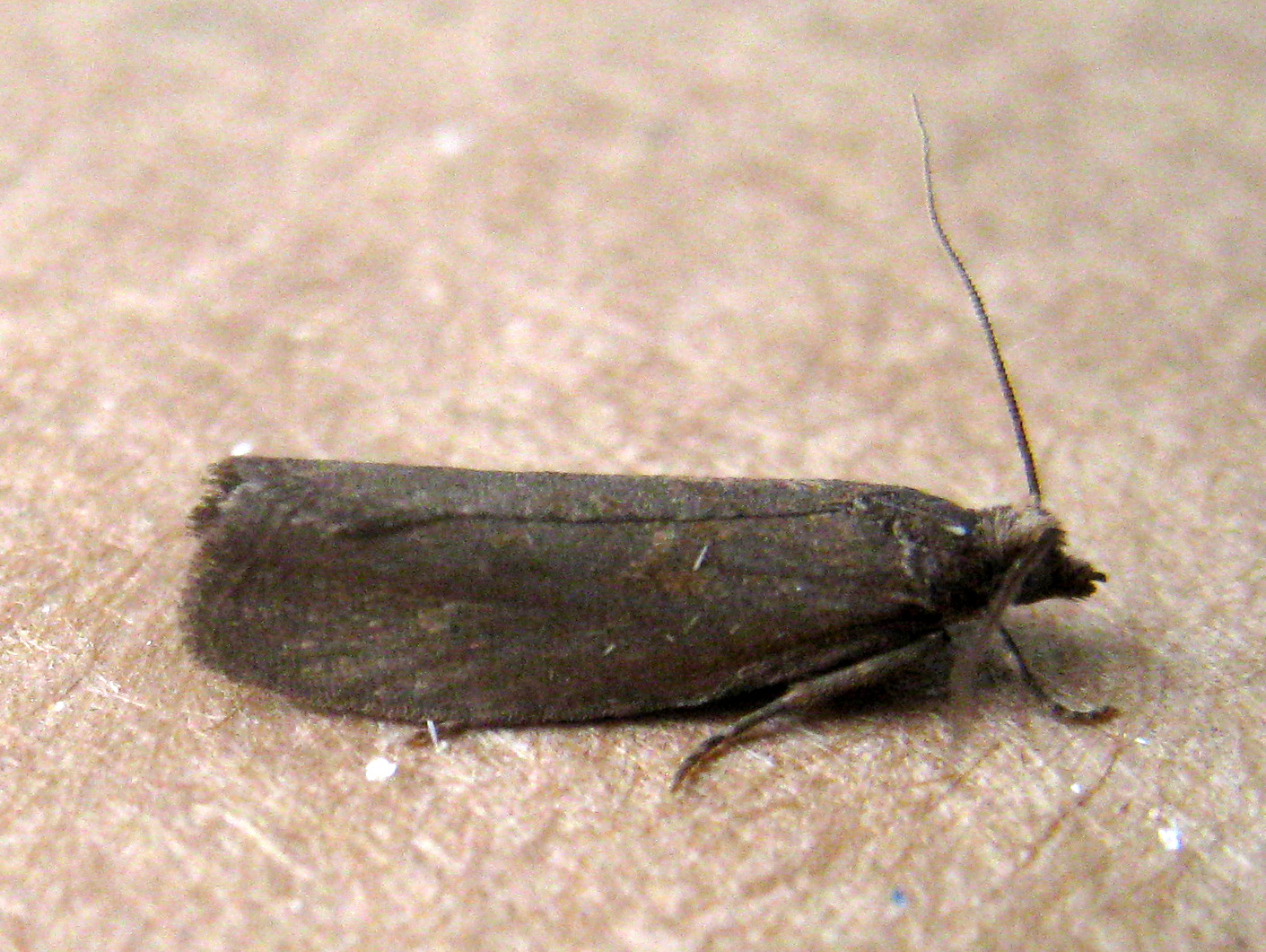
(7th)    Acrolepia autumnitella
(13th)  Yellow-line Quaker

Acrolepia autumnitella, Westcott 7th October

My first Grey Shoulder-knot of the autumn appeared last night, as did the garden's eighth Clifden Nonpareil this season (in quite reasonable condition too), while other species not so readily associated with this time of year have included Lesser Treble-bar (8th), Willow Beauty (11th) and Straw Dot (10th).  None of that trio is actually a particularly unusual sighting in the first half of October although more often than not they are over by the end of September.  

Grey Shoulder-knot, Westcott 13th October

Straw Dot, Westcott 10th October

There are no large numbers of anything now.  Lunar Underwing is down to single digit counts and Beaded Chestnut has overtaken it but not by much.  The November numbers are increasing and five examples of Merveille du Jour last night was nice to see.  What is noticeable around the garden is that our copious amounts of flowering ivy have had few takers so far apart from the odd Brick, Sallow or Angle Shades, which is unusual.  

Dave Wilton Westcott, Bucks

Beaded Chestnut vs Lunar Underwing.

 I have too much tremor to check the hindwings and I'm really not sure about this one. It's dark so there is no sign of the black marks on the leading edge of the wing. The lack of distinct black triangles at the wing tip suggest Beaded Chestnut. The veins suggest Lunar Underwing. The oval mark inclines towards the Beaded Chestnut?


Mark Griffiths, Garsington, Oxford.


Tuesday, 13 October 2020

Merveille du jour


First Merveille du jour for me since October 2017


Alan Diver,

Tackley

Monday, 12 October 2020

Another Clifden!

 A know they're turning up all over the show this year, but here's another one - one of only 9 moths in the trap this morning after a cold night in HP5 (edge of Hawridge Common). It's the third one to turn up in this local area. I've popped it next to a Green-brindled Crescent for comparison. 

Best wishes, David

Sunday, 11 October 2020

Missed it again!

I've been searching the alder in our garden regularly every couple of weeks for leaf-mines because last year I found a vacated Nepticulid mine on it which unfortunately couldn't be identified (mines of Stigmella alnetella and Stigmella glutinosae can't be separated without a larva being present).  Today's search produced just the one mine, unfortunately vacated once again.  Next year, maybe...  

Stigmella mine on alder, Westcott 11th Oct

Still, it wasn't all bad news because I managed to add three more species to this year's garden list by finding a couple of active mines of Stigmella obliquella on willow, one just starting out and one almost finished, and several early blister mines of Phyllonorycter coryli on hazel (they seem to be late starting here this autumn).  Best of all, though, was an active mine of Stigmella perpygmaeella on hawthorn which is completely new for the garden.

Mine of Stigmella obliquella, Westcott 11th Oct

Mine of Stigmella obliquella, Westcott 11th Oct

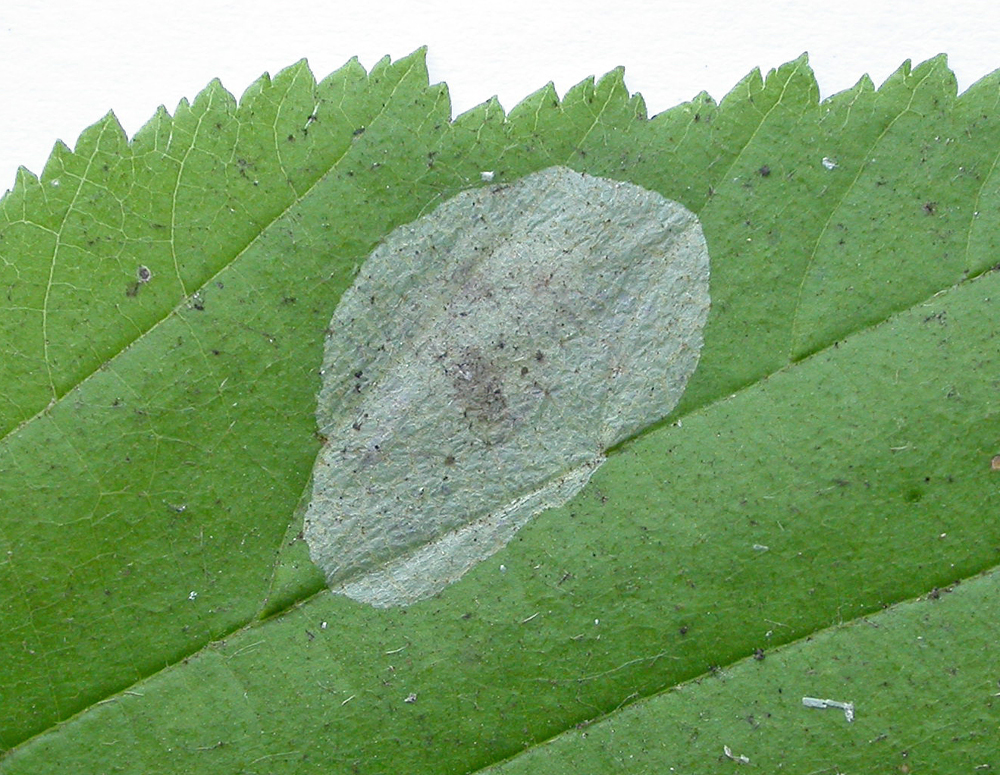
Mine of Phyllonorycter coryli, Westcott 11th Oct

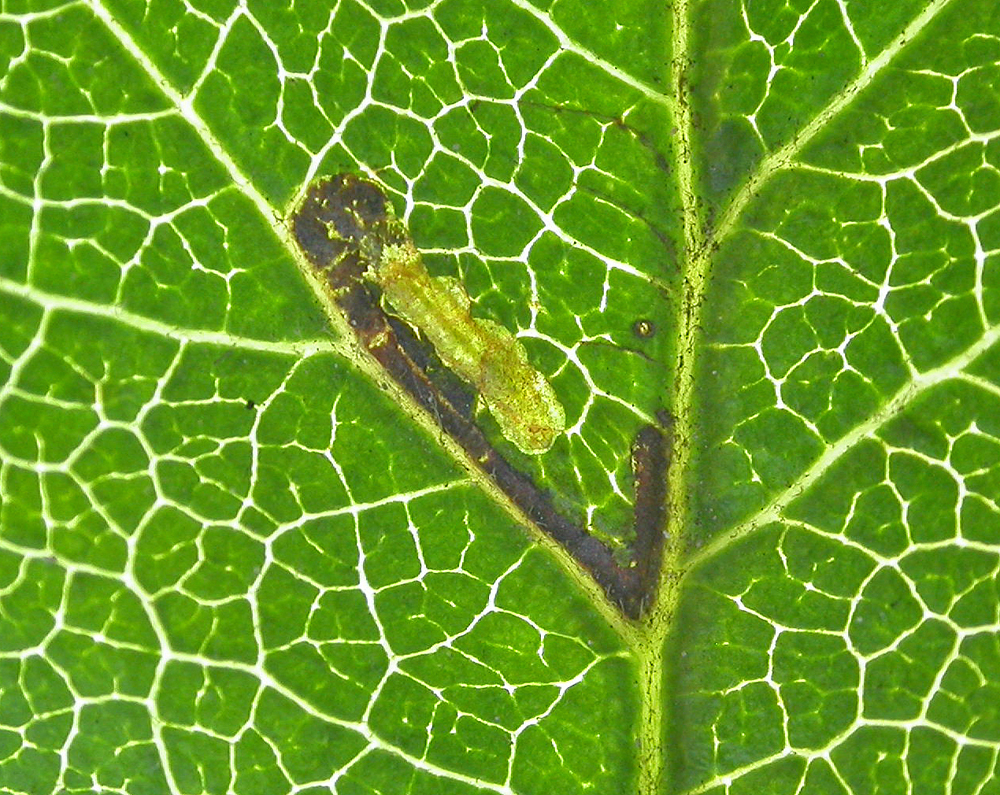
Mine of Stigmella perpygmaeella, Westcott 11th Oct

Stigmella perpygmaeella is the only hawthorn-feeding Stigmella species to lay its egg on the upper surface of the leaf.  The early gallery is surprisingly wide for the start of a mine and is filled with brownish frass.  It is the 26th member of the Nepticulidae to be identified as a mine in the garden, while a further eight have been found as adults (all dissected) but not yet as mines, so there's still work to be done here!    

Dave Wilton Westcott, Bucks  

Thursday, 8 October 2020

Micro help needed

 Last night's catch included 3 Merveille-du-Jour and a latish Burnished Brass. There were also a couple of Diamond-back moths which made me realise how few I have seen this year (10 in total).

There was also this rather large (13mm) micro that I have failed to identify.


Andy Newbold Sibford Ferris, Oxon.

Dewicks Plusia Makes it to Longwick

I almost didn't bother  trapping last night given the wind and rain but I'm glad I did as the fairly meagre numbers (about 24 moths heavily outnumbered by flies!) contained not only a fresh looking Clifden Nonpareil but this immediately recognisable Dewick's Plusia. That's another one of the "dream" moths on the garden list and it certainly raised the spirits sitting peacefully in the eggboxes.

I also trapped this dark plume with distinctly blackish underwings. Apologies for the photos as the light wasn't great this morning. I always admit to being rubbish at plumes. Is it Brown Plume?


Wednesday, 7 October 2020

Various Late Sightings

Some late moth news from the last month or so - a combination of failing to sort photos and losing my moth notebook has delayed me getting round to posting them!

Way back on the 11th August I had another session trapping at Aston Rowant, again on Linkey Down. The main highlight was following Dave's method of trapping under and netting around Juniper to get a few of the pRDB Argyresthia abdominalis (gen detted by Peter Hall). This seems to be the second Oxfordshire record of this species, which was first recorded in the same place by David Agassiz in the 1970s. Others to light were the lovely Parectopa ononidis, Gypsy Moth, Tree-Lichen Beauty, White Point, and Barred Rivulet. I also found a single Citron Plume and Coleophora saxicolella in the bus stop at Lewknor Turn on the way back, both gen detted by Peter H.

Argyresthia abdominalis

Parectopa ononidis

On the 23rd I had a session at Sydlings Copse, spending a couple of hours trawling through Yellow Loosestrife without any sign of Dentated Pug larvae - a few other species found though including Wormwood, Lime-Speck and Grey Pug as well as Peppered Moth (on Mugwort).

Then on the 29th it was back to Aston Rowant and leaf-mines. I added about 12 species to the site list here, the best of which was Ectoedemia arcuatella mining Wild Strawberry, a new moth for Oxfordshire according to Martin. The mines were on plants growing along Hill Ln as it passes through Linkey Down, growing in deep shade under Hazel by the edge of the path, with several mines to a leaf. When I put the pictures on twitter, there was a bit of discussion that suggested this is a typical situation for the species, as other recorders have had them on shady edges on chalk/limestone. Other interest was provided by some Trifurcula mines on Bird's Foot Trefoil (I've heard that being on downland, these would once have been called eurema, but now need to be bred, as habitat is no longer thought to be good enought to separate them from cryptella), Parectopa ononidis on Red Clover, a few of the apple miners, Stigmella speciosa on Sycamore and Stephensia brunnichella on Wild Basil (a mine that's well worth looking out for - it seems to be very under-recorded).

Ectoedemia arcuatella mines - Aston Rowant

Trifurcula sp. mine - Aston Rowant

On the 13th of September, I headed over to Bucks to try Dancersend for Campanula Pug larvae, searching all the Nettle-Leaved Bellflower I could find (c 80 flowering spikes) without success. This seems like a moth that could be lurking on the Chilterns somewhere, and I think is most often recorded in the larval stage in September. Apart from that, I found some mines of Stigmella tiliae on limes on the way to the site, and the mines of Stephensia brunnichella on Wild Basil once again.

On the 22nd I joined Doug Boyes up at Wytham Woods to do some leaf-mining. We mainly targeted plants/species that have gone un-recorded there for a while, and managed to find 13 species new for the woods, some over-looked and some probably new arrivals (possibly for Berkshire as well as the woods?). The best were Cosmopterix scribaiella on Common Reed in Marley Fen (spotted by Doug, and ID confirmed by Rob Edmunds) and Phyllocnistis xenia on Grey Poplar in the Dell. Other good ones were Stigmella tiliae (on Lime), Bucculatrix bechsteinella (Hawthorn), Parornix fagivora (Beech), Mompha terminella (Enchanter's Nightshade), Parectopa ononidis (Red Clover), Stephensia brunnichella (Wild Basil), and Phyllonorycter comparella (Grey Poplar), as well as a single White-Spotted Pug larva on Wild Angelica.

Mompha terminella mines

Cosmopterix scribaiella mines

Phyllocnistis xenia mines

Finally, Peter H very kindly gen detted a batch of moths for me at the start of the month, and alongside Argyresthia abdominalis, there were a couple of other good ones: Coleophora niveicostella (a pRDB Thyme feeder from Aston Rowant 19/7 - 3rd Oxon rec),  Bucculatrix cristatella (Aston Rowant, 16/7), Monochroa lucidella and Elachista utonella (New Marston Meadows, 21/7), and another new moth for Oxfordshire - Sorhagenia janiszewskae (potted off Buckthorn near Goring on 26/7).

Coleophora niveicostella - Aston Rowant

Sorhagenia janiszewskae


Westcott, Bucks

Not a lot has happened in the garden since the report last Wednesday.  Storm Alex brought a lot of rain over several days, so since 2nd October I've reverted to "winter trapping mode" using just the twin-30wt actinic light.  The accompanying MV will only be brought out again if the weather really warrants it.  Four adult moth species have been added to the garden year-list:

(30th Sept)  Agonopterix purpurea, Figure of Eight
(1st Oct)      Feathered Thorn
(6th Oct)      November Moth

Feathered Thorn, Westcott 1st October
 
November Moth, Westcott 6th October

The male November Moth was a typically drab specimen and had its genitalia checked.  For the benefit of our newer contributors/readers, November, Pale November and Autumnal Moths are all found throughout our area and the first two are particularly common.  Males can't be safely identified to species without reference to their genitalia (refer to the text in the Field Guide) and the females, usually obvious by their different wing shape, can't be separated at all.  They need to be recorded as November Moth agg. unless they've been checked.     

There have still been reasonable numbers of moths to see every night, even through the torrential rain on Sunday 4th when numbers dipped to just 19 individuals of eight species.  The following night (Monday 5th) was more representative of current catches, producing 54 moths of 18 species.  Beaded Chestnut is still increasing in numbers although it never gets anywhere near the same totals here as Lunar Underwing which is definitely tailing off now (current count for the year is 2,821).  Mallow had a record year here in 2019 with 32 seen as opposed to the usual two or three.  It is doing quite well again this year too and numbers have already reached 16 since the first on 14th September.  Another Dark Sword-grass visited on the 2nd and that same night saw my first Satellite of the current season.  

This year's Clifden Nonpareil explosion shows no sign of abating yet and two more examples turned up during the week even though the nearest aspen is a kilometre away (there are poplars within 200 metres however).  On 30th September it was sadly just a set of wings on the lawn found before dawn, presumably a bat casualty, while on the 5th a rather worn example entered the trap.  They take this year's total here to seven over nearly two months:

13th August:  one to wine rope
26th August:  one to wine rope
3rd September:  one to light (twin-30wt actinic)
13th September:  two to light (one to 125wt MV, one to twin-30wt actinic)
30th September:  likely bat casualty, wings on lawn adjacent to the 125wt MV trap
5th October:  one to light (twin-30wt actinic)

With five found at other sites in Bucks that takes me to a dozen individuals in 2020.  Who would have thought even last year that we would be seeing so many of these wonderful moths now?!

Clifden Nonpareil, Westcott 5th October

Dave Wilton Westcott Bucks    

Tuesday, 6 October 2020

Delayed post: very early Spring Usher

Meant to post this way back but completely forgot until someone brought it up recently and reminded me: during a Berks Moth Group outing to Mirams Copse on 12th September Roy Dobson had an exceptionally early Spring Usher to his trap. This is by far the earliest record I have come across. On the same night we had Mottled Umber for which I imagine September records are not so unusual, though I don't usually start to see it until later in October personally. Between all the traps we managed a fair list of species with nothing exceptional, but notably very low numbers generally despite very warm and mild conditions. Marc Botham

Red-green or Autumn Green?

 A photo from Nov 2019 is puzzling me. This seems to have some characteristics of both Red-green and Autumn Green Carpet. Which have I got, please? Found near Chesham, Bucks.

Many thanks, David

Monday, 5 October 2020

Acleris schalleriana

Last night was cool and very damp: I set up the traps just after sunset as it was supposed to have stopped drizzling by then, but it continued until around nine o'clock, and thereafter the trees above the traps carried on dripping all night. So it was soggy egg boxes this morning and a poor result with a not-so-grand total of 33 moths of 11 species. Either the Lunar Underwings are dwindling now, or they chose to stay hunkered down last night: only 13 of them turned up, but Beaded Chestnut hit its highest nightly total so far with nine.

I had four micro species last night - Plutella xylostella and Epiphyas postvittana, but also what I think are two new species for the garden: Acleris sparsana and Acleris schalleriana. The former is common, but the latter is local and I'm aware that A. schalleriana can be confused with A. laterana and A. comariana.  The reason I think it's A. schalleriana is that the costal mark extends almost to the apex, and the book also mentions some raised scales, which are visible in the second photo of the moth, even if many have probably been lost.

Acleris sparsana
Newton Longville, 4th October 2020
Acleris schalleriana
Newton Longville, 4th October 2020

Acleris schalleriana
Newton Longville, 4th October 2020

Amongst the macros, there were two Satellites. In the garden I have had single examples on two previous occasions in 2019, both of which were the "classic" form with the kidney mark and the satellites on either side of it all in white. I know that it's quite common for one or all of these marks to be brown on some individuals, but last night was the first one that I've seen like this.

Satellite
Newton Longville, 4th October 2020
Satellite
Newton Longville, 4th October 2020
Tim Arnold
Newton Longville, Bucks

Saturday, 3 October 2020

Leaf miners in the rain

Given the weather I thought I would check out the garden for leaf mines in a brief gap in the rain.

In particular our apple tree was absolutely covered in mines of various types including of course Lyonetia Clerkella and callisto denticulella and leucoptera malifoliella. However there were a number I was not clear on and I have attached a range of photographs which I think might include stigmella malella and phyllonorycta leucographella. There is also a cherry leaf with - I'm guessing, Lyonetia Clerkella again? And finally a couple of small mines on Poplar that I cant find at all!

I was surprised at just how many mines there were on the apple including as you will see from the photographs more than one per leaf in some cases.


Friday, 2 October 2020

ID query from August 13th

 Hi,

Looking through some photos from a few weeks ago, I found I had put this rather worn specimen aside as too tricky for a novice! I'm risking public humiliation now by suggesting 'Cloaked Minor'. Am I even close??


Thanks, David

Flounced Chestnut


I had identified this as Beaded Chestnut. However, it has been suggested that it is, in fact, a Flounced Chestnut. Any thoughts would be appreciated.

The Great Escape

My tenth Clifden Nonpareil of the year gave me a fascinating time last night, as I watched it escape from the trap which I had gone to turn off because of the rain. It was so dazed that it flopped on the grass and I scooped it up and took it - via various adventures recorded on my own blog here - to a rum-and-treacle feast on an oak tree. Its behaviour further convinced me that distraction is a better word than attraction for the effect of light on moths, but I'd be most interested to hear more expert views.  Martin Wainwright, Thrupp, Oxon


Thursday, 1 October 2020

Pale Lemon Sallow?

I almost overlooked this on the lid of the trap and initially thought it Dusky Lemon Sallow but I think it may have the characteristics of Pale Lemon Sallow?

A bit more variety creeping in here in Longwick with Green Brindled Crescent, Barred Sallow and the return of Brimstone, Vapourer, Dark Spectacle, Cypress Pug and canary shouldered thorn.

Having had 3 Clifden Nonpareil last year I thought I was going to miss out this year but luckily whilst recording bats in the garden I saw one flying around the trap area - although it had gone by the next morning.

Clifden Nonpareil


Highlight of an excellent catch of moths at North Leigh on the warmish and wet night of 28th September. A garden first.