Tuesday, 22 March 2016

Another Orthosia

Lead-coloured Drab was out and about last night, two of them coming to an MV set up in local woodland.  This is a species to keep an eye open for now amongst the Clouded Drabs if you have Aspen or Black Poplar nearby.  The males are easily distinguished by their feathered antennae.

Lead-coloured Drab, 21st March

Lead-coloured Drabs, 21st March

Dave Wilton
Westcott, Bucks

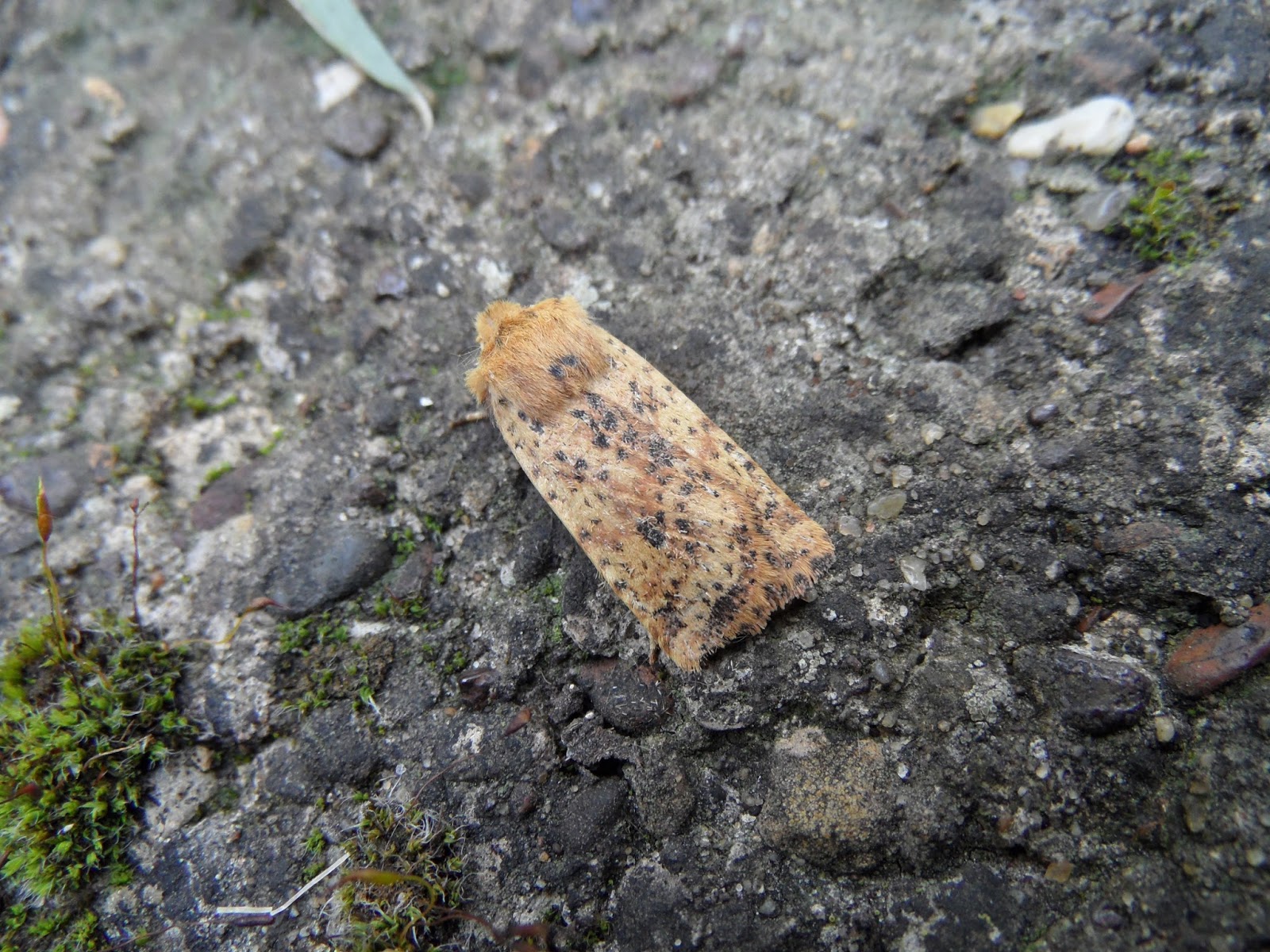
Diurnea fagella?

Is this a poorly marked Diurnea fagella?

Mark Griffiths, Garsington, Oxford

Buckinghamshire Invertebrate Group bulletins

We've just added our 2014 and 2015 Bulletins to the the Bucks Invertebrate Group resources page. Each Bulletin contains reports on moths in the county, as well as a range of other insect news. They're a good read, thanks to all the contributors under the strict but fair guidance of editor Peter Hall.

Click here to download any of the Bulletins. If you'd like to join the (free) mailing list for BIG, contact Bucks and Milton Keynes Environmental Records Centre and ask to be added. BIG's programme of field meetings for 2016 will be available shortly.

Monday, 21 March 2016

Oak Beauty

Pleased to find this in the trap this morning. Didn't get any last year and I think only one the year before. Also Common Quaker, Common Plume and Hebrew Character. No Small Quakers yet.

Mark Griffiths, Garsington, Oxford


Sunday, 20 March 2016

That's more like it

One of my targets this year is the M40 Compensation Area on the south-east corner of Bernwood Forest.  This is former agricultural land which was converted into suitable habitat for the Black Hairstreak butterfly as a mitigation measure when part of the forest was lost in the late-1980s during the construction of the motorway.  It comprises sheltered bands of blackthorn and privet scrub with small areas of wildflower meadow in between.  The site is owned and supposedly managed by the Highways Agency but they've carried out no work at all there for a couple of decades now.  With the fence having been breached in many places, it has become the top grazing spot for every Fallow, Roe and Muntjac Deer in the local area.  As those who have visited will know, it is a very long walk (nearly 3 kilometres) from the main forest car-park, the entrance isn't easy to find and when you get there the traffic noise from the M40 is horrendous!  However, the Black Hairstreak currently does quite well there and I'm interested to find out what moths might also be present.  A visit last night for the usual three hours with one 125wt MV and one 15wt actinic brought in a very welcome 420 moths of 12 species (all macros).  There was nothing of real interest and nothing which hasn't already been reported on the blog, but it was brilliant to see so much activity despite the constant stream of speeding car headlights less than 20 metres away!  Needless to say, the top counts were provided by Small Quaker (134) and Common Quaker (264).

Part of catch, M40 Compensation Area 19th March

Back at Westcott the garden actinic caught 16 moths of five species, of which Early Thorn was new for this year's garden list.

Early Thorn, Westcott 19th March


Dave Wilton
Westcott, Bucks

Moth trap bulbs

I just wondered whether anyone has any experience of using the 20W Eco bulbs supplied by Watkins and Doncaster.


On Friday night I caught 7 Common Quaker, 2 Hebrew Character and 1 Small Quaker using my usual 125W MV Robinson trap.


Last night (Saturday) I tried the 20W Eco bulb in the trap for the first time and was pleasantly surprised with a catch of 3 Common Quaker, 7 Hebrew Character and 1 Small Quaker.


The weather conditions on the two nights were similar. Based on this tiny piece of evidence the results with the Eco bulb certainly look encouraging and I will be experimenting further with the two different bulbs.


Andy Newbold.
Sibford Ferris, Oxon.

Saturday, 19 March 2016

Garden Moths in Seer Green

At last, moths have started appearing in my garden in Seer Green. I've only set the trap for the Garden Moth Scheme so far...

2 x Hebrew Character, 1 x Small Quaker, 3 x Common Quaker and 1 x Oak Beauty, a species which I didn't get at all last year.

I'm also trapping for GMS at the Chiltern Woodland Burial Park, with Yellow Horned (below), Hebrew Character, Chestnut, Small Quaker, March Moth and Diurnea fagella on the list for the year.

Dave Morris, Seer Green, Bucks.

Common Quaker?

Been running the trap quite a few times - last night is the first night I caught anything for months. I got a Clouded Drab, three Hebrew Characters and what I think is a Common Quaker. Can anyone confirm?

Mark Griffiths, Garsington, Oxford


Thursday, 17 March 2016

Your Records

Please have a read of Butterfly Conservation's updated policy here regarding the records you submit to the National Moth Recording Scheme through your County Moth Recorder.  Everyone should be aware not only of the good uses to which your information will be put but also the safeguards that are in place to protect personal information.  

First day-flyer of the year

There was quite a bit of insect activity in the garden this afternoon.  Lots of 7-spot Ladybirds including some mated pairs, my first solitary bee (Anthophora plumipes) and first hoverfly (Eristalis tenax) of the year, plus the little chap shown below who was flying around in the sunshine:

Mompha sp., Westcott 17th March

It is either Mompha bradleyi or (more likely) Mompha jurassicella, both of which I get in the garden, but will need to be dissected to confirm the species.  Both of them hibernate and their larval stages both feed on Great Willowherb Epilobium hirsutum which is widespread in ditches around the village.

Dave Wilton
Westcott, Bucks   

Schalleriana??

Firstly let me apologise for the awful photo, my camera has broken so only option was to use my iPhone. I found this moth sitting on my trap last night, i would be grateful if someone can confirm as Acleris schalleriana. It would be a new species for my garden and for me.
It does have a darkish coastal blotch, but its rather faded. Other than this its been the usual Common Quakers, Clouded Drabs, Hebrew Characters, Small Quakers, March Moth, Oak Beauty and Satellites slowly increasing in numbers.

Darren Seaman, Milton Keynes

Wednesday, 16 March 2016

Woodland Moths

I ran a single MV trap in nearby woodland last night for the usual three hours from dusk.  Despite some welcome cloud cover at last, light drizzle and the chilly easterly breeze combined to ensure that it wasn't all that pleasant a night and it still became quite cold quite quickly.  However, numbers of the early spring species do now seem to be building up locally.  Only one micro, Diurnea fagella, was tempted out but there was a reasonable supply of macros:  Yellow Horned (1), March Moth (2), Shoulder Stripe (2), Brindled Pug (3), Small Brindled Beauty (4), Oak Beauty (2, one quite a dark specimen), Red Chestnut (5), Small Quaker (10), Common Quaker (36), Clouded Drab (5), Twin-spotted Quaker (1), Hebrew Character (2), Pale Pinion (1), Early Grey (1), Satellite (8) & Chestnut (14).

Oak Beauty, 15th March

Twin-spotted Quaker, 15th March

Dave Wilton
Westcott, Bucks  

Monday, 14 March 2016

An early Hummer!

David Glen had a Hummingbird Hawk-moth active in his garden in Radnage, Bucks on Sunday afternoon (thanks go to Ched George for passing on the details).  There are a handful of previous Bucks records for March, in 2004, 2007 & 2012, but this is the earliest ever by five days.


Hummingbird Hawk-moth, Radnage 13th March


Bit off more than it could chew...

There were zero moths in the garden actinic trap here at Westcott last night.  However, during a glance outside from indoors at about 8pm I could see something fairly large, I thought possibly a beetle, zooming around the trap so went out with the net.  Of course, actinics don't put out much visible light so this really was a stab in the dark (and people I've been trapping with will concur that my netting skills are in any case sadly lacking!).  Just for once, though, I did catch something only it wasn't quite what I expected. 

Brown Long-eared Bat, Westcott 13th March

Unknown to me this bat had obviously been chasing the beetle too and ended up in the net instead!  It must have caught up with its prey a second or two beforehand because a subsequent torchlight search of the grass around the trap produced the headless body of a Great Diving Beetle Dytiscus marginalis, possibly too large and crunchy a meal even for a Brown Long-eared.


Deceased Dytiscus marginalis, Westcott 13th March

Running the light trap means that I get regular visits from bats but they're just as entitled to be there and I doubt that they really make all that much difference to the numbers of moths caught.  All bat species in the UK are protected so it would be illegal to interfere with them anyway, even if one wanted to.  After his photo had been taken this one was quickly released and flew off, seemingly unfazed by the experience!

Dave Wilton
Westcott, Bucks           

Up and running

On the hill here at Garsington 1.4 degrees and pretty strong N.E. wind last night. I was rewarded with 2 Common Quaker and a Clouded Drab, my first moths since the end of November.

Steve Lockey.

Sunday, 13 March 2016

Moths are a bit sparse in Aylesbury ---

So far this year i've only recorded two moths in my Aylesbury garden - Chestnut moth back in January, and last night a March moth. Still, better than nothing i suppose! Now i'm unable to get out to local places with my portable trap due to MND, i'm relying on my garden trap and my family to help me continue my mothing interest for as long as possible. Dave Maunder
March moth, 12-3-2016

Chestnut moth, 25-1-2016

Saturday, 12 March 2016

Some cool moths from Wokefield Common

Although it was a bit chilly last night, Marc Botham and I spent a couple of hours mothing at Wokefield Common, now a BBOWT reserve. We were rewarded with 21 moths of six species: Yellow-horned (the most numerous with 12 individuals), Chestnut, Common Quaker, March Moth, Oak Beauty and Diurnea fagella.

Woodcock, toad and three-spined sticklebacks were bonuses (not in the moth traps though).
Martin Harvey


Wednesday, 9 March 2016

Not quite double digits

My garden moth trap only attracted 7 moths last night, but there were 5 species, including my first micro of the year - an Acleris ferrugana/notana. The others were Common Quaker (2), Hebrew Character (2), March Moth (1) and this rather worn looking specimen below that looks like a Dark Chestnut to me - but I am happy to be corrected.


Steve Trigg, Cookham

Double Digits

Only three species had arrived at the actinic trap last night by the time I switched it off at midnight in advance of the heavy rain.  However, it proved to be the first double-digit garden moth count for 2016:  Agonopterix heracliana (1), Clouded Drab (1) & Common Quaker (10). 

Clouded Drab, Westcott 8th March
Dave Wilton
Westcott, Bucks


Thursday, 3 March 2016

Esperia sulphurella

On Monday i found this moth flying around my garden, its an Esperia sulphurella that should be out in April or May flying around in warmish early morning sunshine. I think its going to have to try to hibernate now. A new species for my garden.
Esperia sulphurella 29.2.16 
Other NFY's this week are March Moth on 28th Feb and Clouded Drab on 1st March.

Darren Seaman, Milton Keynes.

NMRS starts collecting Micro-moth records...

...from 1st April 2016.  Further information has now been released by the Moths Count team and can be found here.

Tuesday, 1 March 2016

An early Phoenix

For those with an interest in that angle of moth identification, the recent demise of the Moth Dissection website came as quite a shock, although we were allowed to download the final version of it to carry on using. Behind the scenes a new phoenix has risen from the ashes and with a lot of frantic work from a small group of us, and expertise from Jim Wheeler in website building, it was launched today. You can take a peek here: www.mothdissection.co.uk
Peter Hall

Two more for the Garden

With the final chance for some February records and with the temperature holding up above freezing, the actinic trap was run overnight last night here at Westcott and managed five moths of five species.  Continuing this year's trend, an Early Grey was indeed a little early (my first February sighting).  The others were all Orthosia species of which Small Quaker was the only newcomer to the 2016 garden list.

Despite February's long period with cold nights the garden has so far produced 17 adult moth species (4 micros, 13 macros), a significant improvement over last year's end-of-February total of 11 (2 micros, 9 macros).  To date, this year the totals are identical to those of 2011 when I got my best ever garden result for the first quarter of the year (11 micros, 26 macros by the end of March).  With moths appearing ever earlier, it will be interesting to see how things turn out for 2016.

Early Grey, Westcott 29th February

Small Quaker, Westcott 29th February

Dave Wilton
Westcott, Bucks   

Quaker meeting


St David's Eve finally saw me trundle into action this year, other than indoor sightings of sleepy or dead moth intruders. March duly came in with a lovely Pale Brindled Beauty - greenish to my eye as well as the camera, but I suspect this is eggbox colour transference if that is the right phraseology. Its beauty failed to attract the attention of ten Common Quakers which were all fast asleep, most of them having sought out the various nooks and crannies which eggboxes provide.  Martin Wainwright, Thrupp, Oxon

Saturday, 27 February 2016

At last

Last night 11 moths came to my trap, NFY Satellite x 2, NFY Diurnea Fagella, NFY Oak Beauty, 2 Hebrew Character and 5 Common Quaker. Lets hope this is the start to seeing more moths, up till now its only been ones and twos now and then.

Darren Seaman, Milton Keynes.

Sunday, 21 February 2016

Bagley moths

Took advantage of the mild, if a little bit wet and windy, start to the weekend on Friday evening to get my February survey done at Bagley Woods. I also sat with an MV in a different part of the wood to where I run the monthly surveys for an hour just to see if anything was about. Numbers were low but there were a few moths about including a smart Dotted Chestnut and my earliest ever Water Carpets. Brindled Pug was by far the most common moth, the only species into double figures. No Orthosia's during the hour and only one Hebrew Character and one Common Quaker in the traps left out overnight. Strangely, given numerous reports elsewhere I had no Oak Beauty and only 4 Small Brindled Beauty. Chestnut was the most abundant moth in the traps left overnight with over 40 in one 6W Actinic alone. Otherwise numbers were poor but never-the-less managed a total of 15 species even with quite a few notable absentees. Species caught: Early Moth, March Moth, Dotted Border, Pale Brindled Beauty, Small Brindled Beauty, Brindled Pug, Water Carpet, Chestnut, Dotted Chestnut, Satellite, Red Chestnut, Hebrew Character, Common Quaker, Torticodes alternella, Acleris notana/ferrugana. Marc Botham

Dotted Chestnut, Bagley Wood 19-Feb 2016

Water Carpet, Bagley Wood 19-Feb 2016

A bit too windy

I tried an MV in local woodland last night and persevered for the usual three hours even though the trap was blown over at one stage!  Gusts of over 40mph meant that the air was quite turbulent even in what should have been a relatively sheltered environment.  The final count was just over 30 brave moths, of which Diurnea fagella and Oak Beauty were new for me for the year.

Diurnea fagella, 20th February

Oak Beauty, 20th February

Dave Wilton
Westcott, Bucks 

Friday, 19 February 2016

New Sites

Making the most of the sunshine, I carried out a couple of daytime reconnaissance visits to locations which I plan to trap at regularly this year, yesterday at some wetland sites in Milton Keynes and today on chalk grassland near Stokenchurch, Bucks.  I got a couple of records for my trouble, a larva of Endothenia gentianaeana inside the first teasel I opened at the former (checked back at home to make sure it wasn't E.marginana), plus several active leaf-mines of Stigmella aurella on bramble at the latter.

Larva of Endothenia gentianaeana inside teasel

Larvae of Stigmella aurella mining a leaf of bramble

Hopefully the warmer (if rather windy) nights this weekend will tempt out a few more adult moths.

Dave Wilton
Westcott, Bucks

Saturday, 13 February 2016

First moth in my trap since OCTOBER!

Looks to me like a Chestnut but I'm sorely out or practice and I've not caught one in my garden before so grateful of confirmation - or otherwise!


Friday, 12 February 2016

Early moth

Despite the temperature of minus 1 centigrade, an Early moth came to the front door light here in Radnage by 11pm last night.

First moth for a week

Nothing to get excited about although still nice to see, a Dotted Border appeared at the actinic trap last night, the first garden moth for a week.

Dotted Border, Westcott 11th February
Dave Wilton
Westcott, Bucks

The Garden Moth Scheme


If you're thinking of joining in with the Garden Moth Scheme, now would be a good time to make plans, as the new season starts on 4 March. Run a moth trap in your garden once a week through the year and join in with a project that is helping to monitor moths and study changes in their numbers. 

For full details go to the GMS website. A good place to start is to go to the "Information" menu, and click on "Getting involved". 

Please send your GMS records in to your county recorder as well.

Martin

Tuesday, 9 February 2016

2015 records -follow up

 
These are my photos of the Beauty and Marbled Green from 10th July and 6th August 2015 respectively as mentioned in my post yesterday. Once these are sorted and the weather improves (hopefully) I can concentrate on 2016.


Andy Newbold. Sibford Ferris. Oxfordshire.


Monday, 8 February 2016

2015 stats and distribution maps

Having read other contributors 2015 statistics and high-lights I thought I'd have a quick look at mine.
As I only started trapping in late May and have only got 15 night's records my overall totals are not great (108 species of macro) but did include some species that others had noted as high-lights (e.g. Tawny Pinion, Chocolate-tip, Bordered Straw).
In order to try pick out the more noteworthy species I tried using the distribution maps on the UK moths website but found that these often came up blank (maybe a problem with my computer?). However, when I logged into the nbn gateway website directly and found how to use the browse sites and browse species facilities and to focus in on Oxfordshire Vice county I found the results interesting. Firstly, of the 108 species I recorded 27 were not on the nbn records for the SP33 10km square. I than decided to look at the surrounding 10km squares and found that only 2 species were recorded for all 9 squares (cinnabar and silver Y) but this was largely due to a lack of records in SP44 and SP42 with only 16 and 42 records respectively (some work to be done here if the nbn records are up-to-date).  At the other extreme the only species I  recorded that was not previously recorded for any of the 9 squares was what I had identified as an Obscure Wainscot. I hope this is correct as there seem to be few records for Oxfordshire and the habitat doesn't seem quite right.


Sorry about the length of this contribution but I am waiting for the wind to stop blowing!


Andy Newbold, Sibford Ferris, Oxon.


The full list of species that I recorded but were only on 2 or fewer of the surrounding 10km squares were as follows.
 

Obscure Wainscot
Scarlet Tiger (day flying)
Blair's Shoulder Knot
Red-green Carpet
Satin Beauty
Vestal
Barred Sallow
Bordered Straw
Chocolate-tip
Coronet
Dark Chestnut
Heart & Club
Marbled Green


Saturday, 6 February 2016

Bagworm larva question

I found this bagworm larval case in my house today. While looking at it, it started moving along and I realised there was a live larva inside - it pokes its head out every so often.


My question is, is it worth trying to rear it on, in the hope that I might get an adult moth later in the year?

Steve Trigg, Cookham

Friday, 5 February 2016

milder weather

The surge in temperature along with a promised lack of rain, encouraged me to run the Radnage garden MV trap last night.
   By 9pm a male Oak Beauty and male Pale Brindled beauty were at rest close to the trap. A micro, probably heracliana ; visited the back door light. A Common Quaker added to the haul by 10.30pm and overnight a very melanic Dotted Border male plus 2 Chestnuts were present. On the Chiltern scarp in Radnage, rhe catches tend to be a week or two behind those reported by the Travelling Wiltonbury.

Woodland Moths

Last night I ran an MV trap again in the local woodland which I'm surveying regularly this year and got 114 moths of a very welcome 17 species in the usual three hours from dusk:  Agonopterix heracliana (1), Acleris ferrugana/notana (1), Tortricodes alternella (3), March Moth (8), Shoulder Stripe (1), Brindled Pug (3), Small Brindled Beauty (1), Pale Brindled Beauty (53), Spring Usher (3), Dotted Border (2, one f. fuscata), Early Moth (2), Red Chestnut (4), Common Quaker (5), Clouded Drab (1), Hebrew Character (1), Satellite (2) & Chestnut (23).  Three of those species were my earliest ever records, Shoulder Stripe by ten days, Brindled Pug by six weeks and Red Chestnut by nine days.  It looks as though it is going to be another interesting year!

Shoulder Stripe, 4th February

Small Brindled Beauty, 4th February

Red Chestnut, 4th February

Back at home, the garden actinic managed its best performance of the year so far, bringing in a grand total of six moths:  Agonopterix heracliana (1), Tortricodes alternella (1), Common Quaker (1), Hebrew Character (1) & Chestnut (2).  No complaints here though, because I've now had two species this year which I didn't see at all in the garden in 2015 (Spring Usher which came to the actinic on 1st February and last night's Tortricodes alternella).

Dave Wilton
Westcott, Bucks    

Pale Tussock

Francis Gomme reports that he had a female Pale Tussock flying around in his kitchen in Princes Risborough, Bucks on Tuesday morning, presumably the result of a caterpillar having accidentally wandered in or been brought indoors last autumn. 

Monday, 1 February 2016

Helping the Striped Lychnis

As many of you will already know, Striped Lychnis Shargacucullia lychnitis is a nationally scarce moth whose surviving strongholds are now restricted to the Chilterns, Hampshire and Sussex.  The adult moth is rarely seen so surveying for the species is carried out by looking for its brightly-coloured caterpillars in July and August.  They feed almost exclusively on the flowers of dark mullein Verbascum nigrum. 


To try and help this priority species, BC Upper Thames Branch and its members have over the past year been successfully growing lots of dark mullein plants from seed.  We still have a supply of seeds available.  If you would like to try your hand at growing some for your garden, provided that you live within the area ringed in red on the map below and would be able to offer the plants an open, sunny position to maximise their appeal to the moth, then please send a stamped, self-addressed envelope to Dr Tony Gillie at 53 Ramsay Road, Headington, Oxford OX3 8AY.  The seeds are available free of charge on a first-come first-served basis while stocks last. 


Agonopterix heracliana?

This little fellow turned up in the house over the weekend. I think it's Agonopterix heracliana.

Mark Griffiths, Garsington, Oxford.