Any thoughts on these two?


Much appreciated
Barnaby Briggs, Iver

A Blog for moth recorders in Bucks, Berks and Oxon


Tipping out the dust and dead bodies from the trap this morning I spotted one last moth and retrieved it at the last moment. Pleased I did as it turned out to be a species I've not seen before: Clavigesta purdeyi:

Waring and Townsend say it's 'common'. Hmm. And, if I did see one I wouldn't have expected to spot it in my back garden. Very small for a Tortrix, but its caterpillars mine pine needles, so not, perhaps, surprising.
One of the earliest moths to turn up, on the sheet next to the trap, was this one:
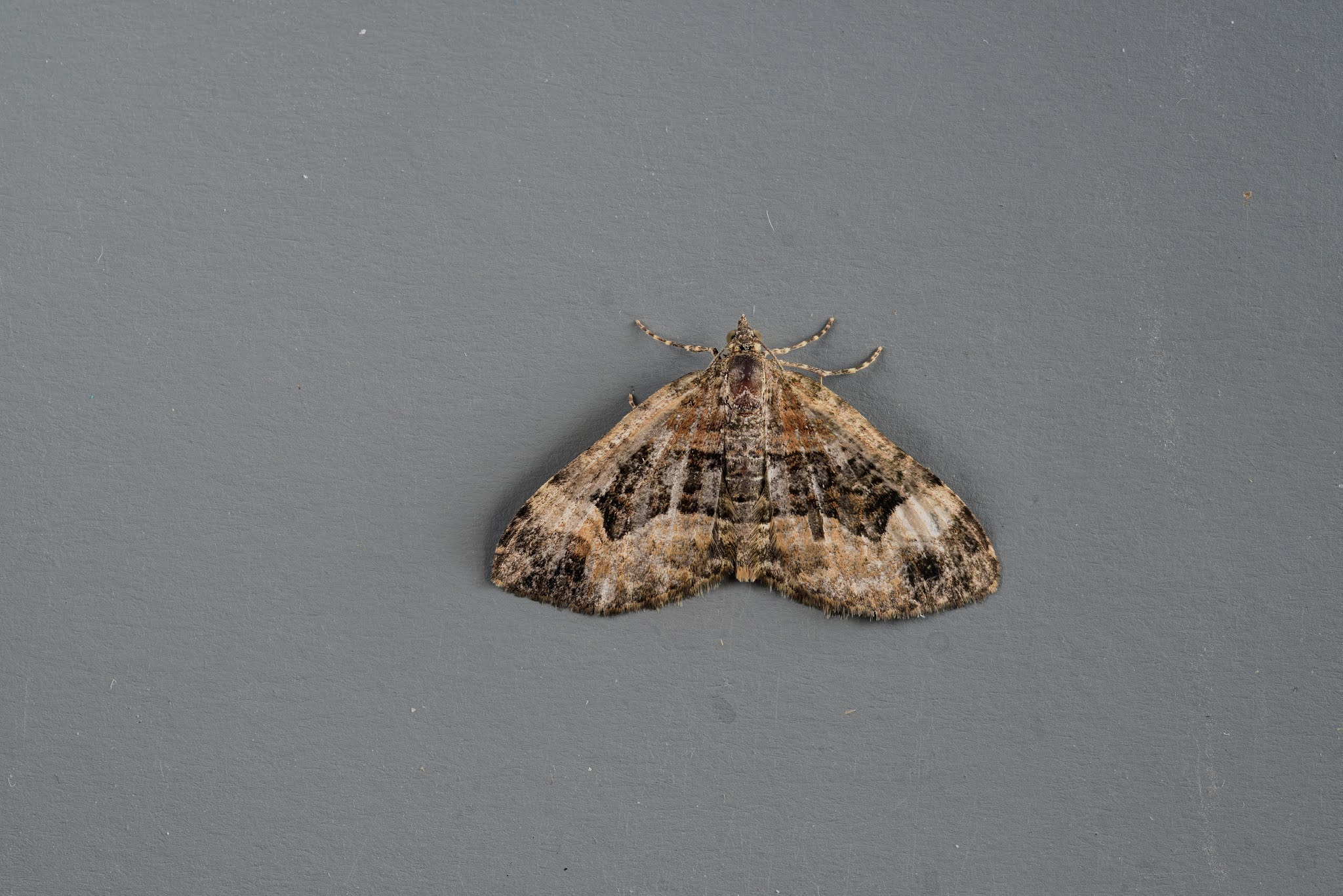
A long way from A1 condition, this, but the best I can do is Sharp-angled Carpet. It's ID doesn't exactly shout out, but I think I'm right. And, again, not one I've seen before. I wonder if this was an immigrant.
A trio of immaculate Pammene aurita brightened up the catch:

54 species last night and a few more still to identify.
Having had a good first year with Clearwing lures and caught all the species I felt I could reasonably expect I decided to have one last go with the HYL lure as it wasn't going to attract anything sitting in the freezer.
There was nothing in the trap last night at 7pm but much to my surprise this individual was there by 7:30 this morning.

Then in the MV trap there was this very large (19mm length) Dioryctria which looks to me more like sylvestrella than abietella. An expert opinion would be welcome.

Andy Newbold, Sibford Ferris, Oxon

This is probably a forlorn hope and many apologies for the awful pictures - as well as the moth choosing to rest on the black bowl, I was being heavily distracted by grandchildren. But this seemed an unfamiliar visitor. It flew off pretty promptly but my initial impression was of something large carpet-sized. Then I realised I was looking at it upside down, giving a misleadingly angular appearance, so it may have been a beauty of some kind. It looks to have a pale blotch at the bottom of each wing and a distinct black rim and you can see from the pic below that it has TV aerial antennae, so presumably male. If you can make anything of it, I'd be very grateful. Martin Wainwright, Thrupp, Oxon

Having tried several times for Yellow-legged Clearwing in oak woods locally, but with no success, I decided to try the lure in the garden again today. There are a couple of young oaks in the garden, but it was more in hope than expectation that I put the VES lure out at around 12:30. Nothing happened until 15:30 when I spotted something flying around the lure which conveniently popped into the trap and proved to be a male Yellow-legged Clearwing.
Unfortunately I only managed a poor photo of the underside of it in the trap, as it made a quick escape while I was attempting a better shot!
This is my fifth Clearwing species in the garden this year, the others being Lunar Hornet, Red-tipped, Red-belted and Orange-tailed.
Phil T

Another load of belated sightings from June and July thanks to my slowness with the backlog of photos and ID-ing!
On the 15th of June I returned to Chilswell Valley for another fairly quiet session dusking. Highlights were Epermenia falciformis in the fen, Pretty Chalk Carpet flying around Traveller's Joy, Aethes smeathmanniana and Coleophora trochilella (kindly dissected by Peter Hall).
On the 20th, inspired by my visit to Otmoor I went over to Wendlebury Meads in search of larvae on Dyer's Greenweed. It was getting a little late for most of the species on this plant, and the fact it was raining heavily and the plants were in flower rather obscured any spinnings making things a little tricky. I had quite a long search before I found a few larvae of Mirificarma lentiginosella on a particularly large and lush plant. I'd initially been searching the plants systematically heading out from the site entrance, many of which were rather runty with few leaves and flowers. After finding the first larvae I switched to focusing on the largest, lushest plants and was soon rewarded with more, finding a total of 9. I think the advice is to rear these out to confirm the ID (and they are currently pupae in my garage!), but pretty sure they'll be this species. Other highlight here was another specimen of the lovely Devil's Bit Scabious feeding Aethes piercei.
 |
| Mirificarma lentiginosella larva |
I returned to Otmoor on the 23rd, thanks to Nick Bowles, to have a look for larvae of Narrow-Bordered Bee Hawk after the sightings of adults and eggs a couple of weeks before. I only had a couple of hours and so didn't cover much of the site or the Devil's Bit Scabious, searching 23 plants. On these I found 30 larvae (2 in 3rd instar, 13 in 2nd instar and 15 in 1st instar) and 13 eggs. This seems to be an extremely high density for this species, which hopefully bodes well for the future of this new colony.
 |
| Narrow-Bordered Bee Hawk larva |
 |
| Narrow-Bordered Bee Hawk larva and eggs |
On the morning of the 16th of July I dug the LUN lure out the freezer and set it up in the orchard of Wytham Woods. By evening it had attracted one specimen of the rather scarce (but perhaps more under-recorded) tineid Triaxomasia caprimulgella, attracting several more as well as three Lunar Hornets over the next couple of days.
I also put the lure out at Sydlings Copse while trapping there on the 21st and managed to get 4 more caprimulgella between 20:00 and 22:00 (with none after when the lure was taken in at 01:00), which I think are the first Oxfordshire records. I put one LED trap on the heath, one under some large oaks near the site entrance, and two in the fen in the vain hope of Dentated Pug. There was still plenty of interest though, with a good selection of wetland species, including Phalonidia manniana, Dotted Fan Foot, Round-Winged Muslin, Lesser Cream Wave, Gelechia sororculella, Argyresthia pygmaella, Donacaula forficella, Limnaceia phragmitella and Hemp Agrimony Plume. Other interesting species were Parectopa ononidis, Haworth's Pug, Sorhagenia rhamniella, Argyresthia glaucinella, Schreckensteinia festaliella, Monochroa cytisella and Pediasia contaminella. Not sure how common the latter is in Oxfordshire, it was netted by the LED trap set on the sandy grassland on the heath, which seems like suitable breeding habitat.
 |
| Pediasia contaminella |
 |
| Triaxomasia caprimulgella |
A few days before, on the 17th I had a good visit to Aston Rowant, starting early afternoon to look for leafmines and day-fliers, before trapping on Linkey Down in the evening. Highlight of the day time session was definitely the mines of Parornix carpinella on the Hornbeams along the ridgeway. It's one I've been aiming to see for a little while, and I think it may also be new to Oxfordshire. Other mine interest was provided by Parornix fagivora on Beech (just the one mine, I've never found more than one or two at any given site) and Perritia obscurepunctella mines on Honeysuckle along Hill Lane. Sweeping on Beacon Hill was very productive, with Bucculatrix cristatella, Scythris picaepennis, 2 Nemophora minimella, and a single Trifurcula headleyella. The latter two are both the third records for Oxfordshire, following single records at Aston Rowant and elsewhere on the Chilterns in the last couple of years. As dusk drew in, I also saw Dusky Plume and Acompsia schmidtiellus flying around their respective foodplants.
 |
| Parornix carpinella mines |
In the evening, trapping produced c130 species, with highlights of Argyresthia dilectella, Coleophora lixella (5), Royal Mantle (2), Satyr Pug, Beautiful Carpet, Large Twin-Spot Carpet, Haworth's Pug, Elachista subocellea and another Pimpinel Pug after one here last year (a lovely fresh one that sadly escaped before photography!).
One the 25th I joined Doug Boyes for a session at Wytham Woods with a few traps around the chalet that proved quite productive. Alongside a few more Parectopa ononidis the definite highlight was a single Olive Crescent (Doug's pic here: https://twitter.com/diarsia/status/1419564085671337989) which seems to be the third VC22 record after a couple in 2017.
On the 26th Doug and I headed out again to trap at BBOWT's Warburg reserve on the Chilterns. With 9 traps mostly provided by Doug (a mixture of MVs, actinics and LEDs) there was lots of new stuff for both of us, even if the hoped for Campanula Pug didn't show. There's an old record from the site and we set a couple of MVs next to a fairly decent patch of Nettle-Leaved Bellflower, but it was always a long shot. Out of 220+ species, highlights were Waved Black, White Satin, Acompsia schmidtiellus, Lunar-Spotted Pinion, Maple Pug, Pretty Chalk Carpet, Triple-Spotted Pug, Mocha (plentiful!), Sorhagenia rhamniella, Caloptilia cuculipennella, Large Twin-Spot Carpet, Psoricoptera gibbosella, Haworth's Pug, Lunar-Spotted Pinion, Pine Hawk, Small Purple-Barred, Royal Mantle, Dark Umber, Bucculatrix frangutella, Parachronistis albiceps and Carpatolechia alburnella.
Big thanks as always to Peter Hall who confirmed a number of the trickier species mentioned here by dissection.
After running the VES lure several times and getting large numbers Orange-tailed Clearwings I decided to put the lure away for a few weeks. I thought I'd give it a go today as I was interested in seeing if I could get any of the micro moths listed as by catch. But then I got my Yellow-Legged Clearwing! So this is now the fourth species to lures this year, Red-belted, Currant, Orange-tailed and Yellow-leggesd. I still have Raspberry and Six-belted but I am not expecting them to get the target species in my garden but I will give them a couple more goes.


Mark Griffiths, Garsington, Oxford.
Hi there,
I know this is not a common species, but I'm not sure how unusual it is round here. It came to light in an edge-of-woodland garden on Saturday night.

Best wishes
David
 |
| Scarce Footman, Westcott 1st August |
Caught a single Mecyna flavalis in the Robinson trap in Sonning last night. I gather it is fairly rare but found in Berkshire. Is it on the increase?


The increase in numbers, especially of various Footman!, was noticeable as others have said as the month drew to a close although a family holiday meant I missed the hot weather here. Straw Underwings and Dusky Sallow felt very autumnal!
Looking through recent posts I have attached a couple of similar photographs from Saturday's catch. The first would appear to be a candidate for Y Rorrella , which would be new for the garden. The second is a plume - which looks like the recent picture posted by Nigel from nearby Loosley Row of Dingy White Plume - however it was quite creamy-yellow and not at all dingy! Thoughts welcome.


Is this a rather worn White-spotted Pug? Wing span 22mm.

Secondly following recent posts I wondered if these could be Yponomeuta rorella. They did seem to have white along the costa but I am far from sure.


Finally could this be a slightly worn Acrobasis repandana? Length 13mm.

Andy Newbold, Sibford Ferris, Oxon.
 |
| Bryotropha domestica, Westcott 30th July |
 |
| Likely Depressaria ultimella, Westcott 30th July |
 |
| Ghost Moth female, Westcott 31st July |
 |
| Rosy Rustic, Westcott 30th July |
 |
| Copper Underwing, Westcott 29th July |
 |
| Copper Underwing, Westcott 29th July |
I have built up a little list of queries and would be very grateful for help. I like to have a stab at micros which I cannot really match with pictures in books or on websites, but I am usually wrong. Much appreciate all assistance. Martin Wainwright, Thrupp, Oxon
 |
| Hedya salicella? |
 |
| Cydia servillana? |
 |
| Apotomis turbidana? |
 |
| I fear too worn to be ID-ed |
 |
| Can you have a Snout without a Snout? |
This micro was in the trap this morning. My best guess is Blastobasis lacticolella - is this right?
David

 |
This is the possible Y. rorella from 27th July. This may or may not be the same individual, as per my original post, there were two. This is the one that got potted and died a few hours later.

Mark Griffiths, Garsington, Oxford.
Hi
In amongst all the willow beauties that settled on the garage wall next to the trap was a Tissue new for the garden and also a wave that was smaller than all the riband waves,is it just a small riband wave or maybe a small fan footed wave,help appreciated.


