Thursday, 6 August 2020

Micro help please

I think my first two are both Cochylis molliculana and the next one is Mompha subbistrigella.

The third is Agriphila tristella and I've put it up as it is the first one I have had this year! Where have they all gone?

Mark Griffiths, Garsington, Oxford.


id Help please ?acrobasis and ?wave

I'd be grateful for id help please - ?acrobasis type 1st two same moth may be too worn for id; is 3rd photo acrobasis consociella?  The wave is one I thought I should be able to identify but it doesn't quite fit with possibilities I've explored - I'm sure will be obvious to readers of this blog ... Thank you for sharing your expertise.


Pug help required

I am struggling with these pugs:

Floundering

Hi everyone and thanks in advance for help in sorting me out over these. I gaily went for Straw Underwings but a friend on my own blog suggests that they include Flounced Rustics and Dave's timely post here yesterday suggests that he is right.  Indeed, I am sure that one on my granddaughter's finger is and FL and I suspect the ones top left and bottom right in the composite pic. Sorry!  I have looked at them until brown whorls and black dashes spin before my eyes and I remember this happening last year. What I really want is a Silver-striped Hawk moth.  PS Has anyone else found that the new Blogger is giving them the biggest picture size by default? Doesn't take long to adjust, but slightly annoying. Martin Wainwright, Thrupp


Wednesday, 5 August 2020

Westcott, Bucks

Nightly catches in the garden here have continued to be unimpressive although a small number of moths amongst those new to the year-list have managed to lift the mood of doom and gloom - the Silver-striped Hawk-moth in particular!  This year's species total has now clawed its way up to exactly 500 which is just over 100 behind the number achieved by 4th August 2019.  The week's newcomers are listed below:

(29th)  Phyllocnistis saligna, Acleris kochiella
(30th)  Phyllonorycter schreberella, Agriphila selasella, Dioryctria abietella, Silver-striped Hawk-moth,
            Ear Moth (awaiting dissection)
(31st)  Yponomeuta plumbella, Epiblema costipunctana, Oak Processionary, Flounced Rustic
(1st)     Small Ranunculus
(2nd)   Agonopterix subpropinquella, Pandemis corylana, Jersey Tiger, Cabbage Moth, Six-striped Rustic
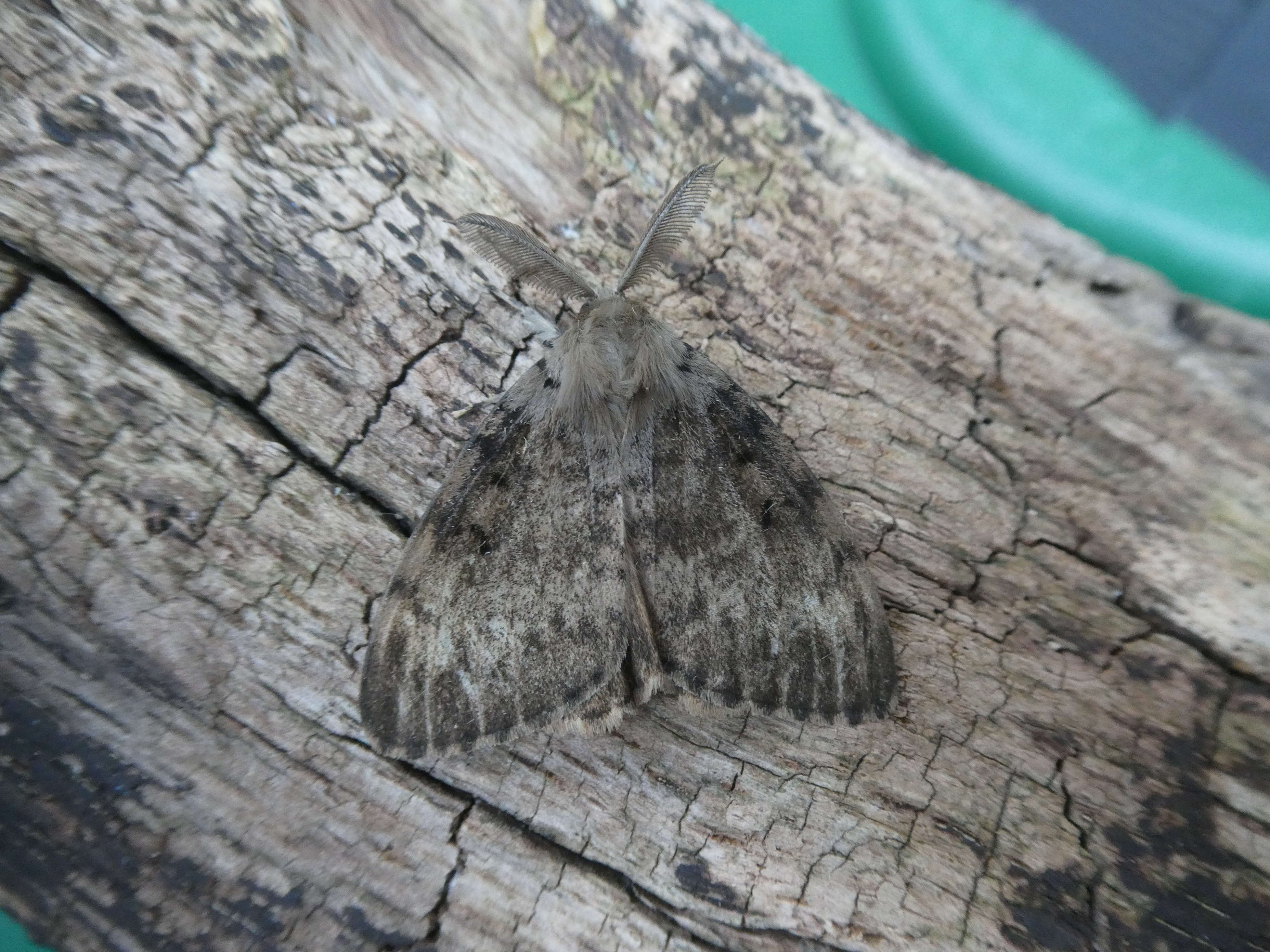
(3rd)    Orange Swift, Gypsy Moth
(4th)    Cydia splendana

Gypsy Moth, Westcott 3rd August

Jersey Tiger, Westcott 2nd August

Small Ranunculus, Westcott 1st August

The Small Ranunculus was one of the best of this week's bunch, its only previous visit here being nine years ago.  More of an urban dweller, its appearance gives me hope that I might one day get Toadflax Brocade which also seems to prefer that kind of habitat.  It was the third year in a row here for Oak Processionary and Jersey Tiger, both of which must be fairly well established locally now.  Gypsy Moth first appeared here in 2005 and the reaction to its appearance at that time was rather different to what we've grown used to now.  Then it had to be reported as an invasive species and "The Man from D.E.F.R.A." (looking nothing like David McCallum or Robert Vaughn) duly came round to our house to collect it.  It was dissected in a Government laboratory somewhere and they confirmed ... that it was a male Gypsy Moth (could have told them that!).  Nowadays they've given up worrying about it, having diverted their attention to Oak Processionary with which they seem to be having the same amount of bad luck in controlling.  

Unusual amongst last night's catch was a Small Elephant Hawk-moth in good condition, my last sighting anywhere this year having been on 4th July.  This is the fourth occasion that I've had an August record for the species (the others were 21st & 24th August 2010 and 21st August in 2017, each after a similar gap of several weeks), suggesting the possibility of a second brood.  It is bivoltine in mainland Europe.

Small Elephant Hawk-moth, Westcott 4th August

Flounced Rustic is the new "confusion species" on the block for August.  It is very variable in ground colour and some forms can look superficially similar to Common Rustic.  However, Flounced Rustic has a straighter leading edge to the forewing and lacks any white scales around the kidney mark.  The main clue is usually the obvious black dumb-bell shaped bar in the centre of the wing, connecting the inner and outer cross-lines.  It varies in intensity and is quite weak in the one shown below (...and just to be awkward can sometimes be absent altogether!).

Flounced Rustic, Westcott 31st July
Dave Wilton
Westcott, Bucks

Acrobasis suavella


Think this is A. suavella, although rather worn, A. advenella would show more reddish around the head?

Monday, 3 August 2020

Oak Eggar assembling

On Saturday afternoon Ched George took a couple of captive-reared Oak Eggar females on a quick tour of western Bucks and had success in luring males of the species at Hell Coppice in Bernwood Forest, at Arncott (Bucks) and at Piddington (Oxon).  One of the females was then allowed to pair up and he dropped the other one off with me.

On Sunday I took her to a couple of local sites in the Dorton area over lunchtime and she then spent the afternoon in our garden, all without success.  I've had Oak Eggar females in the garden trap so they are around locally but the wind was in the wrong direction - all the good habitat for them is to the west of us.  Today she came with me to Finemere Wood for a butterfly transect and then to Marsh Gibbon for a RIS trap pick-up but I had no joy again at either spot.  I decided to go to Arncott where Ched had had success, just to make sure she was still "calling", and sure enough a male appeared within ten minutes.  I moved off quickly to Brill Common where a male appeared within five minutes, then to the church at Wotton Underwood where the response was even quicker with a male in under two minutes.  This one was allowed to pair up with the female.

So for very little effort we've got some extra records for a species which is quite widespread in the local countryside but simply isn't recorded that often.  Just like the Emperor Moth, Oak Eggar males only fly in the daytime and are rarely seen, although the females do come to light.  However, whereas Emperor larvae are easy to rear and over-winter in the pupal stage, Oak Eggars over-winter as part-grown caterpillars and I've never had success in seeing them through to the following year.  Well done to Ched for managing to do it successfully! 

Oak Eggar female, captive-bred

Oak Eggar male from Wotton Underwood, Bucks 3rd August

Oak Eggar male from Wotton Underwood, Bucks 3rd August

Dave Wilton
Westcott, Bucks  

Hook Norton reserve moths

Last Friday we ran a couple of portable traps at the Hook Norton Railway Cutting BBOWT reserve.

A few of the more interesting moths included a female Gold Swift, Dichrorampha alpinana (to be dissected), Agonopterix liturosa and possibly Acrobasis suavella ??.


Female Gold Swift


Agonopterix liturosa


Acrobasis suavella?


Agonopterix liturosa (side view - interesting hair style)

Andy Newbold, Sibford Ferris, Oxon.

Sunday, 2 August 2020

Micros in Merton

I trapped these on Friday night in my garden in Merton. Would appreciate some confirmation or correction of IDs!
Cochylis molliculana (as posted a few days ago?)

I think this is Monopis weaverella

Notocelia roborana?

Yponomeuta padella? I think it may not be possible to separate this from other similar species by photograph?

Possible Phyllonorycter?

I had a reasonably good catch on Friday night in Wolvercote, Oxfordshire, in the high temperatures we had then; and one individual that's been baffling me since then - a very small micro, which looks like a Phyllonorycter of some sort, but if that's what it is, its markings are rather unusual. Any suggestions as to what it is would be very welcome!

Possible Phyllonorycter sp., 31/7/20
Steve Goddard

Three queries /validations

I have the first two as Bryotropha affinis and senectella? but the third, in not to good a shape, eludes me. Any help welcome. Thank you


Steve Lockey (Garsington)


Palpita vitrealis

No exotic hawk-moths have turned up in my garden so far, but on the night of Friday 31st July I did find this Palpita vitrealis in my trap.

Palpita vitrealis - Cookham 31-Jul-20
I have only recorded this moth once before, in October 2013.
Steve Trigg, Cookham

Olive Crescent in Bucks

Simon Buckingham has kindly allowed me to post this information. During the 1960s & 70s Bucks was well known for a colony of this very rare moth. It seemed to have disappeared after the long hot and dry summer of 1976. It is established in some southern coastal counties, but is also a migrant and I suspect this is the case with Simon's record from Hedgerley, south Bucks on 31st July 2020. There was another presumed migrant in S Bucks in 2017.

Saturday, 1 August 2020

Grangelands, Bucks

The Grangelands SSSI at Cadsden, Bucks received another moth survey visit last night from Martin Albertini and myself.  Although the temperature dropped rather more quickly than the forecast suggested it might, it was still a good night and we probably saw in excess of 200 species between us.  After having been reminded by Peter Hall that Argyresthia species need females to stand any chance of success with dissection, I took along an actinic trap which was placed in amongst the best area of Junipers and got another small batch of them to be checked (any of which could be new to the site).  Perhaps the most interesting moth of the night, though, was Moitrelia obductella which is likely to be a first for VC24.

Moitrelia obductella, Grangelands 31st July
Dave Wilton
Westcott, Bucks    

Cochylis molliculana .....

..... I think?


At light in North Leigh, Witney last night. 

Gypsy Moth and a few other less usual suspects

Caught my first ever Gypsy Moth, Dark Spinach and Maple Pug in the MV trap at Ali's Pond in Sonning in the last couple of nights, along with my first records for many years of Bulrush Wainscot and Yellow-tail.

Gypsy Moth

Dark Spinach

Bulrush Wainscot

Yellow-tail

Maple Pug 

Juniper Pug?

This came to our house lights last night and, although slightly worn, I fairly certain it's a Juniper Pug. Confirmation/correction would be appreciated.

Thanks,
Nigel

Help with a couple of Carpets

A great night for me last night with 66 different macro species. Among them were these two carpets. I can't get away from thinking that the first is a Cloaked Carpet, but it seems pretty unlikely and the second a Chalk Carpet. Many thanks in advance.
Lorna Woolhouse, Checkendon, South Oxon

Waved Black?


Help required with this one please.  Waved Black?  A beautiful Jersey Tiger also this morning.


Steve Lockey (Garsington)