Thursday, 27 January 2022

Westcott, Bucks

It is turning out to be a very typical January so far as the garden here is concerned.  The three further macro species anticipated in my last post (15th) have all now turned up, with Pale Brindled Beauty and Spring Usher putting in an appearance together on the 22nd and Early Moth following on the 24th.

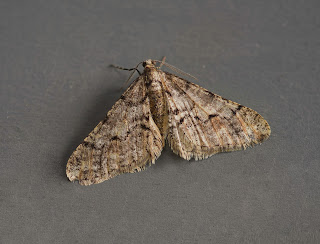
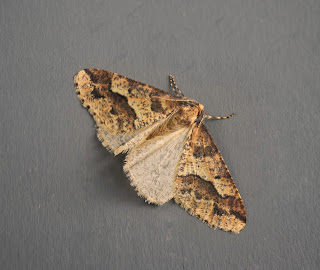
Pale Brindled Beauty & Spring Usher, Westcott 22nd January

Early Moth, Westcott 24th January

Two more micros have also come to the actinic light, with Agonopterix heracliana tempted out of hibernation on the 23rd and my first Tortricodes alternella of the season arriving on the 26th.

Agonopterix heracliana, Westcott 23rd January

Tortricodes alternella, Westcott 26th January

Despite 300+ garden records of Agonopterix heracliana, including regular dissections, I've never had the rather similar confusion species Agonopterix ciliella here and it seems to be quite rare in Bucks.  The moth illustrated above lacked any hint of pink scales on its underside (a feature of ciliella) and was in any case too small.

Dave Wilton Westcott, Bucks

? Early March moth . . . .


 . . . .unless I'm very much mistaken. Herts/Bucks border last night. Is this a record?

Best wishes

David

Tuesday, 25 January 2022

Berkshire moth season 2022

If you want to track what's being recorded in Berkshire during the current year you can do so via the activity page for 2022 on iRecord. We're up to ten species already!: Winter Moth, Spring Usher, Mottled Umber, Brindled Pug, Common Quaker, Satellite, Ruddy Streak (Tachystola acroxantha), Chestnut, Pale Brindled Beauty and Dotted Border.

The total for 2021 on iRecord currently stands at 1,019 species, although there are still records to add, and checking remains to be done. But an impressive total in any case, and thanks to all who have sent in their records (the non-iRecord records will be caught up with when possible!).


Monday, 24 January 2022

More summer queries

Hi again!

A few more queries - this time from August 1st last year. I think the first two are Lunar-spotted Pinion, but would like confirmation that one of the other Pinions hasn't sneaked into my trap.

The third one I have no idea about - unless it's a very weird July Highflyer?

And is the last one Ear Moth?

Thanks in advance - guidance much appreciated!

David


Sunday, 23 January 2022

Memories of summer!

 Hi,

Having had precisely nada in last night's trap, I've been going through some queries from last August (16th).

Can someone please confirm these? I think they are

1. Yellow-barred Brindle

2. Red Twin-spot Carpet (or could it be dark-barred???

3. July Highflyer (although nothing like the options in the book!)

Many thanks and best wishes, David


Saturday, 22 January 2022

First garden moth for 2022

My first moth of the year arrived last night in the garden trap, and it was... a Common Quaker.
My previous earliest record for a Common Quaker was 19th February. At this rate, we will be recording summer moths in March. Steve Trigg, Cookham

Monday, 17 January 2022

Spring Usher

Only two moths last night, a Chestnut and this Spring Usher, which was new for the garden, and for me.


Saturday, 15 January 2022

Westcott, Bucks

Things are still very quiet here, but that's always the case in January.  In the fortnight since the 1st of the month there has been a grand total of nine moths attracted to the garden actinic light from only five different species:  Acleris schalleriana, Acleris hastiana, Mottled Umber (4), Chestnut & Dark Chestnut (2).  Going on past experience I'm unlikely to see Winter Moth now until the autumn, but I would hope to get Pale Brindled Beauty, Spring Usher and Early Moth before the end of January and maybe one or two more over-wintering micros if the weather turns warm enough to tempt them out, although the forecast doesn't look too promising for the next couple of weeks.   

Acleris hastiana, Westcott 10th January

I have added one or two other species as earlier stages, including Stigmella aurella (active mines on bramble), Phyllonorycter leucographella (active mines on pyracantha) and Angle Shades (a fully grown larva).  Finding Angle Shades caterpillars walking across the lawn towards the light in January or February seems to be almost an annual occurrence here.
 
Mine of Phyllonorycter leucographella, Westcott 7th January
 (active striped larva visible at lower end of mine).

Caterpillar of Angle Shades, Westcott 7th January

Dave Wilton Westcott, Bucks

Thursday, 13 January 2022

Getting started for 2022.

 The last mild night, which unfortunately turned drizzly, I put a light out in the back garden. (Spurred on by Martin Albertini to try for Black-spotted Chestnut). No such luck, as yet, but three moths did appear, all in decent condition:

Acleris schalleriana, Spring Usher and Mottled Umber.


The Acleris escaped. 

Sunday, 9 January 2022

Latest moth report for Maidenhead, from Les Finch and Martin Finch

Les and Martin have produced the latest of their annual reports for their home tetrad in Maidenhead. This includes lots of intriguing data and comments on how 2021 compares with other years, links between weather conditions and number of moths seen, and information on particular species of interest. A fascinating read, available from the Berkshire Moth Group website.


Saturday, 8 January 2022

Black-spotted Chestnut

For now at least, Robin Knill-Jones continues to be the only known recorder in our area getting Black-spotted Chestnut Conistra rubiginosa, a situation that must surely change sometime soon!  So far this winter his garden trap in Denham, Bucks has produced the moth on 19th November (1), 22nd November (2), 23rd November (1), 12th December (2) & 29th December (1), then for this year one sometime between 31st December and 4th January and another two - the only moths caught - sometime between 4th and 8th January.  They seem quite happy to fly on really cold nights.  Many of them were marked before release and to date none has re-appeared which is encouraging.

Black-spotted Chestnut, Denham


2021 figures for a Newton Longville garden. Part 3: lights

During 2020, I ran an experiment to compare the effectiveness of an actinic light against my own design of LED light.  I posted several times about this in 2020, with the end-of-year results here.  My conclusion was that LEDs could be at least as effective as actinic lights, probably better.  I have continued this comparison during 2021, always running the two lights on the same night as each other, in different parts of the garden, but swapping over the lights between the two positions on successive trapping nights.  There is a plot twist, but I'll start with a straight comparison of the 2021 results for each light against the 2020 figures in my garden at home.

The presentation of the data is different from last year: there was rather less trapping in the peak summer season of 2021, so instead of gross totals of species and moths, I have converted these to average numbers of species and moths per night.  I have also broken the data into a number of different seasons.  The dates were carefully selected: the second period starts when I changed the actinic light in 2021 (see below); the third period starts when (at last) in 2021 the cold spring ended and the number of species caught in a night rose above 20; the third period ended on my return from France (in both years), which coincides with the reversion of the actinic light to its original type; and the fourth period finishes with the end of meteorological autumn.

Comparison of results in my Newton Longville garden 2020/2021

As I observed in my first post reviewing 2021, numbers were down in the spring of 2021 (second period in the table): the cold weather led to fewer moths of fewer species.  However, the actinic light seems to have been slightly less affected than the LED.

For the first, fourth and fifth periods, the performance of both types of lights in 2021 was similar to what it had been in 2020. However, there is something striking in the summer period (with the paler background in the table).  The LED figures are not markedly different between 2020 and 2021: it's the actinic figures (orange text) that are very much better in 2021 than they were in 2020.  On average, in the summer of 2021 the actinic light caught each night 28% more moths of 65% more species than in 2020, and out-performed the LED light by a smallish margin.

I mentioned that period 2 began when I changed the actinic light and period 3 ended when I reverted to the previous version.  In mid-March, the actinic strip light was broken in high winds.  Acting on advice received the previous summer from mothing friends in France, I replaced it with the Synergetic variety.  A Synergetic light is essentially the same as a normal blue-white actinic - in fact it is identical in physical dimensions and electrically - but the phosphor coating of the tube includes an additional green element.  There is evidence (references to papers on request) that at least some moth species have eyes that are sensitive to green wavelengths as well as to UV and blue (and sometimes red).  As far as I know, Synergetic lights only come as straight tubes and not as compact bulbs: this is because their principal use is in insect-zappers in restaurants and similar locations.

I continued using the Synergetic light from mid-March 2021 until I took it to my in-laws house in France in July.  After using it there, I intentionally left it there and reverted to a normal blue-white actinic when I got back to Newton Longville, which I continued to use until the end of 2021.

The Synergetic seems to have been very much better in the third (summer) period of 2021 compared to the actinic in 2020, but this effect isn't clear in the second (spring) period when the weather was the predominant effect.

In both 2020 and 2021, I also trapped at the house in France: using the blue-white actinic in 200 and the Synergetic in 2021.  Here is a comparison of the results there.  Although I had also used an LED light in France in 2020, I did not use it in 2021, so I have omitted the figures for that.
Comparison of results in France

The French data should be treated with caution as I only ran the traps on very few occasions, so there may be a notable effect of random variation.  Nevertheless, I think I can confidently say that Synergetic lights are very substantially more effective at attracting moths than the normal types of actinics.  I will be using a Synergetic for 2022.

I haven't yet run an analysis to see if the advantages of the Synergetic compared to the actinic are concentrated on specific moth families: if I find anything significant there, I will write another post on this blog.


Tim Arnold
Newton Longville, Bucks

Wednesday, 5 January 2022

Sibford 2021

Despite trapping for 22 more nights than in 2020 both numbers of moths and species were down. Although I recorded some noteworthy macros these were mostly second or third garden records and there were only, a disappointing, 3 species new to the garden to light. Micros were much better with at least 26 new ones to light with hopefully a few more to add once dissections have been completed.

As others have noted many of the common moths showed the biggest decrease in numbers.

Using pheromone lures for the first time far exceeded expectations with 7 clearwing species in the garden with Raspberry Clearwing being the most notable. In addition the FUN lure brought in 7 species including new for the garden Grapholita tenebrosana, Pammene giganteana, P. suspectana and P. aurana.


Andy Newbold, Sibford Ferris, Oxon.

Tuesday, 4 January 2022

Monopis hindwing

 Following on from my post of January 1st I now have an image on the hindwing of the Monopis.

I don't know whether this is clear enough to help further with its identification or whether it need to be kept for the next batch for Peter to dissect.


Andy Newbold, Sibford Ferris, Oxon.

2021 figures for a Newton Longville garden. Part 2: species

In this post, I'll comment on changes to individual species recorded in my garden in 2021 compared to 2020: I haven't been trapping for long enough to make an extended comparison.  With one exception, I am ignoring species that appear on few occasions or in small numbers: their fluctuations are unlikely to be significant.

If I don't apply this "significance" threshold, then random variations become very distracting: for example, a total of 79 species appeared in 2021 that I hadn't found in 2020, but 96 of 2020's species weren't found in 2021.  Those 79 species only represent 176 individuals, or fewer than 5% of the total catch for the year.

One of the species that I found on multiple occasions in 2021 having been completely absent in 2020 was Small Square-spot.  Common Rustic/Lesser Common Rustic is supposed to be very common, so I will make an exception to my "significance" threshold and report that having had just a handful in 2019 and none in 2020, I managed three individuals in 2021.  It is surprisingly uncommon in my neck of the woods; my reduced frequency of trapping in June-August is probably only a part of the reason.

In the opposite sense, species that were absent in 2021 having been significantly present in 2020 include Clepsis consimilana, Hedya pruniana, Sallow, Brown-line Bright-eye and Scarce Footman.


Setaceous Hebrew Character had the biggest increase in absolute numbers (from 90 to 254); Lunar Underwing, Chrysoteuchia culmella and Heart & Dart went in the opposite direction (respectively 847 to 318, 608 to 129 and 447 to 69).

In percentage increase terms, Green Carpet, Garden Carpet and Riband Wave had a good year in 2021.  On the other hand, Shuttle-shaped Dart, Large Nutmeg and Brown-spot Pinion were amongst 19 species that had a decline of more than 50%.  In addition to Chrysoteuchia culmella mentioned above, other grass moths also fared badly - probably due not only to less trapping when they were flying in 2021, but also to a very local factor.  There were changes in the timing of the grazing of the next-door field: unlike the previous year, it was very short during late summer and autumn 2020 when 2021's adults would have been larvae.

In moving on to flight periods, I should emphasise that I only trap once or twice a week, so some timing changes can just be down to different dates when I had the traps out as well as to random chance.  However, I do see one change where I would have expected one:

The cooler and wetter spring of 2021 seemed to result in many spring-flying moths first appearing in my traps about three to five weeks later than in the good weather of 2020.  For example, Heart and Dart was 26 days later in 2021 and Poplar Grey was 20 days later.

A number of Orthosia species hung around later in 2021: Small Quaker, Clouded Drab, Powdered Quaker and Hebrew Character carried on flying for another 10 to 20 days, generally well into May 2021 although in 2020 they had mostly disappeared by the third week of April.  Common Quaker, though, actually disappeared 10 days earlier in 2021.

Dates for autumn-flying moths showed no large or consistent differences between 2020 and 2021.

A total of 65 species (25 macro and 40 micro) joined the garden list in 2021 - my third full, proper year of mothing.  The garden (& house) list now stands at 246 macros and 173 micros.

Apart from Nemapogon granella - which is a story on its own - I recorded no unusual or scarce species in VC24: even Clifden Nonpareil eluded me.  So - not counting a nice record in France - I am contenting myself with a surprise last evening when the VC66 CMR told me that my photographically-supported record of a Coronet on an otherwise very poor night in late June was only the fourth record for County Durham.

Tim Arnold
Newton Longville, Bucks


Sunday, 2 January 2022

Stigmella carpinella

 Catching up with unidentified specimens from the past year this week I was given an unexpected surprise: 


Upon dissection this turned out to be Stigmella carpinella. Since my garden has loads of the larval foodplant in it (Hornbeam) the surprise was that I had not seen it before. 

However, it seems not many people have. I believe it has been identified in Bucks before, but I'm not too sure how many times. In the south-east of Bucks, I am 150 metres from Hertfordshire, where it has been registered once (an hour away in the far east) and several websites have it down as a proposed red data book species. 

Well well. 

Acleris notana/ferrugana


 Just looking for confirmation?? Thanks, David

Not the best of starts

Having managed to go through December without a single blank it was rather disappointing not to get anything at all to the actinic light at Westcott overnight on 1st January, especially considering that it remained so mild.  So, just to get me off the mark in the garden for this year, before the rain came this afternoon I spent five minutes outside looking at bramble leaves and, sure enough, found four active mines of Stigmella aurella straight away.  The larvae can be found feeding throughout the winter months and at this time of year there is no possible confusion with Stigmella splendidissimella.  

Mine of Stigmella aurella on bramble, Westcott 2nd January

I did get to see some adult moths on 1st January, though, because I decided to take a single MV trap to nearby Finemere Wood and ran it there for the usual three hours.  Only six species put in an appearance, comprising Acleris ferrugana/notana, Winter Moth, Mottled Umber, Spring Usher, Early Moth and Satellite.  It will get better...!

Early Moth, Finemere Wood 1st January

Dave Wilton Westcott, Bucks  

Saturday, 1 January 2022

Black-spotted Chestnut in Herts

 I see that Black-spotted Chestnut was recorded in Herts yesterday (per iSpot), and confirmed by Colin Plant, so fingers crossed for a mega start to the UTB year!

2021 figures for a Newton Longville garden. Part 1: totals

I delayed finalising the analysis of my 2021 records until the very end of the year: the mild weather allowed me to run the traps on both 29th and 31st December.  Those two nights yielded a grand total of four moths: a late Scrobipalpa costella was the only Lepidopteran point of interest, but two diving beetles (Colymbetes fuscus) last night were the first I have seen here.

During 2020, I ran an experiment to compare the effectiveness of an actinic light against my own design of LED light.  I posted several times about this, summarising the year here.  I continued this comparison during 2021, but I will discuss that analysis in a couple of posts over the coming days.

In all of my analysis, it is important not to read too much into it: these are figures for moths caught in just one garden, comparing just two years.  There is a lot of chance involved as well as other factors such as weather.

Here is a comparison of the total 2021 records for my garden and a comparison with those for 2020. These figures include moths found in association with the moth traps as well as moths and larvae found elsewhere in the garden or indoors.  Commentary on individual species will be in another post.


The keen-eyed may spot that the 2020 figures presented above are slightly different from those that I originally published a year ago, mainly because I'm including non-trapped moths.  I have spent part of the Christmas break automating the annual analysis job, so it only took me 5 minutes to re-state the 2020 figures on a comparable basis to 2021.

Numbers were down in 2021: many fewer moths of slightly fewer species.  There were two main factors behind this.

One real-world factor was the poor spring in 2021 compared to the fine, sunny spring during lockdown in 2020.  On the nights on which I ran the traps (which is hardly a random sample: I select nights of better weather), it was 4½ °C colder in April 2021 than a year before, and 1½ °C cooler in May.  Met Office data for whole months at Cambridge shows somewhat smaller temperature differences than this, but it also shows just 3 days of frost in 2020 compared to 14 in 2021.  This was probably why in these two months of 2021 the traps caught just one quarter of the number of moths per night compared to what they had achieved in 2020, and between a third and a half of the number of species.

The second and larger cause of difference was a reduced amount of trapping effort in the peak June/July/August period.  A very rough calculation indicates that the effect of this on the total number of moths for the year is perhaps twice as big as the effect of the spring weather.  In normal years I am away a lot in spring and summer; the last two years have not been normal, but I was away rather more in June and July 2021 than in the same period in 2020.  Consequently, I only ran the traps at home seven times during June-August 2021 compared to thirteen times in the same months of 2020.

Complicating the analysis is the fact that there was a difference in lights between the two years which only applied between April and July and which seems to have made the 2021 figures better than they would otherwise have been.  I am still trying to separate the effect of this factor ("Synergetic" versus normal actinic lights), which will make for another post later.

Tim Arnold
Newton Longville, Bucks

Query from last trap of 2021!

 Happy New Year  Thank you for helping me out with id throughout 2021 and for so many interesting blogs about moths in our area.
The mild last night of the year brought 4 moths to my trap including one that I'm struggling to identify. So once again I'm asking for id help please for this moth with very even colouring.


Many thanks once again.

Last moth of 2021

 Just a solitary moth on the outside of the trap this morning.

I think it is probably Monopis obviella (8.5mm in length) although I have not checked the hindwings.

If so it would be a new garden record and a nice way to end the year as long as I keep quiet about it being a "clothes moth"!


Andy Newbold, Sibford Ferris, Oxon.

Thursday, 30 December 2021

Those Damn Chestnuts - and a micro!

Hi there, Firstly - Happy New Year to all those who have helped me improve my meagre knowledge in 2021! Here is a Chestnut (a nicely marked one!) and - I think - a Dark Chestnut. I'm looking at wing shape, the dark colour and the 'sheen', particularly visible on the left forewing. I'm also seeing a row of white dots on the costa, ending near the wing tip. These are visible in the Waring and Townsend illustrations for Dark Chestnut, but not for Chestnut. Are they significant - even diagnostic? On the other hand, am I completely wrong and it's just a very dark Chestnut!
The micro, I think, is Acleris schalleriana - but as always, I would appreciate confirmation.

Very best wishes
David


Tuesday, 28 December 2021

 A propos of the previous post.: Intermediate stage Buff Ermine larvae:


Monday, 27 December 2021

Tidying up 2021 records

Since I returned in late August from a month in France, other commitments have taken up more time than I planned.  One of the consequences is that although most of the moth photographs from August onwards had been labelled, there were a few more difficult ones that hadn't; nor had I looked again at some of the provisional identifications, and none of my records had been transferred from the notebook into my database.  Hence I've been spending quieter moments in the Christmas period going through the last five months of records (including most of the French records that I hadn't checked).  There have been a few interesting memory-joggers in there, and a few puzzles.

The only puzzle whose solution still eludes me is a caterpillar found on the outside of the moth-trap on the night of 28th-29th August which was the first time I ran it after getting back from France.  There appears to be nothing in the Henwood/Sterling/Lewington guide that matches the dark dorsal stripe, the yellowish edging and the green overall colour, with the long black hairs and the somewhat shorter whitish hairs.  Perhaps it's not a final instar.

Newton Longville 28th August 2021

Can anyone identify it?  The overall length was slightly below 20 mm.

With this single exception, I am now up to date for 2021, but I will delay running my yearly analysis: the weather forecast for the end of this week looks promising, so I will probably run the traps on Thursday night (and/or Friday) and hope to augment the figures ever so slightly.

Tim Arnold
Newton Longville, Bucks

A nice December Record from North Bucks


It was a nice surprise to find this unseasonal Angle Shades in the trap this morning - the day after I discovered a fully active adult frog whilst clearing out the still-growing Fools Watercress from my garden stream. What a strange end to the year!

Stowe garden moths 2021

This year I trapped in the garden with a mix of 20W actinic and 125W MV on 162 nights, whereas for most of last year I used just a 6W actinic, trapping on 140 nights, so year on year comparisons are probably a bit questionable.

Nevertheless, it does seem that Setaceous Hebrew Character had a better year with a count of 454 vs. 36 in 2020; similarly Common Wainscot at 649, was around nine times higher than last year, and was also the most numerous species. These two species were also the most frequently recorded, (i.e. occurred on the most trap-nights). On the other hand, despite the overall total catch being 2.5 times higher, both Lunar Underwing and Common Footman numbers were lower than in 2020, presumably reflecting a genuine decrease. Most numerous micro, as last year, was Chrysoteuchia culmella.

The best night for species diversity was 19th July, with 89 species—the same night as reported by both Dave W and Peter A. The highest number caught was 443 moths of 39 species on 7th Sept, with Common Wainscot the highest individual count.

As this was only my second year of mothing I added a lot of new species to the garden list—151 in total, (67 macros, 84 micros), most of which I managed to ID correctly(!), but thanks to Dave for putting me right on numerous occasions and to Peter Hall for ID'ing the species which needed dissection. 

Perhaps most notable among the micros was Platyedra subcinerea which was apparently only the third record for Bucks. Among the macros I was pleased to find Dewick's Plusia, Merveille du Jour (four, but on one night only), Jersey Tiger, Tree-lichen Beauty and Dark Spectacle (which I had passed off as Spectacle, so thanks for picking that up Dave!). I was also delighted and somewhat surprised to get no less than five species of clearwing to lures in the garden—they are beautiful little moths! On the downside, Clifden Nonpareil managed to avoid me, despite regular trapping plus wine ropes deployed at the appropriate time, and despite it turning up regularly nearby in Milton Keynes.  

If I include records from outside the garden as well, it seems, (according to iRecord), that I found 44 new species for my 10 km square SP63, though I think this just reflects the level of recording effort in the square rather than any genuinely unusual finds.

And finally...my youngest granddaughter is quite keen on moths and likes to help inspecting and releasing the catch. One morning, she had a Poplar Hawk-moth on her finger which decided it was time to leave; but instead of heading into the nearest cover it went up and away towards the tree-tops. This was a big mistake, because as we watched, a Spotted Flycatcher suddenly appeared out of nowhere and homing in at high speed like a guided missile quickly snapped it up! I suspect the Spotted Flycatcher didn't need to eat again for quite a while!

Phil T

Friday, 24 December 2021

Tilehurst, Berks 2021

As a casual moth-er, the MV robbo trap was dusted off for 13 appearances (once a month & twice in March). This resulted in a fairly average year for me with 111 species and 461 individuals.
14 new species including Pine Hawk-moth, Cloaked Carpet, Gypsy Moth, Brown-tail and Hoary Footman.
Garden Grass-veneer came top of the pops with 53 (record). Elephant Hawk-moth was No.2 with 28 (record).
Small Quaker made a return at No.9 with 11. This hasn't been in the top 10 since 2011, but is still a long way off the record set in 2010 with 53.
Others that had a poor year were Large & Lesser Yellow Underwing, Lunar Underwing, Square-spot Rustic and Common Quaker.
A big shout out must go to the Micro Tachystola acroxantha, which came in at No.8 with a count of 12.
Since 2005, Light Brown Apple Moth is by far the commonest moth recorded here, followed by Heart and Dart.
Still no Clifden Nonpareil.☹
My sincere thanks to Dave Wilton for helping me with the ID queries.
Merry Xmas everyone.

It is that time of year again...

Just a reminder that, if you haven't already done so, now is the time to think about collecting together your moth records for the year so that they can be passed on to your County Moth Recorder (contact details are available under the "Your Records" tab at the top of this page).  From there the data goes to the National Moth Recording Scheme where it is used to target the very important conservation work for moths which is carried out by Butterfly Conservation and its many volunteers.

Quite a few of you now use iRecord for your data which is actually the method preferred by our three CMRs.  Grateful thanks go to everyone who has submitted records that way over the course of the year, especially those of you who include photographs with most of your sightings - it makes verification so much easier! 

Thanks also to the many supporters of this Blog during 2021 and let's hope we all have a great mothing year in 2022.

Merry 🎄🎅🎄 Christmas!

Tuesday, 21 December 2021

Micro confusion!

 Hi there,

Here are 5 micros from mid-September near Chesham. The photos were put on one side at the time, but I would like help, please, with some and confirmation of others.

Taking the five images in order, I have no idea about No 1. No 2 I think is an Acrobasis sp. - but unsure which one. No 3 I have as Pandemis corylana, No 4 as Carcina quercana and No 5 as Acleris forsskaleana.

Can anyone please put me straight? Many thanks for all the help I've had from bloggers this year and Happy Christmas!  David


Monday, 20 December 2021

Westcott, Bucks

I continue to run the actinic light nightly here in the garden and have yet to suffer a zero return this month, although having said that now it is bound to happen this week!  Not tonight, though, because despite dismal weather six Winter Moths have turned up already and it is only just gone 5pm.  

Of course diversity has been poor, as you would expect at this time of the year, and some nights have produced just a single Winter Moth.  The only species recorded in December have been Acleris sparsana, Acleris hastiana, Epiphyas postvittana, Udea ferrugalis, December Moth, Red-green Carpet, Winter Moth, Pale Brindled Beauty, Mottled Umber, Scarce Umber & Brick.  There was a milder spell with southerly winds for several days from the 11th onwards which had the potential to bring in a few migrants but ferrugalis on the 15th was the only thing which turned up here.

Making a pleasant change from the usual Mompha species, yesterday evening a micro found flying around in the kitchen proved to be Caloptilia stigmatella which was nice to see.  It is one of several from that family which over-winter as adults. 

Caloptilia stigmatella, Westcott 19th December

 Dave Wilton Westcott, Bucks

Sunday, 19 December 2021

The Old Vicarage, Worminghall, Bucks, 2021 in Numbers

Inspired by Dave's annual review here are a few numbers from the Old Vicarage, Worminghall. This is the most intensive effort (by a long way) so I don't have anything meaningful to compare it to for previous years limited efforts (e.g. our all time total number of moths from the site is 484 species). 

Total number of species recorded in 2021 was 427 over approximately 80 nights mainly from one Robinson 125 W MV  (converted to an actinic in the winter) but also an additional Heath Trap and an LED trap when conditions looked good. 

The best night for diversity was 19th July with 112 species of 289 moths. 318 moths of 50 species on 5th September was the highest number of moths in one night which were mainly Common Wainscots (120) and Setaceous Hebrew Characters (90).

Some personal highlights included Cydia amplana, 6 Clifden Nonpariels,  female Gem, Mere and Fen Wainscots, Assara terebrella,  Beautiful China Mark, Metalampra Italica, Minor Shoulder Knot, Olives and Feathered Gothics.

As this was the first year of relative intensive trapping, many species were new for site.  Special thanks to Dave Wilton for all the help in identifying them! 

Clifden Nonpariel 
Assara terebrella
Cydia Amplana
Gem

Friday, 17 December 2021

2021 in Numbers

Finding out what people thought about their own mothing year is always a fascinating exercise.  Around this time in December I try and present a few statistics on what the year has been like for moths in my garden in the hope that others may by now have had time to do something similar.  In fact the numbers for Westcott are very much provisional at the moment because many of the dissections needed to complete the data for 2021 have yet to be carried out, but there is still sufficient information to give an idea of what the results were like.

Just to be clear, it is the comparison with previous years at a particular site which brings out important information, not the comparison between here and other sites in the same year.  Different sites will always produce different results and I'm well aware of how lucky I am to be trapping in this particular edge-of-village garden, surrounded by a reasonable amount of decent habitat. 

Number of nights the traps were run (1st Jan to 30th Nov):  303, of which 158 were with a single trap (twin-30wt actinic) and 145 were with two traps (actinic and 125wt MV).  The overall number of nights was fairly typical (300 in 2019, 317 in 2020, again to the end of November) but there was a significant reduction in two-trap nights thanks mainly to dismal weather in April and the first half of May.

Number of species caught:  at least 650 (circa 330 macros) but will be higher when dissections are complete.  That compares very well with totals achieved over the previous five years, from which the average is 670.

Nights with 100+ species:  13, all in July and using both traps (up very slightly from 11 the previous year but still well down on the 26 of 2018 and 19 in 2019).

Best night for moth numbers:  18th July, 821 moths of 165 species.  The best night would normally see a count above 1,000 individuals.  However, although provisional (depends on dissection results), the species total of 165 currently equals the highest ever recorded here on a single night.

Highest overall counts for a single species:  Common Footman (2,029), Setaceous Hebrew Character (1,624) & Common Wainscot (1,060) for macros, Chrysoteuchia culmella (716), Acentria ephemerella (524) & Agriphila tristella (310) for micros.  Those three macro species were the only moths to score above 1,000 individuals in 2021, the results for Large Yellow Underwing, Heart and Dart, Square-spot Rustic, Dark Arches etc being quite poor.  However, Setaceous Hebrew Character bounced back after a very poor showing the previous year so it is probably all swings and roundabouts. 

New for the site in 2021:  Six macros and at least nine micros.  The new macros were Balsam Carpet & Cypress Carpet (both spreading), Beautiful Marbled (migrant), Red Sword-grass (probable migrant) & Radford's Flame Shoulder (migrant), as well as the Japanese Silk Moth Antheraea yamamai which was obviously a local release or escapee. 

Total number of moths caught in the garden (1st Jan to 30th Nov):  circa 29,000 which is a very disappointing total, down by 25% on the count for 2020 and by almost 50% on the record count for 2019. 

In summary then, moth diversity was at expected levels but moth abundance was much reduced, due at least in part to poor weather during the early part of the season.   

Dave Wilton Westcott, Bucks


Thursday, 16 December 2021

Oak Rustic

A bit worn but this looks very much like an Oak Rustic to me, caught here last night, 15th December.  If confirmed this will be a new species for this site.


There are Holm Oaks in the next door garden.

On 11 December I was surprised to find a rather tatty Vine's Rustic in the trap - I've had this species in November before but the last one seen here this year was on 14 October.

Richard Ellis
Chorleywood


Dozy December Moths

After a big catch of (31) December Moths two nights ago, I had to stop releasing them as my local Robins had spotted what was going on and would have made short work of them. So I decided I'd keep them in the trap for the day and then open it after dark, which I did.
Out of curiosity I checked 
at 10:00 pm to see whether they had gone, to find they were all still there, despite it being a mild night for the time of the year (~ 10°C). And when I checked again this morning,all but  two were still present! Had it been cold I could perhaps have expected it, but it seemed a bit odd. When I have done this before everything usually departs soon after dusk, though as far as I recall, I've not done it before at this time of year.

I shall leave them in the trap again today and see what happens tonight!

Phil T

Acleris schalleriana?

 Is this one Acleris schalleriana? 12mm in length. Caught last night. The first micro for some time.


Andy Newbold, Sibford Ferris, Oxon.