Sunday, 24 February 2019

Box bug?

Following Advice from DW, think Box bug.


Alan Diver
Tackley.

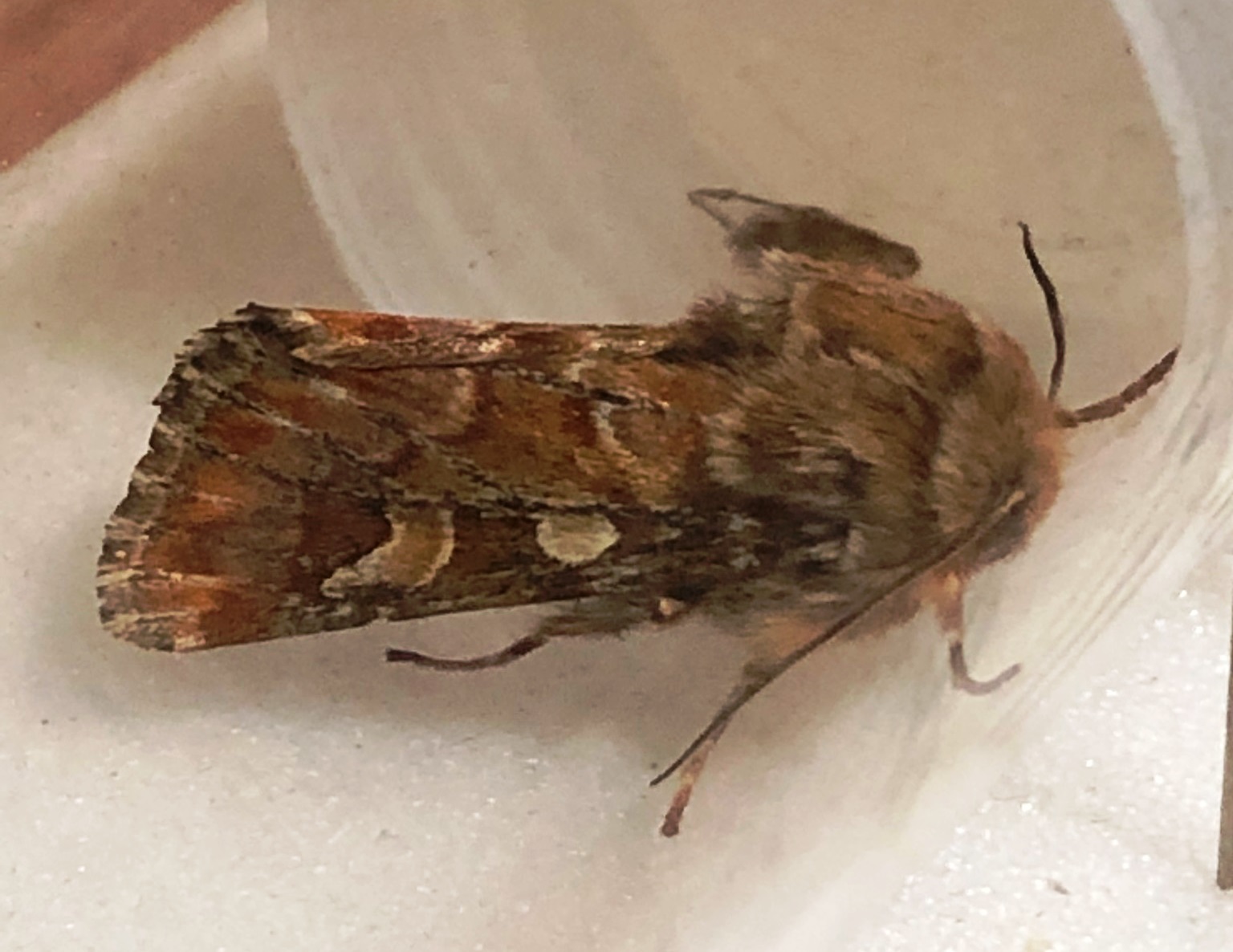
Early arrival is a first for me

There was much talk of moths at yesterday's Buckinghamshire Invertebrate Group meeting, and it inspired me to get the moth trap out last night. I didn't get any of the rare migrants that have apparently been reported from the south coast recently, but I did get a new species for the Great Kimble garden: Early Moth, not previously recorded during the 14 years I've been here.

In fact, 2019 is the first time I've recorded Early Moth anywhere since 1999! I saw one in Shropshire last weekend and now this one posing on my garden shed. I guess it is one of those moths whose beauty is on the subtle side, but I was very pleased to see it.


Bug

Still very quiet for moths in Tackley, Hebrew character, few common quakers and spring ushers and, what I think might be, a dock bug Coreus marginatus?


Alan Diver,
Tackley.

Saturday, 23 February 2019

Pine Beauty

I know it is not a rare moth, but I was pleased to find this Pine Beauty Panolis flammea in the trap this evening.

This is only the 4th record I've had in 20 years here.


Neil Fletcher
Walter's Ash, VC24

Friday, 22 February 2019

Brindled Beauty?

Image as requested.

Steve Lockey (Garsington)


Further Garden Moths

Here at Westcott I've continued to add further moths to the 2019 garden list with the arrival of Hebrew Character (19th), Clouded Drab (20th) and Acleris hastiana & Shoulder Stripe (both 21st).  Shoulder Stripe varies a lot and can be a particularly stunning moth, but my example wasn't one of the prettiest forms!  It is usually on the wing in March and April and this individual does beat my earliest garden record by three days (24th February 2012), but I've had one as early as 4th February in local woodland.

Acleris hastiana, Westcott 21st February

Shoulder Stripe, Westcott 21st February

Clouded Drab, Westcott 20th February

Dave Wilton
Westcott, Bucks

Burial Park Moths

After getting the light fixed for the trap at Chiltern Woodland Burial Park, the moths have started flooding in (well, within reason anyway).
This morning, 5 x Tortricodes alternella, 5 x March Moth, 2 x Dotted Border, 2 x Small Brindled Beauty and 1 x Chestnut.

Also at Chiltern Open Air Museum on Monday, I found an indoor Double-striped Pug.

Dave Morris
Seer Green

Wednesday, 20 February 2019

Esperia sulphurella

Surprised to find an Esperia sulphurella in my garden trap this morning.  I've not seen one in February before.  The photo is not so good but I think you can make out the white rings half way along the antennae.

Others in the trap were Common Quaker and Acleris cristina (both firsts for the year) and a Chestnut.

Richard Ellis
Chorleywood

Monday, 18 February 2019

Woodland moths

I took an MV trap to Shabbington Wood in Bernwood Forest for a few hours last night but it probably wasn't worth the effort due to the lack of promised cloud cover, that bright full moon and mist which formed when the temperature plummeted.  Just eight species came to light and Spring Usher was the only one to appear in the expected numbers:  Tortricodes alternella (35), Small Brindled Beauty (34), Pale Brindled Beauty (26), Oak Beauty (2), Spring Usher (170), Dotted Border (14), Common Quaker (5) & Chestnut (3).  The Spring Usher total included five females (quite variable in their markings) which I found underneath the sheet at packing up time, while the Dotted Border total included a mated pair.

Small Brindled Beauty, Shabbington Wood 17th February

Spring Usher female, Shabbington Wood 17th February

Spring Usher female, Shabbington Wood 17th February

Dave Wilton
Westcott, Bucks

Tinea sp

This tineid appeared in the house today. I get quite a few T.pellionella, mainly in the summer months, but this seemed slightly different in that it was obviously quite big c10mm in length. Also, when potted, it was much less active than T.pellionella normally is here (maybe because it's colder?). I took a record shot, but managed to drop the specimen behind the radiator, so am waiting for it to reappear to pot up for Peter.

Could it be T. pallescentella based on size, or can T. pellionella get this big? The wing also looks more mottled than I am used to seeing on pellionella.


Adam Bassett
Marlow Bottom

Sunday, 17 February 2019

This week's garden records

No surprises, but here at Westcott moths (plural) have continued to appear at the conservatory windows each night over the past week, brought to them by the actinic light being run indoors.  The week's total has comprised Agonopterix heracliana (9), March Moth (2), Pale Brindled Beauty (9), Oak Beauty (1), Spring Usher (5), Dotted Border (2), Early Moth (5), Common Quaker (1) & Chestnut (1).  The Oak Beauty on Friday night and Common Quaker last night were firsts for the year.  Oak Beauty doesn't appear annually here and this is my first ever February garden record (out of just over 30 over the years), but it can be out at any time from January onwards in local woodland.

Oak Beauty, Westcott 15th February

Common Quaker, Westcott 16th February

Another tiny (2mm) Nepticulid was found wandering around on a window indoors yesterday and it looks as though it may be a different species to the one found in similar circumstances on 6th February.  I'm intrigued to know what it is and where it might have come from, especially at this time of year.  I haven't retained any leaf mines indoors this winter and there have been very limited opportunities for anything to fly into the house from outdoors, so perhaps it has emerged from cut flowers or pot plants.  We'll see. 

Nepticulid sp., Westcott 16th February

Dave Wilton
Westcott, Bucks

Sunday, 10 February 2019

Westcott, Bucks

Things are still ticking over here, probably more so than usual for February even though we've had some poor weather.  Last night's collection of moths brought to the conservatory windows by the twin-30wt actinic light was fairly typical and comprised March Moth (1, first of the year here), Pale Brindled Beauty (3), Spring Usher (1), Dotted Border (1) & Early Moth (2).  Pale Brindled Beauty and Spring Usher are both having their best winter ever here.  None of the Orthosia species has been seen yet but I'm sure they'll start arriving soon enough.  Micros have been in short supply with only Ypsolopha ustella and Agonopterix heracliana putting in appearances so far, but I did find a tiny Nep (wing length only 2mm, so not the best of pictures below) wandering around indoors on our bathroom window a couple of days ago.  That could prove interesting and is the first moth of 2019 potted up for Peter Hall to dissect so I should find out what it is in about a year's time! 

March Moth, Westcott 9th February

Nepticulid sp., Westcott 6th February

Dave Wilton
Westcott, Bucks

Friday, 8 February 2019

Oak Beauty & Dotted Border

The garden actinic light attracted 5 moths last night. 3 Pale Brindled Beauty, and 2 new additions for 2019 - 1 Oak Beauty and 1 Dotted Border.

Oak Beauty - Cookham 07-Feb-19

Dotted Border - Cookham 07-Feb-19
Meanwhile, Early Moth continues to avoid my garden. I have only ever recorded two, both in February 2017.

Steve Trigg, Cookham

Thursday, 7 February 2019

Clouded Drab

Just started putting out the trap again, not much, a couple of Pale Brindled Beauties yesterday, this morning a Clouded Drab.

Mark Griffiths, Garsington, Oxford

Tuesday, 5 February 2019

Back to the Moths...

After a warmish day which saw off the last of the snow, it was highly likely that the first part of last night would produce something before the temperature hit zero degrees again, so I ran the twin-30wt light inside our conservatory.  Sure enough, the moths started to appear at the windows soon after dark and by 10pm I'd had Pale Brindled Beauty (11), Spring Usher (1) & Chestnut (1) along with ichneumonid wasp Ophion obscuratus (1).  The only subsequent additions during the night were further singletons of Pale Brindled Beauty and Spring Usher to give a final total of 15 moths - not a bad result in the garden after two weeks off, even if there was nothing new for the year.

Westcott, 4th February
Dave Wilton
Westcott, Bucks 

Friday, 1 February 2019

Merton Moths 2018

I’ve been trapping for about 20 years in my garden which is quite large, in a rural location, backing onto pasture. This area is pretty low lying, prone to flooding, but obviously much drier in 2018. I usually run a 125MV Robinson trap once a week for the Garden Moth Scheme and then trap on another night in between. I only trap from the beginning of March to the end of October when I’m at home. I have to run the MV trap up close to the house, where it can be quite windy, to avoid disturbing neighbours. I’ve started using 6W Heath traps for the ‘in-between’ nights as I can move them around in the garden and put them in more sheltered spots. The garden has quite a lot of hedge, shrubs, fruit bushes, some poplars, horse chestnuts and a couple of small apple trees, plus two small ponds. 2018 was a better year compared with the previous few years but comparisons are not that straightforward. Prior to 2013 I kept records on paper, mainly focused on number of species. I’ve yet to find the time to total up the individual moths trapped, but have the impression that overall numbers have greatly declined since I started (using only a Heath trap for the first 10 years), though variety of species has not. In 2018 I ran the MV trap 35 times and the Heath traps 31 times, total, 64. This is more than the next highest number of trap nights, since starting electronic personal records, of 55 nights in 2013 (all MV). I have been interested to see if different species come to traps in different parts of the garden and different types of lights. I don't think I can say anything definite as yet. I wonder what other people have found? Overall I trapped 240 species in 2018, compared with 225 in 2017, 3920 individuals, compared with 2574 in 2017. There were 9 new macro moths (not previously trapped since 1998) including personal highlights such as Clifden Nonpareil and Dark Spectacle as well as December Moth and L-Album Wainscot and a number of new micros. Agriphila geniculea and the Setaceous Hebrew Character topped the list with 264 and 262 individuals respectively.

Thursday, 31 January 2019

Taxonomic changes

A second round of updates to the Agassiz, Beaven & Heckford check-list of British Lepidoptera has been published in the current (Jan/Feb 2019) issue of the Entomologist's Record and Journal of Variation (Ent Rec), following on from the first update which appeared in Ent Rec during 2016.  You'll need to refer to the article itself (all seven pages of it) to get chapter and verse but the main changes appear to be as follows:

  • Antispila treitschkiella (6.002) is renamed Antispila petryi and Antispila treitschkiella is added as a new species (6.0021).
  • Luffia lapidella (11.008) is deleted and Luffia ferchaultella (11.009) is renamed Luffia lapidella because ferchaultella is now considered to be just a form of lapidella.
  • Bisigna procerella (28.001) is renamed Promalactis procerella.
  • The Syncopacma species (35.001 through to 35.009) are all now renamed Aproaerema
  • Scythris crassiuscula (43.005) is renamed Scythris subcinctella.
  • Crombrugghia distans (45.026) and Crombrugghia laetus (45.027) are renamed Oxyptilus distans/laetus.
  • Aphelia paleana (49.031) and Aphelia unitana (49.032) are renamed Zelotherses paleana/unitana.
  • Large Blue Maculinea arion (61.013) is renamed Phengaris arion.
  • Aphomia zelleri (62.002) is renamed Lamoria zelleri.
  • Ephestia unicolorella (62.065) is renamed Ephestia woodiella.
  • Mother of Pearl Pleuroptya ruralis (63.038) is renamed Patania ruralis.
  • Scallop Shell Hydria undulata (70.121) and Scarce Tissue Hydria cervinalis (70.122) are renamed Rheumaptera undulata/cervinalis.

New species added to the main check-list are Anarsia innoxiella (35.0191), Dichomeris acuminatus (35.0205), Aethes deaurana (49.1231), Cydia interscindana (49.3275), Cornifrons ulceratalis (63.0605), Euchromius ramburiellus (63.0762) and Marigold Shark Cucullia calendulae (73.0527).  Those added to Appendix A [adventives] are Phereoeca lodli (12.0355), Mesophleps ochracella (35.0145), Euzophera costivittella (62.0501), Plesiomorpha flaviceps (70.2785), Herb Emerald Microloxia herbaria (70.3075), Green Drab Ophiusa tirhaca (72.0855), Landguard Ochre Amphipyra effusa (73.0645) and Florida Fern Moth Callopistria floridensis (73.0811).

Monday, 28 January 2019

A different bug

With a general lack of moths the most interesting insect in my trap this week was this bug. About 11mm in length.


I have no idea where to start on bug identification so any pointers would be welcome.

Andy Newbold, Sibford Ferris, Oxon.

Sunday, 27 January 2019

Newport Pagnell Garden Stats


My suburban garden measures 5.3m x 9.6m and is surrounded by houses.  My moth trap is squeezed in a corner and is pretty well boxed in on three sides as neighbours were not happy about their bedrooms being lit up at night. It’s location is most certainly not the ideal.   2018 was the 24th year that I have recorded moths at SP859437 and over that time I have always used a 125W mercury vapour bulb over a variety of receptacles.  My first trap was made using a home brew beer- barrel, my second used one of those dalek type vax machines as the container.  From 1998 to 2016 the bulb sat upon a Skinner trap and for the past 2 years upon a Robinson trap.

2018 yielded 11,676 specimens (some 2,000 more than 2017) from 225 trapping nights between February and November and was the second highest annual total ever (The highest was in 1996 when 16,259 were counted from just 166 trapping nights).  The total number of species recorded was 330, the highest ever, and these comprised 104 micros and 226 macros.  There were 26 new moths , 16 micros and 10 macros, added to the garden list which now stands at around 550.  The pick of the new ones were Clifden Nonpareil, my early Christmas present in September, Humming Bird Hawk-moth, often seen locally but not in my garden and Toadflax Brocade, another that had missed the garden for too long.

My macro-moth  “Top of the Pops”  2018 were Vine’s Rustic, 1115, Heart and Dart, 1038, Large Yellow Underwing, 874, Setaceous Hebrew Character, 767, Shuttle-shaped Dart, 396 and micro-moths were headed by Yponomeuta evonymella, 383.   I do not always keep an eye on “ Top of the Pops” and it rather surprised me that Vine’s Rustic headed the field.

In summary then 2018 must go down as a very good year in terms of numbers.  

Wednesday, 23 January 2019

My garden stats.

After just reading Dave's post here is my garden 2018:

I have a medium-sized untidy garden with a selection of mainly apple and coniferous trees, with a hawthorn hedge, plus various non-native shrubs. The garden behind ours was built on in 2015-6 and I have noticed a large drop in moth numbers since then. The countryside is about 150 yds away, and that is mostly arable farmland.

I run a 15W home-made Skinner trap and mostly trap for the Garden Moth Scheme, thus once a week, plus a few other nights throughout the year if the conditions look promising.

In 2018
- trapped on 45 nights (52 in 2017, 56 in 2016)
- total moths 1222  (932 in 2017, 1155 in 2016)
- total species 202 (192 in 2017, 216 in 2016)
- most moths in a night 145 (6th July) (better than any in 2016/7; record is 281 in Jul 2014)
- most sp. in a night 43 (6th July) (better than any in 2016/7; record is 99 in Jul 2014
- most common macro species was Large Nutmeg - quite a glut in June! with Common Quaker,  Willow Beauty and Heart & Dart in 2-3-4.
- most common micro species was Endotricha flammealis with Cydia pomonella a close second (all my apple trees!); Cydalima perspectalis was third.
- only new species in my garden last year was Currant Clearwing, lured only by a Cotoneaster!

Dave Morris
Seer Green