Wednesday, 23 March 2022

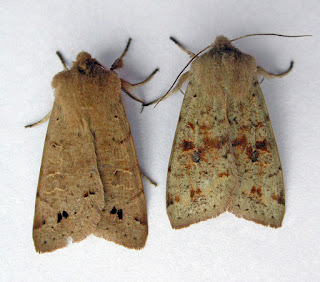
Lead-coloured Drab?

 
I believe this is Lead-coloured Drab, but I'm not really sure because it seems to lack any of the markings noted in the field guide--no pale outlined kidney mark and no pale outer line with dark marks. It is definitely smaller than the several Clouded Drabs that appeared alongside it, but I wondered whether it might just be a worn greyish Small Quaker... 

Here's hoping anyway, as that will make two new Orthosias for the garden in the last couple of days with a Blossom Underwing the previous night.


Tuesday, 22 March 2022

Westcott, Bucks

What a lovely Spring day it was today, with the temperature reaching 18C here this afternoon.  While pottering about in the garden I decided to put out the EMP lure quite late on, at 4.15pm.  Much to my surprise a male Emperor Moth turned up ten minutes later and after a further ten minutes a second one appeared as if to prove this wasn't just a fluke - they're out very early this year!

Emperor Moth, Westcott 22nd March

I removed winter covers from various pieces of garden furniture this afternoon and underneath one on a bench close to last night's trap were half a dozen Orthosias which I'd missed, including my first Blossom Underwing of the year.  Good job I found that one because I only get one or two a year here at the most!  Another daytime discovery today was Acrolepia autumnitella flying around inside the shed.

Blossom Underwing, Westcott 22nd March

Acrolepia autumnitella, Westcott 22nd March

Other recent additions to this year's garden list have been Diurnea fagella (15th), Ypsolopha mucronella (17th), Yellow Horned (17th), Agonopterix arenella (20th) and Powdered Quaker (21st).  Nothing unexpected there, you might think, but I was over the moon to get Yellow Horned because that's a first for the garden - the second new species this year already!  A record image of it, taken in poor light, appears below.

Yellow Horned, Westcott 17th March

Dave Wilton Westcott, Bucks

Drabs


I identified this as Lead-coloured Drab. Based on round wing-tip, overall colour, feathered antennae and sub-terminal line wedges...? Trapped at actinic light in West Oxon.

Monday, 21 March 2022

Late to the party


This is my contribution to the Pammene giganteana-to-a-pheromone-lure story: I note several people have already reported this moth coming to MOL and FUN pheromones. This one turned up at a SKI lure in my back garden in Chorleywood, at around 3.00 yesterday afternoon. I managed to frighten away 2 more at about 4.00 and either the same two returned or two others were trapped later. The lure was hung in dappled shade, but it was a bright sunny day. I presume that normally this is a nocturnal animal. In which case, is it possible that it is the females that, in normal circumstances, dictate the night flying by only 'calling' at night? Or is that an inference too far? 

I did, at the same time, also hang out a FUN lure, perhaps 25/30 feet away, which had no success. 

Sunday, 20 March 2022

Queries from last July

 Hi there,

These two turned up last July and were put into the 'too difficult' folder!

I've rejected Willow Beauty and, I think, Mottled Beauty. So I'm now thinking about Engrailed, Small Engrailed and Square Spot. But the moths arrived in mid-July 2021, which doesn't seem to fit with Square-spot or Small Engrailed. HELP!!

David


MOL pheromone lure again

I've not tried loading videos here before so not sure if this will work.  I imagine the file size may be too large for Blogger, but let's see... 


This is a short excerpt of mobile phone footage taken of the MOL lure in action at the Oakley Wood car-park in Bernwood Forest on Friday morning.  15 examples of Pammene giganteana counted within five minutes of putting out the lure, but there were probably quite a few more than that.  

Dave Wilton Westcott, Bucks

Saturday, 19 March 2022

Unusual Twin-spotted Quaker

I have a large Sallow aka Goat Willow (Salix caprea) in my garden.  It is currently blooming and last night I had 52 moths of seven species.  

One moth confused me for a while. It was quite plain and much larger than the many Common Quaker (Orthosia cerasi). I initially thought it was a pale form of Clouded Drab (Orthosia incerta).  

On closer inspection it clearly had antennae with projections which leads me to believe this is a Twin-spotted Quaker (Anorthoa munda) without obvious spots, which I beleive is f. immaculata.  I have not seen this before. 

A couple of photos  (with and without flash) to compare with the normal form of Twin-spotted Quaker, the feint spots in the photo not at all obvious in life.


Neil Fletcher
Walter's Ash, VC24


A Berkshire million!

I've just realised that the combined Berkshire moth data recently tipped over the million mark, which calls for a small celebration! Thanks to everyone who has ever sent in a Berkshire moth record. If you haven't yet sent in your records, you know what to do 😄🙏

Talking of records, if you use the iRecord website to add your moth records, we recommend that you do so via the specific moth recording form. And there is now a very similar form available via the National Moth Recording Scheme, which also feeds through to iRecord, so that is another route you can use if you prefer. If you do register with NMRS and also use iRecord, make sure you register with the same email address on both sites, so that your records all get linked together. Please don't add records to NMRS and then add to iRecord as well, that will duplicate the records!


Martin Harvey

Berkshire Moth Group

Micro query - acleris?

 I'd appreciate id help with this spotty micro please - could it be Acleris ferrugana/notana despite being pale?  Thank you.


Friday, 18 March 2022

Diurnea fagella?

 Hi,

Is this just a very dark form of D fagella?

Best wishes

David


Thursday, 17 March 2022

Scrobipalpa costella

I had this micro moth attracted to actinic light in my garden the night before last. I am pretty sure it is Scrobipalpa costella, a moth I have recorded before but not this early in the year. Previous records have been in May, June, September and October. I guess it is one of those moths that can turn up at pretty much any time of the year.
Steve Trigg, Cookham

Wednesday, 16 March 2022

iRecord Training

Rachael Conway of Butterfly Conservation has circulated the information below via the County Moth Recorders and this FREE course may be of interest to some of you:


Dear County Recorder

The next programme of Supporting Science iRecord training opens on Friday 29th April 2022.

Our exciting partnership with the Field Studies Council aims to attract new people into the butterfly and moth recording network and develop the data processing skills required to turn records into research.  The Supporting Science project has funded 120 free places and our first round of recruitment was targeted at our partners and projects who work with diverse people and communities.

'Discovering iRecord:  Butterflies and Moths' will introduce the basics of biological recording, such as grid references, data flow and verification using moth or butterfly sightings and other taxa.

The course is perfect for people new to iRecord, or those in need of a refresher to hone existing iRecord skills.  

 -   4-week, self-led, online course for adults, with a weekly time commitment of 3-5 hours.
 -   Access to study content, activities and tutor-graded assignments through the FSC virtual learning platform.
 -   Access to weekly live virtual classroom sessions at the end of each week with the course tutor through
     Zoom (recorded for those that are unable to attend the live sessions).

We would like to invite County Recorders to take part, either by participating in the course yourself or by sharing with those in your network who would benefit from this entry level course, it is an ideal opportunity to train potential verification assistants to help with your role.

For further course information and to book please visit here.

For queries please message or email Rachael here.

Please book early as places are limited

Many thanks,

Best wishes,
Rachael    

Beautiful Plume and Oak-tree Pug?

 Hi - looking for confirmation of these. This tiny Plume moth is new to me, but the wing pattern and abdomen look right (I think!) for Beautiful Plume. And it's a bit early for Oak-tree Pug, but this doesn't look like Brindled to me??

Many thanks

David


Tuesday, 15 March 2022

Pammene giganteana in Cookham

Following on from Dave's post about Pammene giganteana, I retrieved the FUN and MOL lures from my freezer. I tried both yesterday without luck, but today I tried the MOL lure again and a single Pammene giganteana arrived in the early afternoon. So, a new moth for my garden list as well.
Steve Trigg, Cookham

Acleris cristana?

Am I right in thinking this is Acleris cristana? Not sure whether the dark patch in the middle is a raised scale tuft, or just a dark patch, but the overall shape looks better for this species rather than A. hastiana. Came to light last night in oak woodland.


Oak Nycteoline?

 I had originally put this one down as Acleris hastiana but having just seen David's post from a couple of days ago I am now thinking Oak Nycteoline? 


Andy Newbold, Sibford Ferris, Oxon.

Monday, 14 March 2022

Pammene giganteana

Today, for the third time in a week, I put the MOL pheromone lure (for Grapholita molesta) out in a trap in the garden at mid-day in the hope of getting Pammene giganteana which is attracted to the same lure - it also comes to the FUN and SKI lures.  Although the conditions were perfect I wasn't really expecting a result because there's only one tiny oak sapling inside the garden and only one fairly young tree within sight of the house and you have to travel a good mile in any direction to find mature oaks.  However - surprise, surprise - the target species actually turned up within the hour!  Moth species number 1,043 for the garden.  

Pammene giganteana, Westcott 14th March

Pammene giganteana, Westcott 14th March

The distribution of Pammene giganteana locally is not well known, probably because of its early flight period (March and April, sometimes into May) and it appears to be a bit reluctant to come to light.  The availability of the pheromone lures has improved the situation immeasurably and last spring I was able to double my own records for the species in a matter of days, up to about 30 now, simply by taking a lure and trap to any area of oak woodland and invariably the moth would turn up within minutes.  If you have one of these lures, please get them out now while there's very little chance of any other species but giganteana turning up!   

Dave Wilton Westcott, Bucks

Saturday, 12 March 2022

Three more I need help with!

 IDs requested, please if possible.I'm thinking the middle one may be A. ferrugana/notana?

Best wishes, David


Friday, 11 March 2022

Diurnea fagella?

 Hi there,

Had about 6 of these in the trap last night near Cholesbury Common (wood edge). Please confirm I've got it right? An extraordinary night - 220 moths including 130 Small Quakers! 15 species in total, including the first Yellow-horned and Twin-spot Quakers of the year.

Best wishes, David


Another night in the woods

Last night it was the turn of Shabbington Wood at the eastern end of Bernwood Forest to receive a visit.  There, much as expected, the moth catch was more than double that achieved in Finemere Wood the previous night, mostly thanks to even larger numbers of Small Quaker.  Nearly 1,300 moths from 26 species were recorded in the usual three hours:  Ypsolopha ustella (1), Diurnea fagella (8), Acleris ferrugana/notana (3), Acleris literana (1), Tortricodes alternella (175), Pammene giganteana (1), Yellow Horned (57), March Moth (40), Brindled Pug (5), Pale Brindled Beauty (3), Small Brindled Beauty (63), Oak Beauty (65), Spring Usher (3), Dotted Border (9), Engrailed (6), Red Chestnut (35), Pine Beauty (1), Small Quaker (673), Common Quaker (66), Lead-coloured Drab (2), Clouded Drab (5), Twin-spotted Quaker (3), Satellite (8), Chestnut (18), Pale Pinion (1) & Oak Nycteoline (2).

Pammene giganteana, Bernwood 10th March

Brindled Pug, Bernwood 10th March

Pine Beauty, Bernwood 10th March

Twin-spotted Quakers, Bernwood 10th March

The lack of Shoulder Stripe was a bit of a surprise because I'd recorded 15 of them at Finemere the previous night, but Tortricodes alternella was still going strong in Bernwood whereas at Finemere it was almost over with only ten seen.  No sign of Water Carpet, White-marked or Blossom Underwing yet at either site but I suspect it won't be long before they're out and about too. 

As it happens I'd tried the MOL pheromone lure in the garden at Westcott over the previous two days but had no takers, so it was good to see that Pammene giganteana (which comes to that lure but doesn't often appear at light traps) was indeed flying now.  Last year I managed to add several new woodland sites for it locally thanks to pheromone traps hung out during the daytime.  The moths usually appeared within a matter of minutes.  

Dave Wilton Westcott, Bucks   

Thursday, 10 March 2022

Humble garden catch at Tilehurst

In the trap last night.
Common Quaker (2) : Small Quaker (1) : Satellite (1) : Oak Beauty (2) : Small Brindled Beauty (3) : Common Plume (3) : and maybe a Dark Chestnut (1) 
Other than Oak Beauty all firsts of the year for me.
Maybe a Dark Chestnut. 
Small Brindled Beauty. 
Small Quaker.
Common Plume.

Finemere Wood, Bucks

I trapped in Finemere Wood last night for the usual three hours from dusk and, as expected for such a mild evening, got plenty of moths (450+).  Small Quaker was out in force (258 counted and they were still piling in while I was packing up).  Small Brindled Beauty (52) was the next most abundant species, followed by Common Quaker (33) and Yellow Horned (25).  The remainder comprised Diurnea fagella, Acleris ferrugana/notana, Tortricodes alternella, March Moth, Shoulder Stripe, Early Thorn, Pale Brindled Beauty, Oak Beauty, Dotted Border, Spring Usher, Engrailed, Red Chestnut, Lead-coloured Drab, Clouded Drab, Satellite, Chestnut, Early Grey & Grey Shoulder-knot.  No surprises but it was good to see such a lot of activity!

Yellow Horned, Finemere 9th March

Shoulder Stripe, Finemere 9th March

Lead-coloured Drab, Finemere 9th March

Dave Wilton Westcott, Bucks

Wednesday, 9 March 2022

Dotted Chestnut, Stoke Goldington

 I remember when I took my first specimen to an excited George Higgs, to add to his Willen collection in March 2005. This moth was quite scarce then, I guess much more frequent now.


Tuesday, 8 March 2022

Crawling into the light

 This overwintered small caterpillar making the effort to climb to the front door lights (1 x actinic and 1 x UV LED), I'm currently assuming is Scarlet Tiger?


Micro from November 2020

 Hi there,

Going through some old photos. Is this an Acleris? And if so, is it ferrugana/notana, which I know cannot be separated visually? Thanks and best wishes, David


Sunday, 6 March 2022

Variable Dotted Border

 Two very different examples of the species amongst this year's record haul of over 85 moths on a woodland edge site near Chesham. I had no idea that the brown/beige colouring
could be reversed like this. 28 March moths were on a white door behind the Robinson trap!

Best wishes

David

T. alternella??

 This turned up the other night. Not much to go on, but I wonder if it's a very lightly marked - or worn - T. alternella? Two images of the same specimen. Thoughts?

Best wishes

David