Three welcome new moths for the year, last night: Shoulder-stripe, Yellow Horned and Blossom Underwing, possibly my favourite Orthosia.


A Blog for moth recorders in Bucks, Berks and Oxon
Three welcome new moths for the year, last night: Shoulder-stripe, Yellow Horned and Blossom Underwing, possibly my favourite Orthosia.
 |
| Caloptilia populetorum, Westcott 22nd March |
 |
| Epermenia chaerophyllella, Westcott 22nd March |
 |
| Streamer, Westcott 25th March |
I put out my mercury light on my Robinson trap last night in my Wolvercote, Oxfordshire, garden, along with a smaller portable actinic trap, without much expectation of anything: just wanting to get my mothing year off to some sort of start. I'm glad I did, as my second ever Emperor Moth (and my first in the current garden) graced the Robinson trap; along with, in the actinic trap, the other moth pictured (one photo with flash, the other without) which, judging by other posts here, I suspect may have been a Lead-coloured Drab (my initial assumption was a rather poorly-marked Twin-spotted Quaker, but I think it was too small, and the markings aren't right). I'd be grateful for confirmation; if it is a Lead-coloured, I think it's my first.
 |
| Emperor Moth, 24/3/22 |
 |
| Possible Lead-coloured Drab, 24/3/22 |
 |
| Possible Lead-coloured Drab, 24/3/22 |

On Tuesday night I took two MV traps to Finemere Wood for the usual three hours from dusk and got 767 moths of 23 species with nothing unexpected. 493 Small Quakers were counted so they're still going strong. Last night it was the turn of Bernwood Forest, again with two traps, and there the Small Quaker total exceeded four digits with 1,023 counted. 30 species turned up, including signs of new emergences with Early Tooth-striped (1), Purple Thorn (1), Brindled Beauty (1) & Nut-tree Tussock (4) putting in welcome appearances. The Purple Thorn and Brindled Beauty were my earliest ever records.
 |
| Early Tooth-striped, Bernwood Forest 23rd March |
 |
| Purple Thorn, Bernwood Forest 23rd March |
 |
| Brindled Beauty, Bernwood Forest 23rd March |
Dave Wilton Westcott, Bucks
I caught the two below last night, so presumably they are both the same species. The paler one looks rather like A. schalleriana, though that seems pretty unlikely as we are not on chalk here, but on clay, so I guess it is more likely to be a variant of A. ferrugana/notana.
I have retained the paler one if needed for dissection.


This one is new to me, so I'm just looking for confirmation that it is A kochiella.
Many thanks
David

 |
| White-marked, Radnage 22nd March |
Following Dave's advice I have been putting the FUN lure out in the garden for the past few days and finally hit the jackpot!
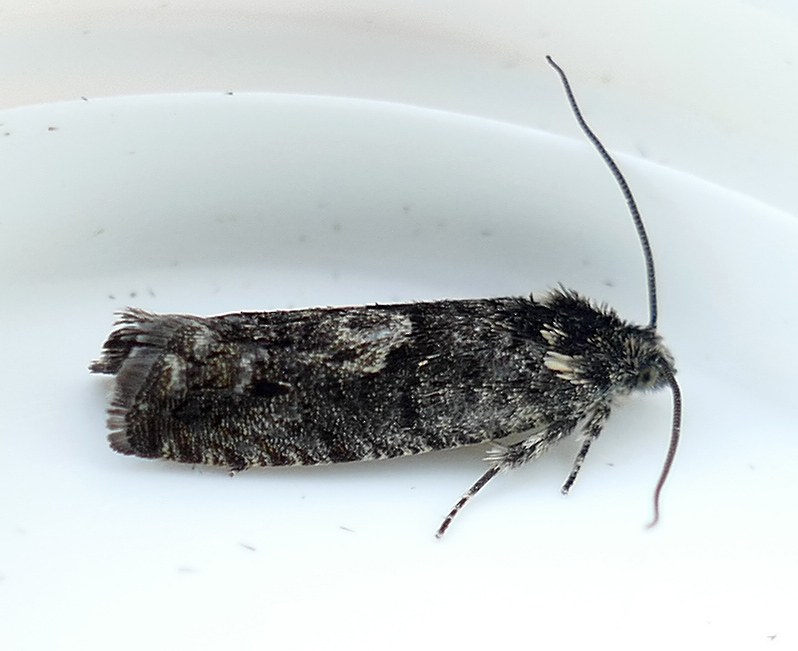

Finally caught up with what I assume is Lead-coloured Drab in my Stoke Goldington garden. This moth preferred the actinic front door light to the MV trap! A better marked example than Phil's, significantly smaller than the Clouded specimens.

As an aside, if running two traps with different light sources on the same night, when entering records into iRecord, is it best to fill out two separate moth group forms, one for each source? Also, do you know if anything is actually done with the data corresponding the moths attracted to different kinds of light sources?


 |
| Emperor Moth, Westcott 22nd March |
 |
| Blossom Underwing, Westcott 22nd March |
 |
| Acrolepia autumnitella, Westcott 22nd March |
 |
| Yellow Horned, Westcott 17th March |

I identified this as Lead-coloured Drab. Based on round wing-tip, overall colour, feathered antennae and sub-terminal line wedges...? Trapped at actinic light in West Oxon.

This is my contribution to the Pammene giganteana-to-a-pheromone-lure story: I note several people have already reported this moth coming to MOL and FUN pheromones. This one turned up at a SKI lure in my back garden in Chorleywood, at around 3.00 yesterday afternoon. I managed to frighten away 2 more at about 4.00 and either the same two returned or two others were trapped later. The lure was hung in dappled shade, but it was a bright sunny day. I presume that normally this is a nocturnal animal. In which case, is it possible that it is the females that, in normal circumstances, dictate the night flying by only 'calling' at night? Or is that an inference too far?
I did, at the same time, also hang out a FUN lure, perhaps 25/30 feet away, which had no success.
Hi there,
These two turned up last July and were put into the 'too difficult' folder!
I've rejected Willow Beauty and, I think, Mottled Beauty. So I'm now thinking about Engrailed, Small Engrailed and Square Spot. But the moths arrived in mid-July 2021, which doesn't seem to fit with Square-spot or Small Engrailed. HELP!!
David


I've not tried loading videos here before so not sure if this will work. I imagine the file size may be too large for Blogger, but let's see...
Dave Wilton Westcott, Bucks
I have a large Sallow aka Goat Willow (Salix caprea) in my garden. It is currently blooming and last night I had 52 moths of seven species.
One moth confused me for a while. It was quite plain and much larger than the many Common Quaker (Orthosia cerasi). I initially thought it was a pale form of Clouded Drab (Orthosia incerta).
On closer inspection it clearly had antennae with projections which leads me to believe this is a Twin-spotted Quaker (Anorthoa munda) without obvious spots, which I beleive is f. immaculata. I have not seen this before.
A couple of photos (with and without flash) to compare with the normal form of Twin-spotted Quaker, the feint spots in the photo not at all obvious in life.


Neil Fletcher
Walter's Ash, VC24
I've just realised that the combined Berkshire moth data recently tipped over the million mark, which calls for a small celebration! Thanks to everyone who has ever sent in a Berkshire moth record. If you haven't yet sent in your records, you know what to do 😄🙏
Talking of records, if you use the iRecord website to add your moth records, we recommend that you do so via the specific moth recording form. And there is now a very similar form available via the National Moth Recording Scheme, which also feeds through to iRecord, so that is another route you can use if you prefer. If you do register with NMRS and also use iRecord, make sure you register with the same email address on both sites, so that your records all get linked together. Please don't add records to NMRS and then add to iRecord as well, that will duplicate the records!


Martin Harvey
I'd appreciate id help with this spotty micro please - could it be Acleris ferrugana/notana despite being pale? Thank you.


Hi - looking for confirmation of these. This tiny Plume moth is new to me, but the wing pattern and abdomen look right (I think!) for Beautiful Plume. And it's a bit early for Oak-tree Pug, but this doesn't look like Brindled to me??
Many thanks
David


I had originally put this one down as Acleris hastiana but having just seen David's post from a couple of days ago I am now thinking Oak Nycteoline?

Andy Newbold, Sibford Ferris, Oxon.
 |
| Pammene giganteana, Westcott 14th March |
 |
| Pammene giganteana, Westcott 14th March |
IDs requested, please if possible.I'm thinking the middle one may be A. ferrugana/notana?
Best wishes, David


Hi there,
Had about 6 of these in the trap last night near Cholesbury Common (wood edge). Please confirm I've got it right? An extraordinary night - 220 moths including 130 Small Quakers! 15 species in total, including the first Yellow-horned and Twin-spot Quakers of the year.
Best wishes, David


